diplo.news
Germany's Foreign Minister Calls for Majority Voting in EU Foreign and Security Policy
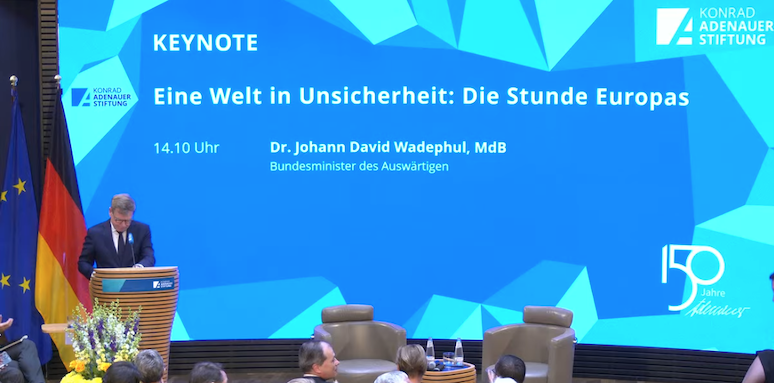
Federal Foreign Minister Johann Wadephul (CDU) has called for fundamental reforms of the European Union to make the organization “more agile, flexible and more effective.” According to him, this primarily involves replacing the requirement for unanimity in foreign and security policy with qualified majority voting. “Especially when it comes to security issues, the unanimity principle can put us in existential danger. It’s a matter of life and death,” Wadephul said at the 13th Adenauer Conference on Wednesday in Berlin. Germany’s goal in Europe remains the greatest possible unity and consensus, but not based on the lowest common denominator. In principle, smaller groups of states within the EU must be able to cooperate without being blocked by individual states. In the past, for example, Hungary and Slovakia have repeatedly obstructed decisions, such as those regarding Ukraine.
According to the Foreign Minister, for a clearer political profile of the EU, foreign policy responsibilities should also be bundled in Brussels, which are now distributed in various institutions such as the European External Action Service, the Foreign Affairs Representative Kaja Kallas, the European Council, the EU Commission and the Council of the European Union. An enlarged Union could not continue with the same structures as before. Both the Commission and the European Parliament would need to be adapted to the new requirements in order to remain functional. For instance, the Commission should then represent only two-thirds of the member states—currently, each country appoints a commissioner. Wadephul emphasized that expansion, for example to include the Western Balkan states, is part of the EU’s credibility.
Europe now needs the courage to change and must take action. In 2025 alone, Germany lost around 300 industrial jobs per day; Chinese trade policy is distorting the market, and at the same time, European exports—particularly to the U.S.—are plummeting. Although the European single market is the third largest in the world, its potential is far from being fully utilized. “There are plenty of brilliant ideas, but they too often end up elsewhere.” In terms of technological dominance, Europe has fallen significantly behind the US and China. European patents must lead to European companies. “The EU must become a key player.”
Despite all the differences with the U.S., Wadephul described the transatlantic relationship as strong. He noted that the U.S. had liberated Germany from Nazi terror and played a decisive role in its reconstruction. He added that whatever current irritations might arise would not deter him from his fundamental trust in the U.S. and many of its leaders, including U.S. Secretary of State Marco Rubio, whom he holds in high regard. “There have been many ups and downs.” Germany’s role, he said, is one of balancing and mediating. Nevertheless, Europe must grow up. The president of the Konrad Adenauer Foundation, former Defense Minister Annegret Kramp-Karrenbauer (CDU), recalled a prescient warning from Konrad Adenauer dating back to 1950. “What does Europe live on? It lives on the goodwill of the United States. That, too, will not always remain the case. One day the moment will come—and must come—when this Europe can once again help itself and must stand on its own two feet.” Adenauer would have turned 150 this year.
Regarding the conflict between the U.S. and Israel with Iran, Wadephul emphasized shared security interests. The nuclear issue—that is, the renunciation of nuclear weapons—must be discussed from the outset in the negotiations. He could only strongly urge Iran to reach agreements with the U.S.
gd
.webp)