diplo.news
Why Europe Needs a Federal State
By Christian Moos

The modern rules-based international order, institutionally embodied by the United Nations, is not a natural state of affairs. It is a contingent construct of power politics—created, sustained, and enforced by the United States of America. Its actual validity has always extended only as far as the United States and its allies were willing and able to guarantee it.
Within the sphere of influence of the Soviet Union—that is, in the unfree part of Europe—it was scarcely applied. In its understanding of legal constraint, multilateral conflict resolution, and liberal economic order, it stood instead in the tradition of the order of the British Empire: an Anglo-Saxon–shaped world order, not the realization of a global republic. That its true founding document was the Atlantic Charter of 1941 is therefore no coincidence, but rather an expression of both its ideological and power-political origins.
The UN as a Reflection of the Balance of Power
The United Nations are, and always have been, neither more nor less than a mirror of power relations. They could not stop proxy wars or violations of international law. Only when the superpowers had a shared interest could a conflict be contained. One such moment - particularly formative for Europe - was the Suez Crisis of 1956: Washington and Moscow, otherwise bitter adversaries, both sought, for different reasons, a return to the status quo ante, and the United States pressured Great Britain, France, and Israel to withdraw from Egypt. That the two European powers were forced to yield under massive pressure exposed their global impotence. From then on, their veto power in the Security Council remained a formal privilege without strategic weight.
To put it even more plainly: the rules-based order functioned as long as a benevolent hegemon guaranteed it and the bipolarity of the Cold War effectively froze it at its West–East fault lines - Europe and the Korean Peninsula - almost in the sense of cuius regio, eius religio. Outside its own sphere of power, this order was also in the interest of the Soviet Union, because although violations of the rules remained possible, those same rules enabled face-saving mechanisms of de-escalation within the systemic conflict, which, for example, helped prevent a Third World War during the Cuban Missile Crisis. Nevertheless, the rules-based order proved incapable of preventing either the escalation of the Indochina conflict into the Vietnam War or the Soviet invasion of Afghanistan, to name just two prominent examples of so-called proxy wars on the southern periphery.
China as a maritime and trading power …
In the world of the early twenty-first century, this always imperfect order now exists only in theory. Since the end of the Cold War, through the brief unipolar moment of the United States as the sole remaining global power, and up to the rapid rise of China as its challenger, the United Nations system has undergone profound change. In 1945, China was a country devastated by war against Japan and on the brink of renewed civil war; after the Communist takeover it was initially internationally isolated, later a rival of the Soviet Union.
In 1971, the People’s Republic became a member of the Security Council and, in parallel - prepared through American back-channel diplomacy - was significantly upgraded internationally a year later. After the economic opening under Deng Xiaoping in 1979, China gained international standing despite the Tiananmen Square massacre of 1989 and became a member of the World Trade Organization in 2001. The US President Barack Obama’s “pivot to Asia,” more than thirty years after China’s strategic shift, nonetheless marked a turning point. China’s rapid rise - often described, with reference to Athens and Sparta in the Peloponnesian War, as the Thucydides Trap - turned it into the central strategic rival of the United States.
The United States has been steadily withdrawing from the United Nations at least since Trump’s first presidency - thereby opening up increasing influence and room for maneuver within the system for China. Europe, for its part, long regarded China - whose authoritarian turn intensified around 2012 and which began to act more aggressively abroad, particularly but by no means only with regard to Taiwan - as an economic El Dorado, while largely ignoring the risks associated with its rise, for far longer than the United States did.
… and as a self-assured veto power
Today, China is a self-confident veto power that decisively shapes the United Nations. Yet Beijing uses this position only ostensibly to strengthen the universal legal order. When Xi speaks of multilateralism, he means multipolarity. China seeks, through the United Nations, to enforce its own principles: a right to development combined with strict non-interference, state sovereignty as the supreme good, and the vision of a multipolar world in which international norms are interpretable through the prism of power politics.
China’s veto and blockade policy and the “partnership without limits” it declared in direct connection with Russia’s war of aggression against Ukraine have further restricted the United Nations’ capacity to act, just as the accelerating retreat of the United States from the international community has done. Yet China and the United States do not constitute a new bipolarity. Unlike during the Cold War between 1946 (Kennan’s Long Telegram, Churchill’s Fulton speech) and 1986 (the Reykjavík Summit, the INF Treaty), the world is no longer bipolar.
Europe without the means of power, without unity
Nevertheless, the EU appears to be betting on the continuation of the rules-based order of 1945 - which in reality has been eroding for decades. Unlike the United States, however, Europe possesses neither the necessary means of power nor the strategic cohesion to preserve or restore this order. At the same time, the United States is not merely retreating in a classically isolationist tradition, but is acting increasingly erratically and aggressively.
The so-called “Trump Corollary,” as labeled by the American president himself, has - contrary to frequent claims - little in common with the fundamentally defensive Monroe Doctrine of 1823. The foreign policy of the second Trump administration is explicitly offensive and confrontational, calling alliances - most existentially for Europe in the case of NATO - and international law into question. As a result, the order that the United States itself created, shaped, occasionally violated, but ultimately preserved no longer exists. Europe looks on largely powerless as these developments unfold, accompanied by the staccato-like attacks of the US president on Truth Social, which accelerate the disintegration of order.
Spectator rather than actor
Nowhere is Europe’s impotence more painfully visible than in the conflicts in the Middle East. Iran represses its own population, destabilizes the region through proxies, spreads terror, and aspires to nuclear capabilities whose acquisition cannot be accepted in light of its openly declared intent to destroy Israel. Yet even if the war aims of the United States and Israel were legitimate and clearly defined, it remains doubtful whether they are achievable; and whether the negative consequences of this war will not outweigh its potential benefits. Europe can hardly influence any of this. It is a spectator, not an actor.
The same applies to the Gaza war, triggered by Hamas’s attack on Israel with support from Iran and its other regional shadow militias. Europe’s influence is close to zero. And as long as the United States shows no consistent interest in defending international law, it becomes all the more difficult for Europe to exert a moderating influence on Israel’s policy: not to question Israel’s legitimate right to self-defense, but to restrain disproportionate action that isolates Israel internationally and undermines its long-term security.
Furthermore, Turkey, the United Arab Emirates, Qatar, and Saudi Arabia also demonstrate through their foreign policies (for example in Yemen and Sudan) no willingness to respect international law when it does not serve their interests. These states, too, act according to power politics; with regard to international law, at best selectively, not normatively. The lesson is bitter but clear: only an order whose observance is secured by credible, strong guarantor powers can uphold international law. Moral appeals do not replace the projection of power.
An order that no longer exists
This diagnosis leads to an uncomfortable but unavoidable conclusion: Europe can no longer derive its security, its interests, and its political capacity to act from an order that no longer exists. It is not enough to align with other middle powers that likewise benefited at all times from the selective, interest-driven Pax Americana. Cooperation does not replace a power base. Even the considerable weight the EU brings to bear in trade policy cannot change this finding.
Recently concluded trade agreements represent a glimmer of hope. However, the difficulties the EU faces in fully bringing them into force point to deficits in its internal structure. Moreover, free trade depends on a stable international order such as secure shipping lanes. Just as a phase of globalization ended in 1914, the most recent globalization has, with the collapse of the Pax Americana, at least for the time being come to an end.
NATO undermined
It is not that these developments go unrecognized in Europe. For years, under the heading of “strategic autonomy,” attempts have been made to respond to the waning reliability of American security guarantees. The second Trump presidency has by now unmistakably significantly accelerated this process, not out of European strength, but out of external compulsion. At the same time, NATO, as an alliance whose military and political capacity to act rested essentially on American power, leadership, and reliability, has been structurally damaged. Without a stable strategic anchor in Washington, it loses its character as a credible security guarantee.
What Europe lacks is not insight into this situation, but the political and institutional framework to deal with the autonomy that is inevitably being demanded. There is a lack of strategic cohesion, of clear priorities, and of a shared vision of how European security, power projection, and political order are to be ensured in the twenty-first century. Autonomy is rhetorically demanded, but institutionally and in terms of power politics avoided. Europe possesses neither a coherent strategy nor the necessary decision-making and enforcement mechanisms to organize its own security and development independently, credibly, and sustainably.
The potential is there
Yet Europe would have the potential to do so if only it learned from history. Two hundred and fifty years ago, the British colonies in North America declared their independence. They quickly realized that mere cooperation was insufficient to secure it. As a loose confederation, they were not viable: they stood in the tension field of competing great powers - Great Britain, France, and Spain - while the protection of their trade routes and their security by the Empire and its navy had fallen away.
Only the resolute step toward a genuine union fundamentally changed their strategic situation. A common foreign and security policy, the creation of their own armed forces and a formidable navy, a unified economic and financial order, and an effective executive turned the former colonies into a sovereign actor. The American Constitution was far more than an idealistic unification project; it was a sober, power-political response to a hostile environment. Sovereignty arose less from shared values than from institutionalized decision-making and enforcement capacity.
No regard for values
Europe today stands at a comparable historical juncture. Here, too, cooperation and values that prove scarcely resilient in times of crisis are no longer sufficient. In a world of systemic rivalry among the United States, China, and Russia, a politically fragmented Europe is structurally disadvantaged. The United States is acting increasingly unpredictably, no longer as a partner but as an adversary. China is deliberately expanding its global influence, also against European interests. Russia openly relies on military force and revisionist power politics. None of these actors waits for European coordination processes or shows consideration for them.
Without uniting into a political community worthy of the name, Europe will be unable to preserve its freedom, its prosperity, or its values. The alternative to political unity is not another, more stable alliance, but a creeping loss of power and ultimately external domination or worse. A Europe that remains dependent in security policy, militarily fragmented, and strategically divided becomes the object of others’ decisions, not their co-architect.
Self-blockade and signals of weakness
Decision-making mechanisms based on national vetoes and consensual self-blockade are unsuited to a world of strategic competition. They prevent decisive action, delay responses, and signal weakness. Merely better-coordinated foreign and security policies within existing structures, even the abolition of individual EU member states’ vetoes, are no longer sufficient. Europe needs an effective executive that pursues a unified overall strategy - political, economic, technological, and military - and a strong supranational legislature that provides democratic legitimacy for European grand strategy.
This is inconceivable without a federal European constitution. Sovereignty cannot be conjured; it must be institutionally organized. Europe faces not only existential challenges in the East, even if the greatest acute danger is currently visible there. The real decision is more fundamental: whether Europe takes the step from a cooperation-based association of states to a sovereign political actor or whether it lets this historical moment pass and leaves its future to others.
Europe’s task will be, together with middle powers, with like-minded democracies worldwide, and with a rising India which, by virtue of its demographic and economic weight alone, plays a key role - to help ensure that rivalry between China and the United States neither escalates nor leads to a Sino-American accommodation at Europe’s expense. Europe must become an anchor of stability, a strategic mediator. This can succeed only through a strong European federation. Trade agreements are of central importance, but they alone will not ensure renewed stability of the international order. That order is the prerequisite for a free-trade–driven, peacefully prosperous world.
Honesty in EU enlargement
Europe must also be honest with itself on the question of enlargement. The accession candidates urgently need to be integrated into a European system. However, they can neither join the EU in its present form nor directly accede to a European federation, which presupposes a higher level of already secured common standards. Ukraine must be integrated into the internal market, but cannot readily join the common agricultural policy. Above all, it needs security guarantees and sustained material support for its defensive capability - and that must function even without the United States.
Yet a stable European order requires more than peace and security for Ukraine and the associated simultaneous effective deterrence and, in the longer term, face-saving reintegration of a non-aggressive Russia into a stable European order. It demands a new integration architecture that encompasses those states closely linked to Europe but unwilling or unable to become immediate members of a federal union.
A ring of closely allied states
Here, a pre-accession political association suggests itself: a ring of closely connected states. Prospectively, it could even include the United Kingdom - particularly as a privileged security partner with a legitimate need for political independence - as well as parts of the Western Balkans and those EU member states unwilling to join a federal union.
Such a structure would increase Europe’s geopolitical depth, stabilize its periphery, and at the same time clearly define the federation’s external borders. It would create a buffer zone that promotes Eurasian stability without overextending the federal core order. That core order - the federal state - would exert significant gravitational pull and provide a stabilizing weight vis-à-vis Russia over the long term. Germany, as the “central power of Europe,” must be a constitutive part of this federal state.
Europe needs a Federal State
For all geopolitical challenges - the eastern flank, transatlantic relations, US–China rivalry, China itself, Africa, and the Arctic etc. - Europe needs a federal state. And that federal state, in turn, needs greater internal balance and a shared socio-political orientation that, despite all differences among today’s EU states, fosters cohesion and a shared vision of the future.
It is not only foreign and security policy considerations that argue in favor of a European federation. The demographic and socio-economic challenges facing the member states are so immense that individual nation-states can hardly cope with them alone.
Europe can survive only if it unites like the American colonies once did after gaining independence into a United States. A federal order is the prerequisite for Europe to shape its own interests and to co-shape a new order and its rules: outwardly through clear borders and strategic stability, inwardly through political unity and capacity to act.
Otherwise, Europe risks, at best, irrelevance; more likely, external domination, renewed division, and in the worst case, chaos.
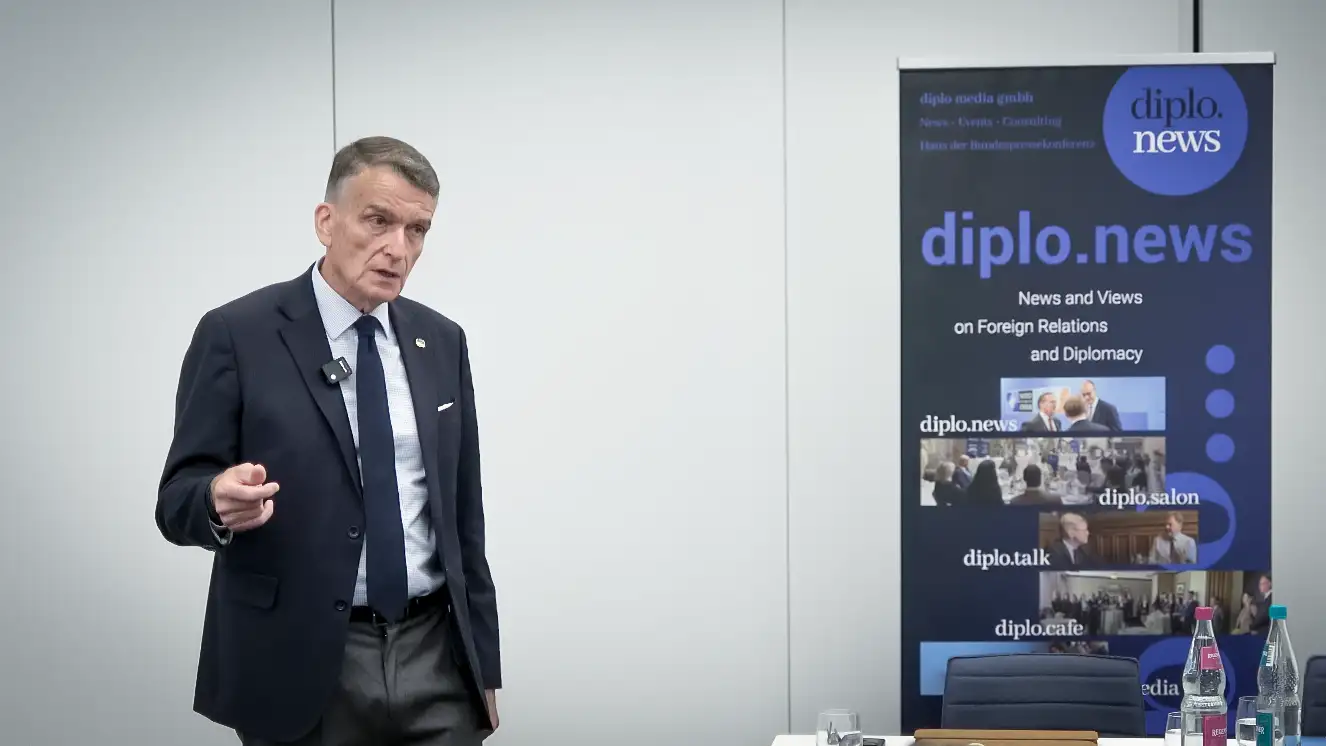
The author is Secretary General of Europa-Union Deutschland, Berlin. Opinion pieces by guest authors do not necessarily reflect the views of the diplo.news editorial team.
.webp)