diplo.news
“We are at an irreversible turning point in world history”

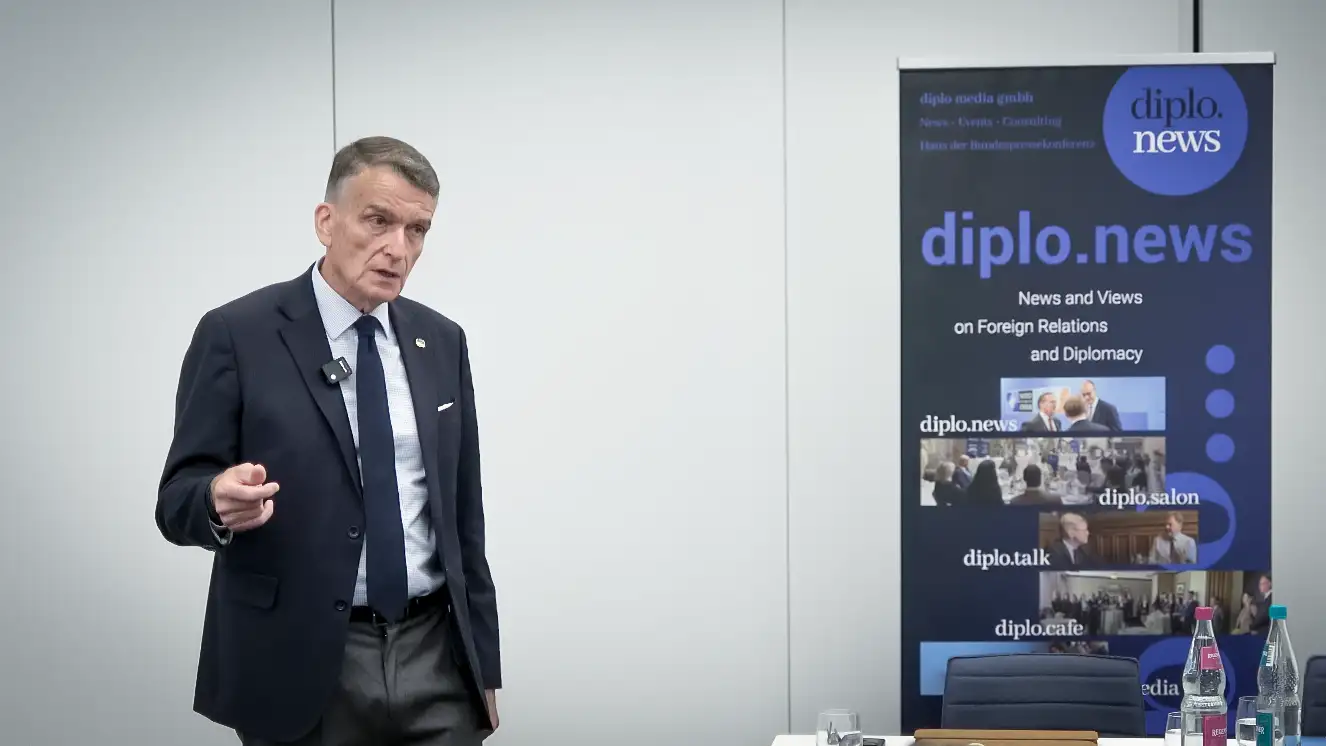
Thailand is one of Southeast Asia’s largest economies and a key founding member of the Association of Southeast Asian Nations (ASEAN). The organization will celebrate its 60th anniversary next year; with 11 members, it promotes economic, political, and security cooperation. Thai diplomacy seeks to mediate in regional conflicts—particularly in Myanmar, where authoritarian domestic developments have driven tens of thousands of people out of the country. Due to its long border with Myanmar and its political ties, Thailand serves as a bridge within ASEAN. Career diplomat Vijavat Isarabhakdi, who had visited Berlin as a student shortly before the fall of the Berlin Wall, was a guest on Wednesday at the Political Dialogue Forum at the Ritz Carlton, hosted by the Royal Thai Embassy, this year in partnership with the Konrad Adenauer Foundation and Asienbrücke e.V.
Following President Trump’s and President Putin’s visits to China: How is Thailand positioning itself today between the interests of the U.S. and China? Do you fear that Thailand is becoming too economically dependent on China?
Thailand’s foreign policy is guided by strategic autonomy, balance, and pragmatism. Our approach is to maintain constructive relations with all major partners based on shared interests. Ultimately, regional stability is best served when countries are free to chart their own course. The United States and China are both important partners for Thailand. We welcome the said visits to China and are hopeful that these high-level exchanges will lead to greater political and economic stability across the region.
How significant is the risk that Thailand will become too economically dependent on China?
Overconcentration on any single market or supply chain could serve more as a risk than an opportunity. Thailand’s strategy is focused on diversification, resilience, and expanding strategic options. This is the reality for many countries in the Indo-Pacific, where economic interdependence is a structural feature of the global economy.
To this end, we are advancing and deepening our economic partnerships with the European Union, including through the Thailand-EU FTA negotiations, as well as with Germany, Japan, India, the United States, and other partners. At the same time, we are also strengthening Thailand’s own competitiveness in future industries. So, our objective is not to reduce engagement with one partner in favour of another, but to ensure that Thailand remains economically resilient, strategically flexible, and open to mutually beneficial cooperation with all.
What role does Thailand wish to play within ASEAN?
ASEAN has long been a foundation for long-term stability in this region. In a more turbulent environment, this role becomes even more essential. This is the moment when we need more ASEAN, not less. ASEAN must continually adapt as the challenges we face are constantly evolving. ASEAN’s future directions should be guided by 3 interlinked strategic imperatives:
First is regionalism, by prioritizing ASEAN’s shared regional interests and preserving ASEAN centrality.
Second is resilience, by strengthening ASEAN mechanisms to better withstand geopolitical uncertainties and external shocks.
And third is relevance, by preserving ASEAN’s important role as a credible and trusted partner both within and beyond the region.
How can ASEAN respond more effectively to crises?
ASEAN itself and its Member States must act with greater agility, unity, and foresight by aligning around shared regional interests and improving coordination and decision-making, especially in times of crisis. Our resilience depends on managing external pressures and strategic competition. Through ASEAN Centrality, we can strengthen practical cooperation, improve crisis coordination, and build trust to prevent tensions from escalating. ASEAN must remain relevant within and beyond the region by being a credible and trusted partner, supporting multilateralism and a rules-based order, and ensuring that regional integration delivers real benefits and opportunities for our people.
Has ASEAN failed in its handling of Myanmar?
In many ways, it brings together the challenges that I have outlined. It is a test of ASEAN’s unity, resilience and relevance. Recent developments, including the recent election and the granting of amnesty to former President U Win Myint as well as the relocation of Daw Aung San Suu Kyi (democracy advocate and Nobel Peace Prize laureate, ed.) to a residence, are positive steps. I would be remiss not to say that the election was by no means perfect but such progress offers a window, however narrow, for a more conducive environment towards dialogue and reconciliation. It is also an opportunity for ASEAN to pursue a practical pathway through a calibrated and gradual re-engagement with Myanmar that supports the implementation of the Five-Point Consensus (including cessation of violence and humanitarian aid, ed.).
But let me be clear: such engagement must be a two-way street. Myanmar must also do its part in response to the expectations of ASEAN and the international community. And we hope that these developments will lead to greater humanitarian space, de-escalation and reduction of impacts on civilians, and progress in the peace process.
How can Southeast Asia remain geopolitically stable despite rising global tensions?
The short answer is that a strong, united, and inclusive ASEAN enables the region to remain stable.
What does that mean specifically?
As we advance our regionalism, strengthen our resilience, and maintain our relevance in a changing world, ASEAN will not only navigate what lies ahead but also continue to serve as a stabilising force in our region. Its rules and norms guide interactions among parties and partners in the region. Its initiatives allow all stakeholders to advance our common interests. And its mechanisms serve to address the existing and unforeseen regional challenges.
Yet, ASEAN is increasingly being tested by external geopolitical developments. Take the ongoing situation in the Middle East, for example. The situation continues to affect energy security and the broader economic resilience of the region. ASEAN initiatives such as the ASEAN Power Grid and the Trans ASEAN Gas Pipeline, together with Thailand’s strategic energy management and robust refining capabilities, will not only reinforce regional energy resilience and ASEAN solidarity, but also enable Thailand to sustain stable production levels of other essential petroleum products, which translate to our country’s energy security. This is a win-win situation for Thailand and ASEAN.
Thailand benefits greatly from tourism. How concerned are you that political instability could damage the country’s international image?
The Bhumjaithai Party secured a strong mandate following a decisive electoral victory in February 2026. Although the government operates as a coalition, its substantial parliamentary majority ensures stability and continuity in Thailand's proactive diplomacy and governance. Personally, I believe this victory reflects a public desire for stability amidst an increasingly turbulent landscape. The electorate has clearly entrusted the Bhumjaithai Party to continue the work it began during its brief period as the leading governing party at the turn of the year.
While the possibility of political change can never be entirely dismissed in a democracy like Thailand, our nation remains a fundamentally open society. Regardless of domestic politics, Thailand will always be welcoming to visitors and deeply respectful of diversity. This openness is reflected in our strong people-to-people relations with Germany. We are thrilled that in 2025, over 960,000 German tourists visited Thailand—a 10.6% increase from 2024—solidifying Germany as our largest tourist demographic from the European Union.
What opportunities does Thailand see in cooperation with Europe, and specifically Germany? How does Thailand intend to attract more foreign investment?
Europe has been a key strategic partner for Thailand. Our diplomatic exchanges and relations with many European countries date back for centuries. Our partnership is even more critical in today’s geopolitical and geoeconomic climate, not only as a major trade and investment partner, but also as a source of technology, innovation, sustainability expertise, and trusted long-term economic cooperation. Thailand sees strong opportunities to deepen cooperation with Europe.
In which areas?
In areas such as advanced manufacturing, clean energy, digital transformation, resilient supply chains, climate transition, and skills development. This is also why Thailand attaches importance to advancing the Thailand-EU FTA, which would strengthen investor confidence and economic connectivity. Germany, as Europe’s largest economy and Thailand’s largest trading partner in the EU, is a particularly important partner. We see strong complementarities in high-tech industries, green technologies, vocational training, industrial upgrading, and potentially strategic infrastructure and logistics connectivity.
To attract more foreign investment, Thailand is focused on creating the right ecosystem: a strong industrial base, strategic location at the heart of ASEAN, improved connectivity, competitive investment incentives, skilled workforce development, and greater regulatory readiness for future industries.
How concerned are you about political polarization in the country?
Thailand is committed to democratic governance, the rule of law, and freedom of expression, while recognising that rights also come with responsibilities and must be exercised within the framework of the law, as in any democratic society. Thailand has an elected government, an active parliament, an independent judiciary, vibrant public debate, and an engaged civil society. Like many democracies, our democratic development continues to evolve.
How does your government respond to international criticism regarding democracy and freedom of expression? Does your government consider this criticism justified?
We respect the views and concerns expressed by our international partners, particularly close partners in Europe and the United States, and we remain open to constructive dialogue. Whether such criticism is “justified” often depends on perspective. Some observations reflect genuine concern, which we take seriously. At the same time, certain assessments may not always fully reflect Thailand’s legal, constitutional, and social context, or the complexities that democratic societies face in balancing freedoms, public order, and institutional processes.
Why does your government often react sensitively to international criticism from Europe or the U.S.? What concrete steps are you taking to show foreign observers that Thailand is an open democracy?
I would not characterise Thailand’s response to criticism as “sensitive”. But we are definitely sensitised to the voices and views that we believe should be clarified. Like any sovereign country, we believe discussions on domestic matters are most constructive when they are based on mutual respect, balanced understanding, and engagement rather than assumptions or incomplete information.
Which global challenges concern you personally the most?
The trend towards increasing global fragmentation—or at least the growing perception of it—is at the forefront of my concerns. Paradoxically, geopolitics dominated the discussions at the 2026 World Economic Forum, highlighting how challenges to the international rules-based order now impact every aspect of daily life: not only traditional security but also global supply chains, AI regulation, the green transition, human rights, respect for the rule of law, and other socio-economic agendas.
I believe that this sense of urgency offers an opportunity for us to double down on international law as the bedrock of our harmony and shared prosperity, while also overcoming bloc politics that prevent us from addressing the critical issues at hand. We have reached a defining, and likely irreversible, turning point in global history—one where we must now be guided by a shared resolve, rather than simple alliances, to forge a more resilient, inclusive, and cooperative global future.
The questions were asked by Ewald König.
.webp)