diplo.news
Desire and Reality
By Milan Dóka
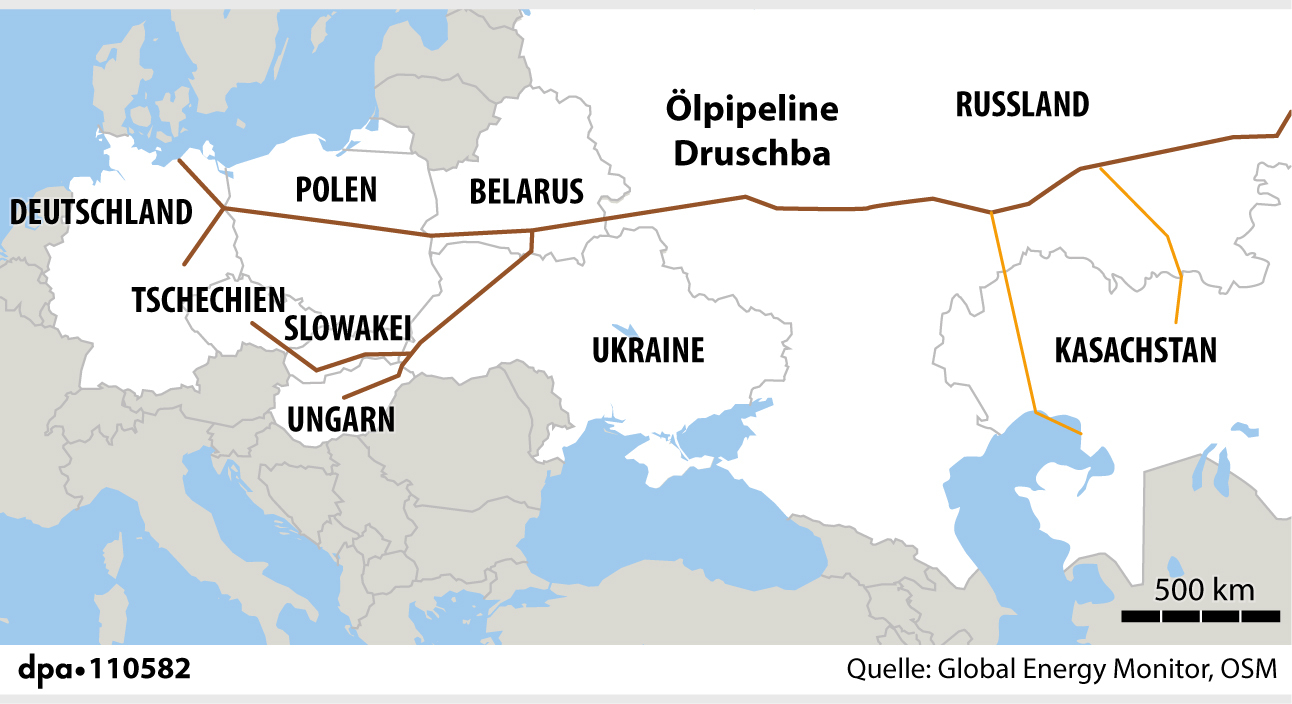
Completed in 1964, the Druzhba (Friendship) pipeline supplied Eastern and Central Europe, as far as East Germany, with Russian crude oil, though supplies have been increasingly restricted since the start of the war in Ukraine. In May of this year, Moscow halted the supply of Kazakh oil to the PCK refinery in Schwedt, Mecklenburg. (Graphic: dpa picture alliance/dpa Infografik GmbH)
EU member states expect the new Hungarian government to return to the European mainstream and engage in more constructive cooperation in the future. But the situation is not quite that simple. Even a government led by Prime Minister Péter Magyar is likely to represent Hungarian interests in contentious issues—and energy policy could become one of the central points of dispute. An EU regulation passed in January of this year prohibits member states from purchasing Russian natural gas starting no later than November of next year. Imports of Russian oil are already banned under sanctions related to the war in Ukraine, though exceptions currently remain in place for Hungary, the Czech Republic, and Slovakia. In principle, however, the EU wants to ban oil imports completely as soon as possible. Hungarian Prime Minister Magyar, on the other hand, has repeatedly stated that his country cannot fully break free from Russian energy until 2035.
Natural gas – a question of political will
Hungary’s annual natural gas consumption is around 8.3 billion cubic meters. In 2025, approximately 7.5 billion cubic meters of Russian gas entered the country via TurkStream. However, these two figures cannot be compared on a one-to-one basis, as Hungary stores gas and also re-exports it.
Nevertheless, replacing Russian natural gas is likely to be the relatively easiest task. According to energy expert and former State Secretary for Energy Attila Holoda, this would primarily require a political decision: Hungary has pipeline connections to nearly all of its neighboring countries; moreover, a significant portion of Europe’s LNG infrastructure is accessible via Austria, Croatia, and Slovakia. Starting in 2027, gas from the Romanian Black Sea field Neptun Deep could also reach Hungary.
The total annual technical capacity of alternative import routes amounts to approximately 13.6 billion cubic meters, which is significantly higher than Hungary’s consumption. Russian gas could therefore theoretically be replaced even if no gas from Azerbaijan or elsewhere could be transported to Hungary via the TurkStream route. However, Holoda considers even such a restriction unlikely, as it would cause the Russian side to forgo significant transit revenues.
The question of the long-term contract with Gazprom is more complicated. Hungary has committed to purchasing 4.5 billion cubic meters of Russian gas annually through 2036. If the EU import ban takes effect this coming fall, the question arises as to whether payment obligations will continue for gas that Hungary is no longer permitted to purchase. While international law expert Tamás Lattmann emphasizes that he is not familiar with the details of the non-public contract, he believes that such a ban could legally be considered a case of force majeure and exempt the Hungarian side from liability for damages. However, this would not rule out a protracted legal dispute with Gazprom.
Crude oil – agreement with Croatia necessary
The situation is more complex when it comes to crude oil. If supplies via the Druzhba pipeline—which runs from Russia through Ukraine—were to be suspended, Hungary would be largely dependent on the Adriatic/JANAF pipeline from Croatia for its imports.
The Hungarian oil company MOL estimates the combined annual capacity of its two refineries at 14 million metric tons and argues that JANAF cannot supply this entire volume. In addition, MOL accuses the Croatian pipeline operator of exploiting its monopoly position and charging excessive transit fees. JANAF rejects this claim, stating that the rates are in line with market standards and that, with appropriate flow enhancers, the volume required by MOL could also be transported.
According to Attila Holoda, the 14 million metric tons represent merely a nominal refining capacity that has never been fully utilized. In addition, domestic crude oil production amounts to approximately 1.1 million metric tons per year. The remaining import needs can therefore be met via the Adriatic Pipeline. Hungary also has considerable strategic reserves: when fully stocked, they amount to about 72 percent of annual consumption.
The conflict is therefore at least partially political in nature. Hungarian-Croatian relations have been strained for years by the fact that MOL acquired a 49 percent stake in the Croatian oil company INA, along with extensive control rights. The transaction was accompanied by a corruption scandal: A Croatian court handed down a final conviction against MOL CEO Zsolt Hernádi and former Prime Minister Ivo Sanader. According to the verdict, Hernádi had offered Sanader a 10 million euro bribe so that MOL could obtain significant control rights over INA despite its minority stake. Hernádi was convicted in absentia; Hungary did not extradite him to Croatia. The conflict in Croatia is also emotionally charged because, during the War of Independence, INA was considered one of the most symbolic companies of Croatian statehood.
The INA affair and the figure of Hernádi continue to burden relations between the two countries to this day. Consequently, any future Hungarian government looking to move away from Russian oil would need to resolve not only technical and pricing issues with Zagreb, but also the legacy of a political conflict that is more than a decade and a half old.
Nuclear energy – the most sensitive issue
The most difficult question arises with nuclear energy. In 2014, Hungary signed a contract with Russia to build two new reactors in addition to the four existing units. So far, around two billion euros have been invested in the Paks II project, yet even twelve years later, construction remains in an early phase. According to experts, one reason for the delays is that the Russian state corporation Rosatom is struggling to meet the requirements for project documentation. Added to this are significant political and legal controversies in Europe – less because of nuclear energy itself than because of the Russian involvement.
Attila Aszódi, a member of the Scientific Advisory Board of the Hungarian Atomic Energy Authority, points to the central role of the four existing reactors in Hungary’s energy supply: They generate about half of the electricity produced domestically and—including imports—cover about one-third of total electricity consumption. The current operating lifespans of the units are set to end in the 2030s. Canceling Paks II without a viable alternative would therefore pose significant risks to the security of supply.
Aszódi, who previously served as the government commissioner responsible for maintaining nuclear capacity in Paks, also points out that a large part of Europe had turned away from nuclear energy at the time the project began. In the meantime, however, numerous countries have initiated new nuclear projects. From his perspective, it would therefore be unfair if Hungary had to start completely from scratch on a new project now.
Aszódi sees two potential solutions. The first would be to extend the operating life of the four existing units by up to 20 years. However, it remains unclear whether this would be technically feasible in its entirety. The second option would be to continue with Paks II: In Aszódi’s assessment, the completed reactors could eventually be operated using not only Russian fuel, but also French or American fuel. The construction contract with Rosatom does not, in itself, imply a permanent dependency on Russian fuel elements.
The greatest uncertainty lies in the non-public contract itself—and in the question of whether the Russian side is even capable of completing the project. It remains unclear under what conditions the agreement could be amended or terminated, and whether Rosatom can actually finish construction.
"Rezsicsökkentés" – the holy grail of social policy
A shift away from Russian energy also carries significant domestic political risks. Under Fidesz governments, the Hungarian population has become accustomed to purchasing electricity and natural gas at state-regulated unit prices that are below market rates. This system is known in Hungary as “Rezsicsökkentés,” or the reduction of utility costs. Maintaining this system currently costs the Hungarian national budget around 1.7 billion euros per year. If replacing Russian energy requires more expensive alternative sources—such as LNG—these costs could rise further. Given the already difficult state of public finances, this would further limit the Tisza government’s room to maneuver.
Abolishing the "Rezsicsökkentés" system and passing market prices on to the public would, however, be political suicide for a Magyar government. Hungarians have been accustomed to regulated energy prices for more than a decade; at the same time, given Hungary's income levels, many households already struggle to pay their bills. Furthermore, before almost every election, Viktor Orbán has warned the public that a Fidesz defeat would mean the end of "Rezsicsökkentés." If this were to happen, his party would benefit.
Moving away from Russian energy would therefore entail economic, supply-related, and domestic political risks for a new Hungarian government. The real question, then, is not whether Hungary can reduce its dependence on Russian energy, but how quickly—and at what economic and political cost.
.jpeg)