diplo.service
How important are table manners?
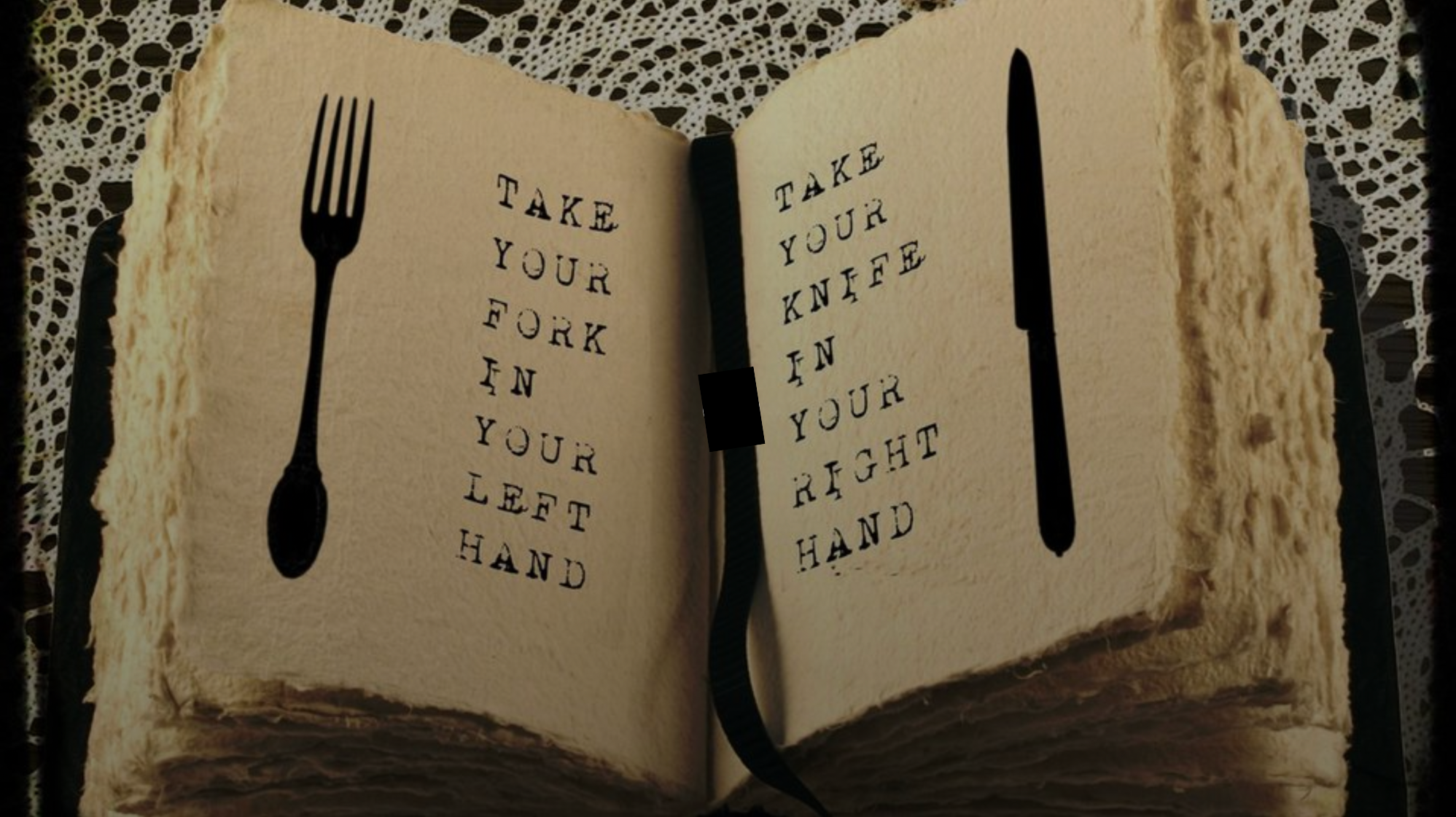
“Table manners are one of the surest signs of whether someone was taught good manners as a child.” (Asserate in his book Manners). They say a lot about upbringing, family background, and social origins. Here I am referring to a middle-class upbringing that, at least in the past, was modeled after the nobility; it is this so-called “good upbringing” that has become accepted in society and has turned into a convention. Of course, there are still regional or situational variations.
Table manners are the best measure of a person’s behavior; they are used to “label” people. On the one hand, this is a bit old-fashioned, as it emphasizes formality—consideration in personal interactions is more important than the correct handling of knife and fork—but that’s just the way it is. Especially among the older generation.
Half-naked and slurping
Good table manners, however, are also a form of consideration. At least indoors, you should sit at the table with your upper body covered; the sight of bare, perhaps even sweaty skin isn’t always appetizing.
If someone hangs over their soup plate and slurps their soup, that looks anything but dynamic, not to mention the noise; you should remember that for your upcoming job interview with a meal afterwards.
The same applies when someone brings their fork to their mouth with their elbow resting on the table. It is a matter of aesthetics, and whether we like it or not, this is also largely part of general convention. It follows that good table manners make a person’s company pleasant. And they are career-enhancing; no one will hire someone for external contacts if they do not know how to behave properly during meals with business partners.
Elbows don't belong in your neighbor's ribs
Long story short: You’re doing everything right if you sit down at the table dressed (appropriately), sit up straight, keep your arms close to your body, and place both hands on the table—just past your wrists. Slumped figures with rounded backs hunched over their plates are a sad sight, and anything but dynamic.
Even when cutting into a tough schnitzel, you should keep your elbows close to your body and not ram them into your neighbor’s ribs. In the past, in strict households, this was taught by requiring one to balance a book on one’s head while eating (sit up straight!) and perhaps even (in addition?) to hold two thin books wedged between one’s arm and torso to prevent the elbows from drifting outward.
Those days are gone, as are the days when the head of the household would lift a son’s elbow off the table and slam it down with painful force. These old disciplinary measures, however, show just how important good table manners were considered to be.
What's that hand doing under the table?
And it’s a matter of transparency: as long as you’re seated at the table, your left hand should rest on it. If it disappears under the table, people wonder what you’re doing with it. At least here, but not in the U.S. There, it’s actually common practice (though that doesn’t answer the question). More on that when we discuss using the knife.
But we're already well-versed in all this, so let's turn our attention to the soup with appetite. Without slurping and without blowing too vigorously on the spoon to cool it down. Unlike the English, we put the tip of the soup spoon into our mouths. The British do it with the side of the spoon, but then again, their spoons are smaller and shaped differently for that purpose.
What to do with the last bit of soup?
It is frowned upon to lift the soup plate to get the last bit of soup onto your spoon—in my opinion, unjustly so, because even that can be done elegantly. For Countess Schönfeldt, whom I hold in high esteem and who is the author of the highly recommended book "Anstand", this is indeed “a sign of unbridled greed,” but in my opinion, there is no reason to send the soup plate back to the kitchen with sloshing residue at the bottom.
If soup is served in soup cups, you can drink the rest of the soup from the cup; that's what the handles are for. However, please refrain from doing the same with a soup plate.
We hold the knife in our right hand, cut with it, and bring the cut piece to our mouth with the fork in our left hand. This requires some practice, which can be difficult for children, but it can be learned so well that it becomes completely automatic.
The knife, the fork, the Colt
Americans, however, do not do this. While they cut the meat with their right hand, holding it steady with the fork in their left, they then put the knife aside and switch the fork to their right hand to spear the cut piece and bring it to their mouth. Meanwhile, their left hand slides under the table onto their lap.
It is said that this custom arose because Americans historically had to be ready to draw their Colt at any moment. However, this would only benefit those who could draw and shoot with their left hand, which is why I'm not entirely sure if this explanation is accurate. Perhaps it was simply a convenience when raising children. Although there are indeed more important things than holding the fork in the left hand in these cases; for us, however, it has become a firm rule.
When in doubt, use a knife
Not always, though. If a dish is served that doesn't require cutting, such as a casserole or a rice dish, then according to old etiquette, no knife is placed on the table at all, and the meal is eaten with the fork in the right hand. This rule can be found in etiquette books from centuries past.
The reason for this was likely a desire to limit the use of knives at the table, as the knife, originally intended for carving game, was too often used to continue an old feud. Nevertheless, even in such cases today, I would set a knife and leave it up to the guest whether they use it, as is increasingly common, to push the last bits of food together on the plate.
The Battle with the Potato
In the past, cutting potatoes with a knife was considered a major faux pas. Erica Pappritz, the doyenne of good manners in the 1950s and 60s, called it in her authoritative book Etiquette "barbaric." I hope she wasn't referring to the Danes, as they, like many other non-Germans, are unaware of this uniquely German rule.
Which leads me to no longer consider it mandatory today. However, be warned: older generations still view cutting potatoes with a knife as one of the most serious breaches of table manners. So, in your own best interest, refrain from doing so if you're invited to your future in-laws' for the first time, regardless of what you think of this rule. It could diminish your chances.
Purists and Gravy
And don't mash a large quantity of potato with your fork in advance to mix it with the gravy. While that might taste great, the rule remains that you should only separate one bite of potato with your fork, mash it, and then, if you must, discreetly mix it with the gravy. And when you do take sauce, pour it over the meat, not the potatoes.
I assume that, since time immemorial, the sauce has primarily served to make the meat juicier. The two do go well together, after all. In short: for purists, sauce and potatoes are a delicate combination. A refined person doesn’t actually mash potatoes with a fork at all. Unfortunately.
Greetings from the 'Barbarians'
I clearly remember a small illustration showing a shipwrecked man in old-fashioned clothing drawing a knife to defend himself against a shark swimming toward him in the sea. The shark then says, “But Mr. Knigge, fish with a knife?” The rule against cutting fish with a knife still applies, even though the blade no longer tarnishes from the fish’s protein.
The reason for this rule is also to prevent a sharp knife from cutting the fish bones during preparation, making them harder to find and the meal more difficult.
So, what to do? Some may have inherited beautifully decorated old fish cutlery, where the knife has a different shape and is blunt. If you're serving fish as a main course, now is the time to bring it out. Otherwise, set the table with and use two forks.
If a barbarian (I’m exaggerating à la Pappritz) has set the table with regular knives, use them carefully so as not to make finding the bones even more difficult. But it’s not the end of the world either. By the way, smoked and pickled fish are cut with a regular, sharp knife.
The Pitfalls of Lettuce Leaves
There’s some debate over whether it’s okay to cut lettuce. To be more precise: technically, you’re not supposed to. As someone who, over the course of my career, has had to take my tie to the dry cleaner after countless meals with lettuce—so much for a “free meal”!—I’m all for cutting large lettuce leaves. They have the unpleasant tendency to reopen on their way to your mouth, even after you’ve carefully folded them with your fork, and to fling the sauce against your shirt and tie like a small medieval siege weapon. To avoid this, I’m willing to do almost anything. However, it is frowned upon, even if it is practical.
The Spaghetti Taboo
Spaghetti with Bolognese sauce presents similar problems. However, using a knife here is taboo. So, the chances of going home with a clean shirt after this meal are still fifty-fifty. If you're not allowed to cut them, are you at least allowed to twirl them with a fork in a spoon, even if Italians don't do that? I think, here, you are. Especially since spaghetti here isn't served in those deep plates, like in Italy, where you can and should use the curve of the plate rim to twirl the fork. And here, it's also frowned upon to let bitten-off spaghetti slide back onto the plate.
How to Rest Your Knife and Fork
You do put your knife and fork aside sometimes, for example, to drink. Then you place the cutlery, as you held it, on the plate (experts call it the "twenty past eight position," referring to a clock face).
It is incorrect to place the handles of your knife and fork on the table and the rest of the cutlery on your plate. This "bridge-building" is frowned upon for two reasons. Firstly, it takes up a lot of space, potentially encroaching on your neighbor's area. Secondly, there's a risk that gravy or sauce could slowly run or drip down the handle onto the tablecloth.
If you're expected to keep your cutlery between courses, there are "knife rests" provided for you to place your utensils on. The aim is to keep the tablecloth clean. Most people consider this particularly elegant; I would personally prefer to have a fresh set of cutlery for the next course. However, this can, of course, be challenging with a large number of guests.
What the Cutlery Position Signals
The position of your cutlery also indicates whether you have finished eating or if you intend to have more. If you place your cutlery as you held it, in the aforementioned "twenty past eight position," you are signaling that you wish to continue using it and eat more.
However, if you place your knife and fork parallel to each other on the plate, either with the handles pointing downwards (6 o'clock) or slightly shifted to the right (5 o'clock), you are signaling that you have finished using your cutlery.
Rules for Wine Glasses
There are also certain rules for drinking. You should wait to take your first sip of wine until one of the hosts has (ideally) toasted everyone, or quietly and discreetly (less formally) taken a sip themselves. This is your cue that you can now drink whenever you wish, regardless of whether the wine changes from white to red.
The days when only the host was allowed to toast the guests, who were expected to return the toast after a proper interval, are over. Only when it comes to sparkling wine/Prosecco/champagne with dessert should you perhaps wait for the hosts or perhaps one of the guests. They may have set aside the time between the main course and dessert for their thank-you speech and have been waiting for the glasses to be filled so that everyone could toast the hosts together.
Otherwise, there is only one other important rule when drinking: Wipe your mouth with your napkin before every sip. Otherwise, you can trace the entire evening’s menu on the rim of your glass, right where you drank. And that doesn’t look very appetizing.