“The Ukrainians will not give up.”
By Gudrun Dometeit
War is just a word; it has many faces. On the front lines, it is loud, bloody, and desperate. In the rear, it lurks, ready to strike, and often presents itself quite inconspicuously.
At first glance, Kyiv is the kind of city where you’d hardly expect to find it—at least not in the city center. There’s hardly any damage; bars and restaurants are crowded, and galleries and fashion boutiques are open. Young Ukrainian women are sipping Aperol Spritz at tables on the street. It’s the weekend, after all. One of Ukraine’s most important religious buildings, the magnificent St. Michael’s Monastery with its cathedral—once blown up by the Soviets—looks as if it has just been restored. On this Saturday, quiet, solemn, and somehow soothing chants can be heard coming from the windows of individual buildings.
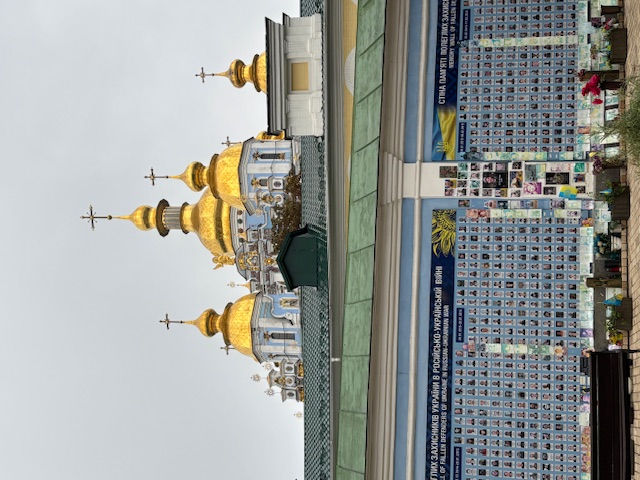
But there are also piles of sandbags in front of buildings; burned-out vehicles stand as silent reminders of the many battles in eastern Ukraine; an armored vehicle guards a blocked-off street next to St. Sophia Cathedral. The gallery of photos of fallen soldiers on the wall of St. Michael’s Monastery—many of them in their twenties, smiling, confident, some grim and determined—has grown significantly since my last visit. And the farther you drive into the outskirts, the more often you pass charred, bullet-riddled residential buildings, factories, and warehouses. In early September, a Russian airstrike triggered a massive fire at one of the most important medicine depots in Boryspil, near Kyiv.
At night, the people of Kyiv say, it’s the worst. When your smartphone blares five or six times because there’s another air raid alert. And you don’t know how you’re going to get through the next day, exhausted as you are.
Since the summer, Russia has not only been bombing Ukraine with increasing frequency, but has also been deploying—in addition to ballistic missiles—new jet-powered Geran drones, with speeds of up to 600 kilometers per hour, making them significantly faster than the Shahed drones used previously. They are intended to wear down Ukraine’s air defenses. Both sides are increasingly targeting energy infrastructure, warehouses, industrial facilities, and, of course, military installations. As of today, Tuesday, neither Moscow nor Kyiv has adhered to a ceasefire regarding attacks on energy infrastructure—a truce reportedly negotiated by Donald Trump.
Winter Offensive
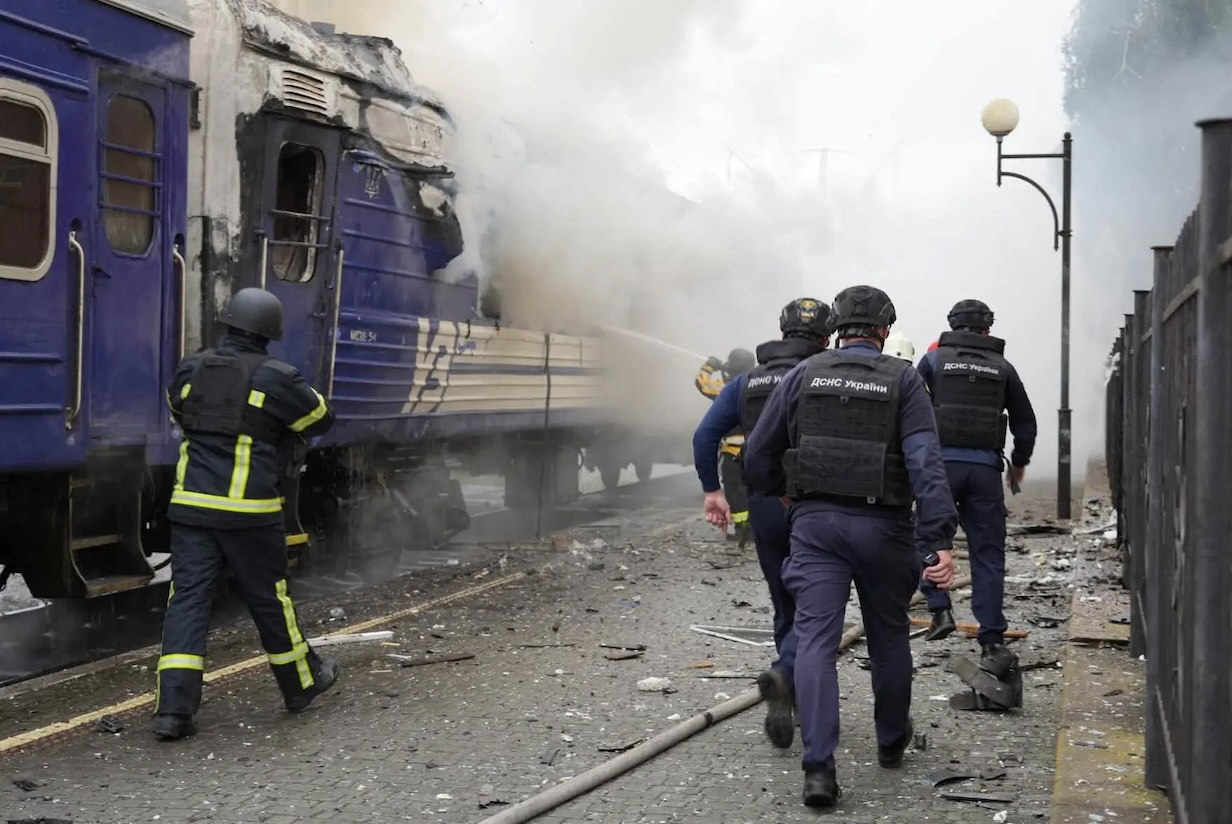
Early Sunday morning, Russian Geran-5 drones also attacked western Ukraine and the Polish-Ukrainian border. According to the Polish Border Guard, one of them set a truck on fire about one kilometer from the Dorohusk-Jagodin border crossing, while another struck the locomotive of the Kyiv–Warsaw passenger train, also near that border crossing.
No one was injured, not even the passengers on a private train carrying international diplomats, politicians, business leaders, scientists, and journalists, which had passed through the area shortly before on its way back from Kyiv. All were participants in the “Yalta European Strategy” (YES) conference, which Ukrainian oligarch Viktor Pinchuk organizes once a year, primarily for supporters of his country.
The war was suddenly very close; it had crept up without the passengers on this train—including this reporting journalist—having the slightest clue. Was the attack actually intended for the private express train, which carried, among others, former British Prime Minister Boris Johnson and the chancellor’s foreign and security policy advisor, Günter Sautter? It was certainly an attempt by Russia to intimidate Poland and other Europeans—and likely not the last. The attacks were a preview of what Ukraine and the coalition of the willing can expect in the very near future.
“Whether Ukraine survives this winter depends above all on whether we can protect our airspace,” Andriy Biletsky, commander of the 3rd Army Corps, told conference participants right at the start. He was connected online to the bunkered conference room of a Kyiv hotel. “We should be able to respond to anything that flies.” To do so, the country urgently needs more Patriot interceptor missiles—ideally, around 300. The air defense system is becoming less and less capable of repelling attacks; figures of just 50 to 60 percent were circulating among the participants.
The problem: Because the U.S. has not provided any new funding for Ukraine’s defense since last year, Europeans must either purchase such systems from the U.S. manufacturer Lockheed Martin or transfer them from their own stockpiles. The German government has allocated 11.5 billion euros for 2026, in part for the purchase of two Patriot systems. However, the U.S. company is barely keeping up with production of the interceptors, partly due to the war with Iran. And it is rather unlikely that the U.S. will resume direct aid payments in the foreseeable future—as both Democrats and Republicans in the U.S. Congress made clear during a discussion.
Catastrophic economic situation
Thus, all requests for more money were directed at the Europeans, even though the EU—having provided over 220 billion euros since the war began in 2022—is already Ukraine’s largest donor. Ukraine’s economic situation, however, is dire. According to Roksolana Pidlasa, the young chairwoman of the Verkhovna Rada’s Finance Committee, the government cannot even cover normal government expenditures with its own budget—such as paying civil servants’ salaries or providing support to soldiers’ families. She estimated the shortfall at $1.35 billion (1.17 billion euros). Every day of the war costs Ukraine $190 million (165 million euros).
Furthermore, tax revenues are falling rapidly due to the constant attacks on infrastructure and businesses. The blockade of the Black Sea transport corridor has caused revenues—particularly from grain exports—to plummet. The situation is precarious, admitted Ukraine’s new Prime Minister Serhii Koretzkyi, who has been in office for two months, especially since Russia appears to be planning “a kind of blitzkrieg” this winter. The government is using loans to shore up companies’ liquidity and supply chains. When asked why Brussels should actually increase its financial support despite major corruption scandals, Koretzkyi assured that the anti-corruption authorities are absolutely “on track” and doing their job.
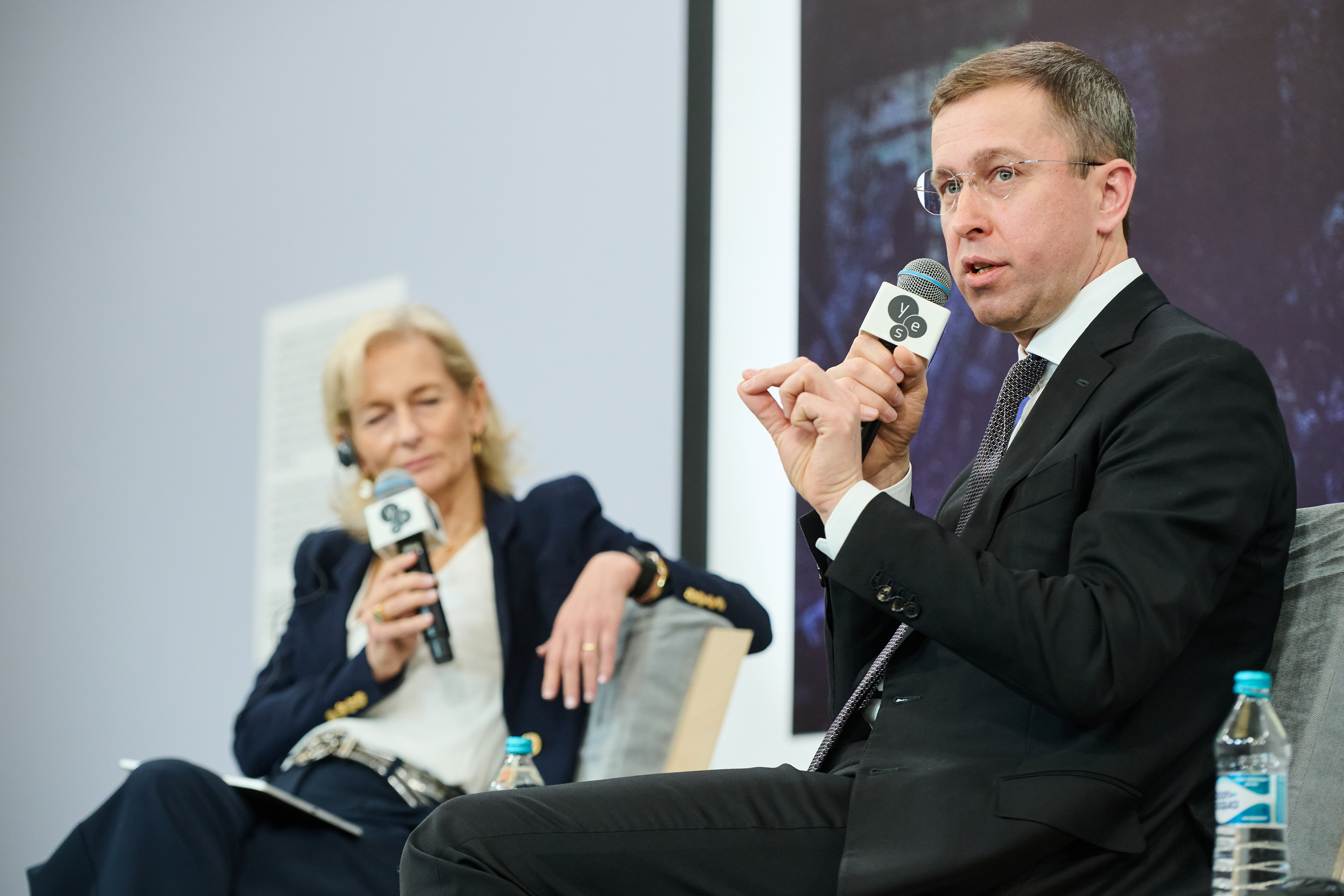
According to its own figures, Ukraine needs an additional 27 billion euros (total budget: 123 billion) for defense this year. Increased drone and missile production, more soldiers—all of this costs money. At least, that is how members of the government justified their request for additional funding. According to one proposal, at least 13 billion euros could be disbursed early from the second tranche of a 90-billion-dollar EU loan scheduled for 2027.
An old idea also resurfaced—one that Chancellor Friedrich Merz (CDU) had promoted last year but which failed due to resistance from Belgium and Italy: the use of frozen assets belonging to the Russian Central Bank totaling approximately 210 billion euros, most of which are held in accounts with the Belgian financial services provider Euroclear. Instead, an EU summit in December had agreed on the 90-billion-euro loan.
The reaction to the substantial additional demands sounded cautious. A group of European diplomats who discussed the financing of the aid on the sidelines of the conference noted that any solution must ensure that investors are not deterred from future investments in the European market.
High-tech war
It is well known how skillfully Ukraine has so far adapted and modernized its warfare against Russia, an opponent that appears overwhelmingly superior. Even members of the U.S. military have expressed admiration for these advances. Now, the next technological leap appears to be on the horizon: The development and deployment of unmanned, AI-controlled systems capable of replacing human soldiers, particularly in dangerous frontline sectors—the so-called “kill zones.” This would be especially important, as Ukraine has been significantly outnumbered by Russia from the outset and now anticipates a covert mobilization that could result in approximately 600,000 Russian soldiers on the front lines by the end of the year.
“Our partner must be prepared for modern warfare,” said Yevhen Lasiichuk, commander of a rapid response force. Even the most advanced heavy artillery isn’t efficient enough, he noted. What matters most are agility and flexibility. Tactics and technologies are often adjusted on a daily basis. “Today’s warfare is extremely fast-paced; even the smallest units now make data-driven decisions. That’s the way to survive.” According to him, 80 percent of targets are already being engaged by unmanned systems. According to Danylo Tsvok, head of an AI lab at the Ministry of Defense, Ukraine has also developed an unmanned air defense system that is 95 percent autonomous. U.S. General David Petraeus, who asked the question and repeatedly praises Ukraine’s military-technological achievements during public appearances, nodded in approval.
At the same time, both Russia and Ukraine are developing new ballistic missiles with a range of up to 850 kilometers, capable of striking targets deep within enemy territory. These types of missiles are particularly treacherous because they hurtle toward their target at high speed during the terminal phase, making them more difficult to intercept. “Our goal is to stop (Russia’s) production of ballistic missiles and destroy the launchers,” explained Vadym Skibitsky, a major general in the Ukrainian Military Intelligence Service.
In light of rapid technological advances, a French AI entrepreneur shared a concern on the sidelines of the conference that until now had been more the stuff of science fiction movies. Ukraine, he said, could in the future serve not only as a testing ground for the deployment of new drones but also for combat robots. “In the end, we’ll have a war of unmanned systems, because Russia will keep finding ways to respond to new technological developments.”
Controversial and other heroes
Some Ukrainian military officials, a foreign diplomat said, are now speaking of a final battle against Russia—a last, all-out effort that will not end in dependence, oppression, or occupation, as has been the case in the country’s turbulent history.
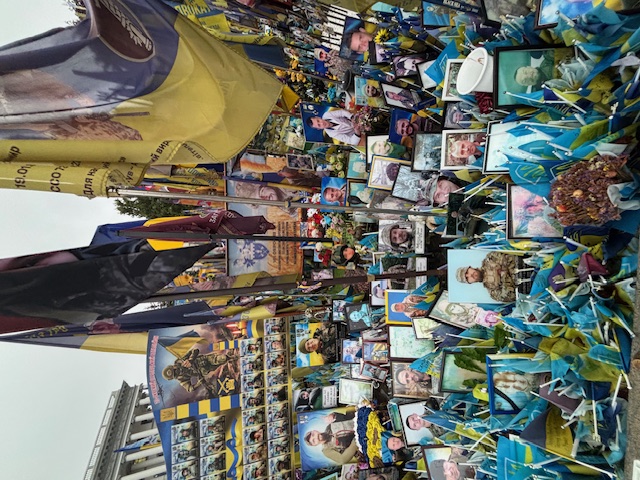
From this group, Ukraine draws its role models—people who embody the struggle for freedom and independence. Like Symon Petliura, who, as commander-in-chief of the Ukrainian People’s Army and head of government during the brief period of an independent state between 1917 and 1920, fought against the Bolsheviks, the White Army, and Poland. On Khreshchatyk, the wide boulevard in the center of Kyiv, directly across from an ever-growing sea of flags, photos, and flowers with which Ukrainians honor their fallen soldiers, huge posters stand in the middle of the sidewalk. Designed by the Museum of National History, they trace the politician’s career: “Petliura—A Life for Independence.” Elsewhere, there are monuments and streets named after him.
However, Petliura is a controversial figure among historians and, above all, among Jewish organizations—much like the nationalist politician and Nazi collaborator Stepan Bandera, who is revered especially in western Ukraine. Petliura is accused of bearing political responsibility for the murder of tens of thousands of Jewish civilians by members of the People’s Army. In 1926, while in exile in Paris, he was shot by a Jewish activist who had lost several family members in the pogroms. Nevertheless, a court acquitted the assassin.
Whenever the war ends, Ukraine will have to come to terms with its history, including its relationship with Poland. Recently, President Volodymyr Zelenskyy bestowed the nickname “Heroes of the UPA” on an army unit to honor the Ukrainian Insurgent Army, which, under Bandera’s leadership, carried out massacres of Poles and Jews during World War II. Warsaw, one of Ukraine’s most steadfast supporters, demanded that Zelenskyy revoke the award. Tensions have been running high ever since. Poland’s Foreign Minister Radosław Sikorski emphasized that the UPA was an organization hostile to minorities that murdered thousands. “But if Germany and France managed to initiate the reconciliation process five years after World War II, then surely Poland and Ukraine will be able to do the same after more than 80 years.”
The role of diplomacy
But when and how will the Russia-Ukraine war end? No one really knows, and even at this conference, no magic solutions were offered. Only one thing was certain: No one here wanted appeasement toward Moscow. “The war can only end one way: through negotiations,” explained Jonathan Powell, National Security Advisor to the new British Prime Minister Andy Burnham and an experienced negotiator in the Northern Ireland conflict, in Colombia, and in the Basque Country. “One day, when we least expect it, Putin will be ready for negotiations.” However, it is important to initiate a process leading to that point and to address specific issues—such as the blockade in the Black Sea—in advance.
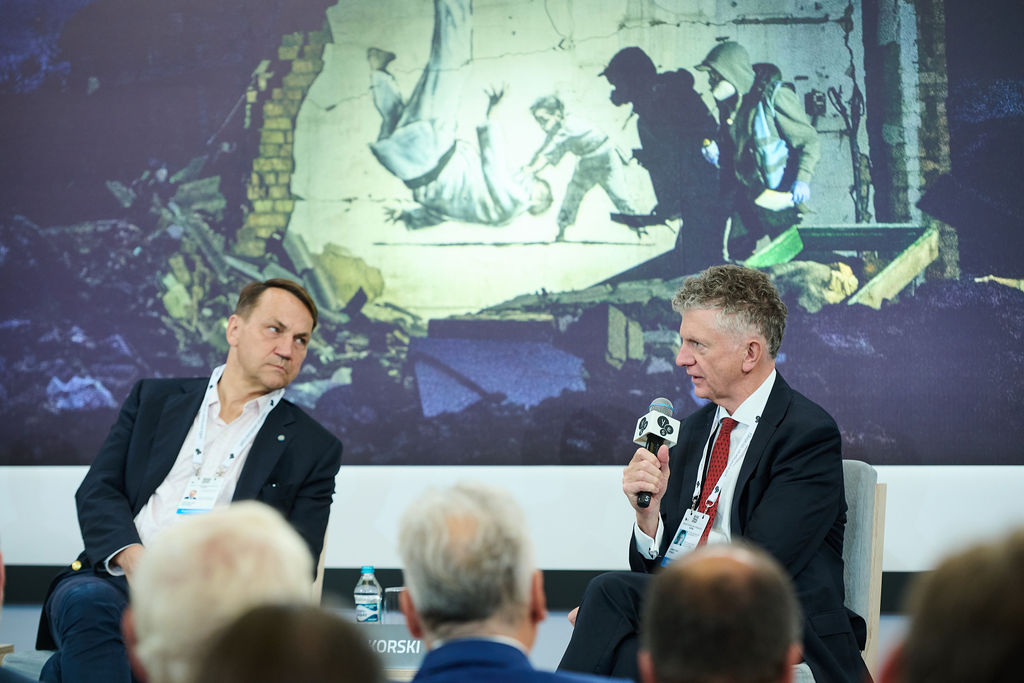
Everyone agreed—not just those on stage—that Russian President Vladimir Putin could only be forced to the negotiating table through tougher sanctions, economic pressure (particularly in the energy sector), and military strength. The “shadow fleet” must be combated more consistently; for example, ships could be denied standard services in Baltic Sea ports. And Foreign Minister Sikorski argued for “acting so aggressively that Putin becomes unsettled about our intentions.”
German political scientist Carlo Masala, however, expressed skepticism. Putin is playing for time, he said, seeking to wear down Western societies—all of which are reeling from financial problems and gradually growing weary of war.
Former British Prime Minister Johnson took the most uncompromising stance, advocating for Ukraine’s membership in NATO and the EU. “This is a fundamental and imperial war. The only way to solve the problem is through clear statements about Ukraine’s future.” Otherwise, Putin would say, “See, I warned you that the West would break its promises.” However, Johnson is no longer considered to possess significant political influence. Just a few weeks after Russia’s invasion on February 24, 2022, he had already advised President Zelenskyy not to make any concessions, thereby allegedly helping to prevent a peace deal with Russia.
Davyd Arakhamia, the parliamentary group leader of the ruling “Servant of the People” party, stated that he is convinced Russia will eventually return to the negotiating table. Arakhamia negotiated with Moscow in Istanbul in 2022 and appears to maintain good contacts with the Kremlin in general. He says he speaks with every new member of the Russian leadership. Unfortunately, however, Putin is currently surrounded only by those who support the war.
A major escalation?
Anything seems possible in this war between Russia and Ukraine, which has now been raging for four and a half years: a ceasefire, the start of negotiations, a temporary escalation to secure a favorable starting point for talks, or the spread of the war beyond the opponents’ borders. “The Ukrainians will not give up—I know that from my own experience,” emphasized former Google CEO Eric Schmidt. The legendary tech entrepreneur is likely to contribute significantly to this effort himself. The American has visited the front lines on several occasions. He is developing new drones equipped with artificial intelligence, including interceptor drones to counter the Russian Shahid drones. One cannot shake the impression that this war is, above all, an incredibly profitable business.