“School food is not charity — it is economic infrastructure”
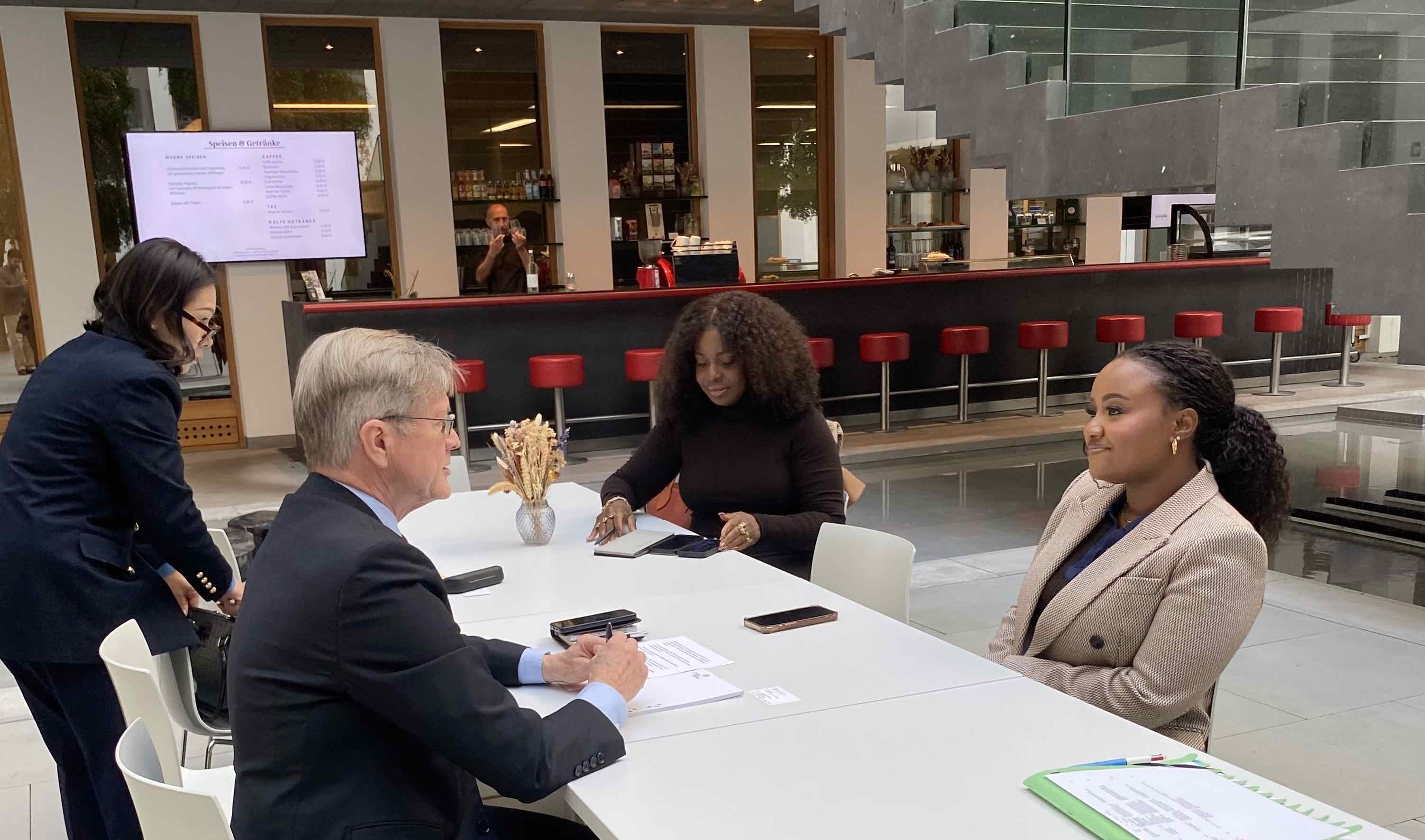
Kenyan social entrepreneur and nutritionist Wawira Njiru has built an innovative school feeding model through her organisation Food4Education. What began with a small fundraiser and 25 children has grown into an organisation employing thousands of people and providing meals to hundreds of thousands of schoolchildren every day. Njiru sees school feeding not as charity, but as economic infrastructure – creating opportunities for local farmers, suppliers, families and entire communities. In 2026, she received the German Africa Prize in recognition of this approach.
You were still very young when you founded Food4Education. What inspired you to focus on school meals?
I grew up in Kenya and wanted to make a difference, particularly in education. My parents had both received support to pursue their education. My mother, for example, was able to go to school thanks to a scholarship. I wanted to do something that could change the trajectory of a child’s life.
While studying nutrition in Australia, I asked teachers at the public schools my parents had attended what the biggest challenge facing their pupils was. Their answer was simple: the children were hungry. To me, that was a very basic need that had to be addressed.
I organised a small fundraiser in Adelaide, where I was living at the time. I raised 1,250 dollars and sent the money back to Kenya. That is how I started – with just 25 children.
I have always believed that if you can solve a problem for someone, you should at least try.
At what point did you realise that this small initiative could become something much bigger?
A major turning point came in 2016. We grew from feeding around 50 children to 300, and then to 1,000. We had introduced contributions from parents, asking them to pay towards the meals. When I saw that parents valued what we were providing and were willing to contribute, I realised that there was something important here.
The children kept coming back every day. I had initially worried that we might feed them one day and they would decide the next day that they did not like the food. But they returned, and that showed us how much the meals were needed.
Later, we built our first central kitchens. Each additional kitchen gave us new data. We could compare costs, operations and results, and see that the model could be replicated across multiple schools. Introducing our Tap2Eat technology, which allows parents to contribute through mobile payments, was another important step.
How do the children see you? Are you a mother figure to them, or simply the entrepreneur behind the organisation?
To many of them, I am just some woman. The people who really matter to the children are those who prepare and bring them their meals every day. They know the cooks, the drivers and the people who serve the food. Those are their heroes.
A driver once told me that he was in a shop when a child came in with his father. The child proudly introduced him: “This is the man who brings me food every day.” Stories like that make me very happy.
We now have around 6,000 employees. I want them to feel proud of their work and recognised in their communities. I may be behind the organisation, but I could never do this on my own.
You received the 2026 German Africa Prize. Had you heard of the German Africa Foundation before?
No. When the Foundation contacted me, I was surprised. I had never visited Germany and initially wondered how they had heard about us.
What particularly pleased me was that the award recognised not only the meals we provide to children, but also what we have built in Kenya: economic infrastructure that brings farmers and suppliers into the system and distributes food to many schools. I felt that was a very meaningful reason for the recognition. I was deeply honoured and grateful.
Does your work demonstrate that Africa should be seen not only as a recipient of development aid, but also as a source of innovation and expertise?
I certainly hope so. Africa is showing that we are ready to take charge of our own future. When I started, I wanted to address a problem in my own community. I did not want to wait for someone from outside to come and fix it for us. Many Africans are doing exactly that today.
The international community needs to recognise this and work with local organisations. Many of them are not simply running small projects; they want to grow and reach many more people. Our goal is to serve one million children every day in Kenya alone. We are also looking at other countries.
Partnerships are essential. If I came to Germany to feed children, I could not simply do that without working with German organisations, understanding the local system and learning about the realities here. The same principle applies when working in Africa: cooperation must involve local partners and take account of local circumstances. Africa consists of 54 very different countries.
In Germany, fundraising campaigns often portray Africa through images of poverty and hungry children. Is that a problem?
Of course, there are serious challenges in parts of Africa. Our work exists because some children struggle to access adequate food. But how we talk about these challenges and the images we use really matters.
At Food4Education, we do not photograph children before they receive their meals. When you see them in our pictures, they have already eaten. They are happy, smiling and enjoying their food.
We want to tell stories not only about problems, but also about potential and solutions. I believe our best solutions often come from within our communities – and they can then be relevant to other parts of the world as well. Africa is a continent of 1.5 billion people. It should not be reduced to images of poverty and despair. There are challenges, but there are also enormous opportunities.
You have repeatedly said that school feeding should be understood not as charity, but as economic infrastructure. Why is that distinction so important?
Who wants to be seen simply as a recipient of charity? It can be disempowering. People feel that they are receiving something rather than participating in something.
Infrastructure, by contrast, becomes part of the fabric of economic and social life. When we build school feeding as infrastructure, the benefits go beyond the children. Farmers, suppliers and entire local economies benefit as well.
We source more than 80 per cent of our produce locally. The only product we import is rice. When I started, I did not even have the option of importing food. I had to learn how to work with market women and smallholder farmers.
I often think of a woman called Mary. She started supplying us with relatively small quantities. Today, she has bought a Toyota Hilux and is planning to buy a lorry. Her business has grown significantly in about two years. She can support her family and provide work for others. That is what I mean by economic infrastructure.
What role should Germany and other European countries play in supporting African solutions?
Germany and European countries have an important leadership role to play. It is about helping people fulfil their potential. School feeding provides a foundation for that: children receive the nutrition they need and are better able to benefit from education.
At the same time, jobs and income are created. Parents, suppliers and other people involved in the system benefit economically. International partners should therefore invest more in local organisations and African solutions.
Sometimes programmes are designed outside the continent without sufficient understanding of local realities. That does not always work. What matters is developing solutions together and building partnerships on equal terms. African innovations can then have an impact far beyond the continent.
Have you drawn inspiration from models in other countries?
Yes. When we began thinking about expanding our work, I researched successful school feeding programmes around the world. The Indian model particularly interested me. The circumstances are not identical, but some of the challenges relating to population density and geography are comparable.
In India, central kitchens are used to prepare meals and distribute them by truck to several schools. We adopted that idea and adapted it to local conditions together with our team in Kenya. Japan also has a very successful school feeding programme.
So this is an international story: I studied in Australia, was inspired by a model from India, and developed the approach further with a Kenyan team.
Does international development cooperation need to rethink the way it has traditionally worked?
I think it does. It needs to be much more rooted in local realities and local actors. Food4Education is based on a partnership between parents, government and philanthropy. Around 60 per cent of our costs are covered locally. Donors therefore account for a smaller share of our work.
It is also important to see people not simply as beneficiaries, but as participants. We regularly ask parents, children and teachers whether they are satisfied with the meals and what impact they see in their schools. We collect satisfaction data and have the results independently verified.
I would like to see other development organisations consistently ask: Are the people we are trying to serve actually satisfied with what we provide? And do they have the opportunity to give honest feedback, including criticism?
You aim to reach one million children in Kenya every day by 2027. What are the biggest obstacles?
We are building 200 kitchens this year. That is a major logistical and organisational challenge. We also face difficulties in food procurement, rising prices and weather events such as El Niño.
In some regions, basic public infrastructure is lacking. We have to make sure, for example, that there is access to water. Sometimes a kitchen is built in a community where access to water was previously very limited. Recruiting and training staff is another challenge. We currently employ around 6,000 people, and our team will need to grow further.
I sometimes say that in Africa you build the car while you are driving it – and you are also building the road you are driving on. That makes the work challenging, but it is also part of what makes it so meaningful.
You studied in Australia before returning to Kenya – a decision that not everyone supported. What did that experience teach you?
I went to Australia when I was 19. My parents paid for my first semester, and after that I worked several jobs, including in nursing homes and disability care. That taught me a great deal about caring for people and being of service. You have to do your work well even when you do not always receive a thank-you. It also taught me independence.
I founded Food4Education when I was 21 and still studying in Australia. Returning to Kenya was not an obvious decision. My parents and many other people thought I should stay in Australia. They hoped I would build a good life there.
But I wanted to return. That taught me to make my own decisions and stand by them. Most importantly, Kenya showed me what I was capable of: building something that serves people and creates jobs.
When someone tells me that their job with us has enabled them to build a house or send their child to university, it really touches me. If I had stayed in Australia, perhaps I would have had a car and a mortgage – and that would have been it. In Kenya, I have been able to build something that goes far beyond myself.
This is your first visit to Germany. What impression will you take home with you?
I have felt very welcome here. Everyone has been kind, curious and genuinely interested. My parents are here with me, and so is my grandmother. She is around 80. At dinner, she told me that she had never imagined she would one day come to Germany for an occasion like this. That moved me deeply.
I find it inspiring to see how many people in Germany genuinely want to understand what is happening in Africa and how better partnerships can be built. I hope this award will help make African organisations more visible and strengthen the dialogue between Germany and Africa.
The interview was conducted by Ewald König