diplo.service
How do we set the table?
The first question concerns the tablecloth. In the past, it was said that it had to be white; this signified elegance and, according to Asfa-Wossen Asserate, the author of the book “Manieren” (Manners), it also reflected the originally sacred nature of communal dining.
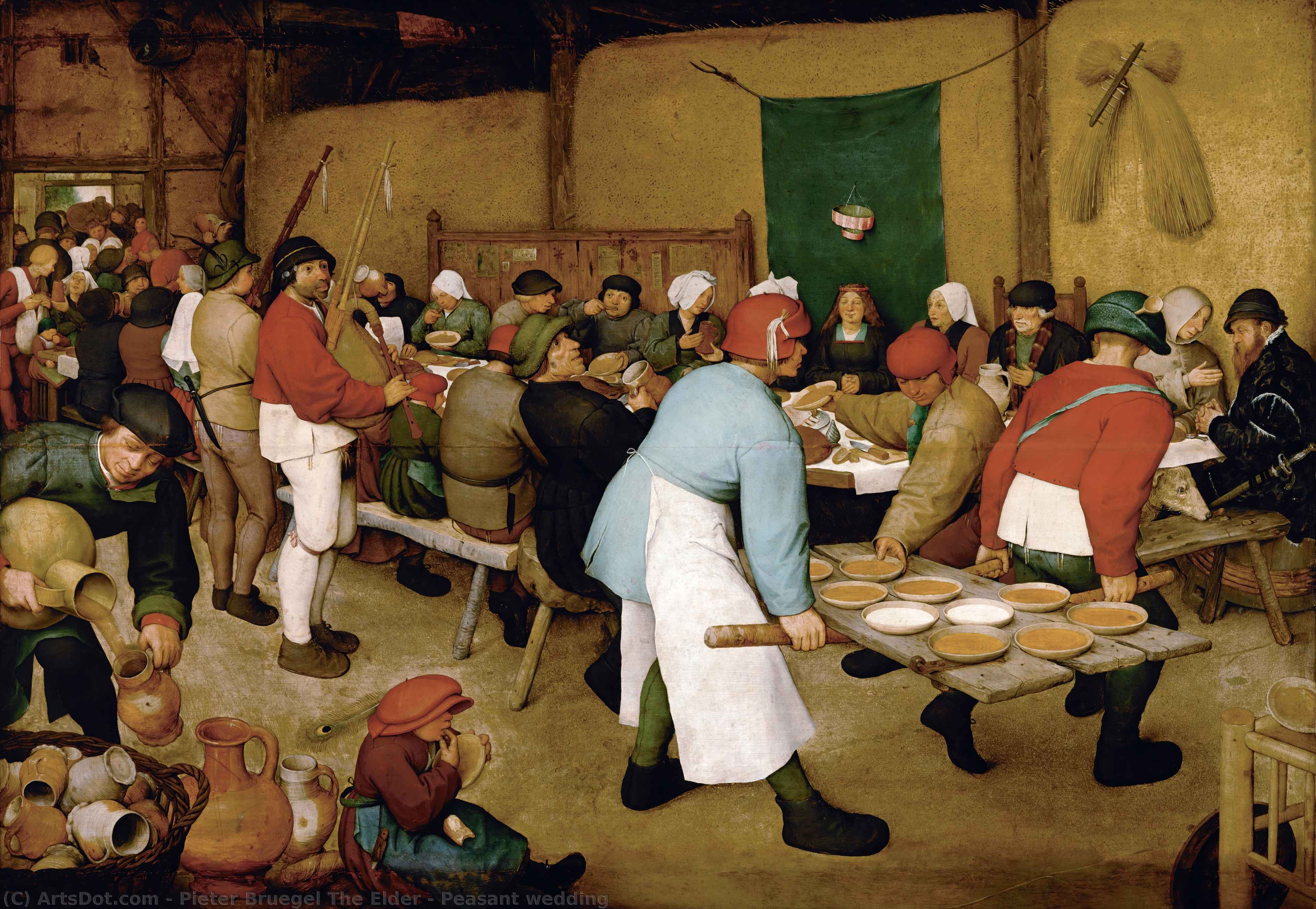
Well, the ancient Germanic tribes and the ordinary farmers of the Middle Ages would have eaten off wooden boards, unimpressed by such notions. One must imagine that, back then, during festive meals, boards shaped like a door were placed on two trestles.
The table is “taken down”
Meals were eaten on these boards, assembled to form a dining table, and when finished, "the table was taken down," meaning the entire structure was carried away again. You can still see this in paintings by Pieter Bruegel the Elder ("The Peasant Wedding").
We aren’t quite that rustic, but we can do without a tablecloth if we have a nice tabletop. On it, we place placemats, on which the plates and cutlery are then set.
You can see this very clearly in the image accompanying the post “Where do we seat the guest of honor”—see the chapter on Umgangsformen (3). Otherwise, a tablecloth is a good option—no longer necessarily white, but in any color, solid-colored, or even patterned, with only a slight compromise on elegance. The colors enliven the festive look of the set table; with a white tablecloth, this effect could only be achieved with colored napkins and floral decorations.
Charger Plates for Visual Appeal
It looks particularly festive when dinnerware is placed on charger plates, large plates made of silver or another metal, which are purely for visual appeal and otherwise have no function. At private dinners, I do without them simply for lack of space; that’s why I’ve cleared my china cabinet of this excess clutter
As a host, however, I have set the table with them. Once, this led to a distracted waiter serving the main course to a guest before the plate was set, and the guest scooped the food onto the decorative plate; after a brief moment of confusion and a plate swap, the meal continued undeterred.
Dinner and side plates
Now, let's talk about the dinnerware. Depending on what we are serving, we set a large flat plate for the main course. On top of that comes a soup plate if we are serving soup to start, or a small plate for an appetizer. It doesn't matter whether you set soup plates or soup bowls (with saucers!).
For an appetizer, you could offer a salad, which can also be served alongside the meal. In that case, however, you must place a small plate at the top left, 'at 11 o'clock', in front of the main course plate; on the left, as the guest holds the fork for eating salad in their left hand.
There's usually no space left on the table for dessert plates; they are kept ready and set after the main course, unless a pre-plated dessert is served directly on the plate.
Dangerous crowding on the table
If you want to serve bread, for example with a soup, the plate for it also goes to the top left next to the salad plate; but then space becomes dangerously tight.
Now for the cutlery. For the main course, we set the large cutlery next to the large plate, the knife on the right with the blade facing inwards and positioned so that any engraved monogram is visible ̶ mostly only found on inherited cutlery nowadays ̶ , and the fork on the left with the tines facing up. Then, further to the outside, comes the smaller cutlery for the appetizer. If something needs to be cut, the small knife goes on the right and the small fork on the left.
If there's nothing to cut for the appetizer, such as with a salad, the knife is omitted, and the fork goes to the right.
If soup is served first, the large soup spoon goes to the right of the knife.
How to signal that dessert is coming
To visibly indicate that dessert will be served, we place the dessert cutlery – a small spoon and a small fork – above the plates, as shown in the sketch below.
Some also place the soup spoon above the plates, but this is not advisable. It can get mixed up with the dessert cutlery, and some guests might mistakenly think a dessert requiring a large spoon, such as a cold soup or zabaione, is being served. They might then hesitate to use that spoon for soup until they've looked to the hosts for clarification.
Antique Fish Cutlery: Beautiful, but Unnecessary
Few people still own fish cutlery today. While antique fish cutlery is often beautifully crafted, it's no longer as essential as it once was, as modern knives don't tarnish from fish protein.
The dull fish knives are also designed to prevent you from cutting through fish bones, which would make them harder to detect. So, if you've inherited such a set, use it when serving fish as a main course; it's too beautiful to leave gathering dust in a drawer.
It is neither necessary nor appropriate for rollmops or smoked eel. This is because there is no risk of cutting through bones with pickled or smoked fish. These often require a very sharp knife.
The Arrangement of Glasses
Guests will also be thirsty. Glasses are placed to the upper right of the plates, roughly 'between 12 and 3 o'clock'. Wine is usually served with the meal, typically white wine with the appetizer and, if appropriate, red wine with the main course. Therefore, the (smaller) white wine glass is placed first in the row, followed by the slightly larger red wine glass, curving upwards to the left.
If you wish to serve sparkling wine or dessert wine with dessert, these glasses are added to the upper left; they will be easily accessible once the other glasses have been used.
Water glasses are essential even for festive occasions; therefore, a water glass is placed top right in front of the plates, comfortably outside the line of wine glasses.
Beer glasses only upon request
I would only place beer glasses on the table if specifically requested. The beer enthusiast who makes this request will have their glass readily accessible on their right; they will hardly touch any other glass, and if they do, it will only be out of necessity.
In short: As with cutlery, the guiding principle here is to make it easy for the guest, allowing them to "work their way through" the row of glasses sequentially. If you know your guests' preferences, you can certainly let your imagination guide you.
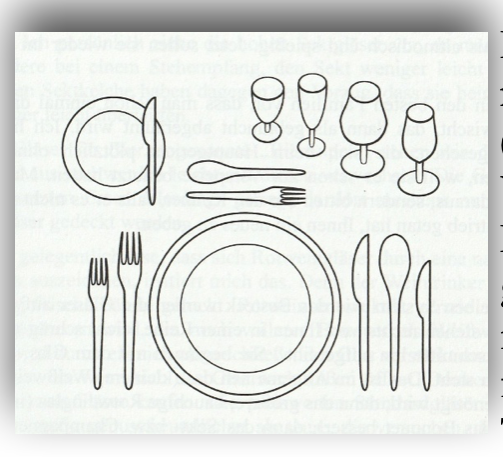
The perfect place setting
Here is an illustration of what has just been described. The table is set for a main course, soup, and a cold appetizer, though the appetizer plate is still missing, as small plates are difficult to place on soup plates. However, you can discern the planned meal sequence from the cutlery. The dessert cutlery is arranged ̶ spoon handle to the right, fork handle to the left ̶ so that it can be easily picked up (though experts disagree on this; some prefer to hold the spoon in the left hand).
To the left, the bread plate with a small butter knife, and the glasses in order (from right): white wine, red wine, sparkling wine, water. The image mentioned earlier in the article "Where do we seat the guest of honor" is confusing in this regard; not even I can decipher the planned meal sequence from it. Perhaps the table is set in a museum, as an example of ancient Spanish court ceremonial. I actually once raised this point at the Hofburg in Vienna, and I was kindly informed that the table had been set based on an old painting.
Cloth or paper napkins
By the way, the napkin goes to the left of the plate. If there's no space there, it can also be draped more or less artfully on a plate; see the photo provided. Cloth napkins are undoubtedly more elegant than paper napkins, but sometimes it's also permissible to think practically.
Incidentally, the photo also shows finger bowls – bowls filled with water where you could clean your fingers if, on rare occasions, you were allowed or even had to eat with your fingers, for instance, with artichokes. A rather uncommon accessory.