A friendship not entirely untroubled
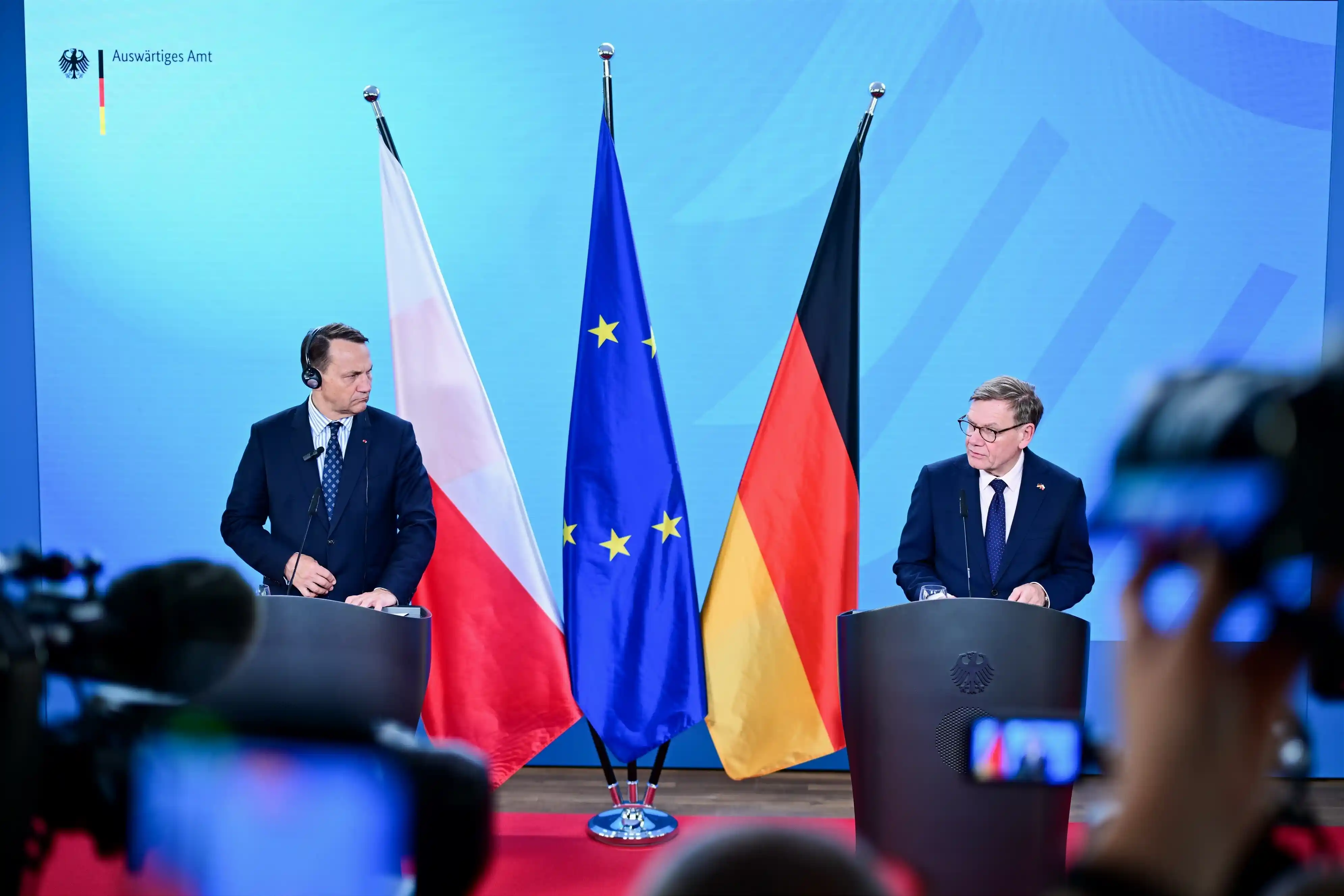
On the occasion of the 35th anniversary of the German-Polish Neighborhood Treaty, Warsaw and Berlin have signed a defense agreement. It reaffirms mutual assistance in the event of an attack and, in its 14 articles, provides for, among other things, joint military exercises in the Baltic Sea, cooperative defense procurement projects, improved interoperability, and cooperation on cybersecurity and combating hybrid threats.
The agreement spells out what has long been clear—that both countries share responsibility for European security, said Foreign Minister Johann Wadephul (CDU) in Berlin. “Together, Germany and Poland form the backbone of European defense and NATO’s deterrence against the Russian threat,” he explained to some 700 guests at the German-Polish Forum in the packed Weltsaal of the Federal Foreign Office. However, according to expert assessments, the agreement does not go beyond obligations that would also be possible under Article 5 of the NATO Treaty or the mutual assistance obligation in Article 42 of the EU Treaty. According to Polish media, however, a more far-reaching agreement modeled on the Polish-French and Polish-British defense pacts recently concluded by the heads of government would have had to be approved by Polish President Karol Nawrocki—which the conservative critic of Germany would likely have refused to do.
At the same time, Germany returned cultural artifacts looted by the Nazis to Poland, including a medieval manuscript of one of Poland’s oldest religious poems and a valuable Jagiellonian ring attributed to Polish King Sigismund I, which had most recently been housed at the Jewelry Museum in Pforzheim. Wadephul also announced the opening of a third Goethe-Institut—following those in Warsaw and Kraków—in Lublin. Given tight budgets and the closure of Goethe-Instituts in other countries, the politician regarded this as a special gesture. "The German-Polish relationship has become a mature friendship," he declared.

Yet despite such praise, both sides openly emphasized that the relationship not only had room for improvement—in areas such as language support and youth exchanges, for example—but also still suffered from certain tensions, some of which were historically rooted. According to Wadephul, the view of Poland is all too often superficial, and sometimes even ignorant. Among the contentious issues are the border controls imposed by Germany to curb migration, compensation for victims of the German occupation during World War II, and the transportation infrastructure between the two countries. For example, trains take at least five hours to cover the 570-kilometer route between Berlin and Warsaw. “This has to go faster,” said Wadephul. “We need a true high-speed rail line between our capitals—one that doesn’t end in Berlin but continues all the way to Paris.” The transportation ministries of both countries plan to discuss this in early July.
Poland's Foreign Minister Radoslav Sikorski expressed particular incomprehension that Germany still controls the German-Polish border, thereby complicating the lives of commuters. "We have done everything to seal the external border. And it is sealed," he told journalists. Wadephul pointed out that the decision to suspend the checks rested with the two interior ministers.
Once again, Sikorski urged the German government to make a gesture of reparations toward the elderly survivors of Nazism—those who were imprisoned in concentration camps or forced into labor. “And this must happen quickly.” Germany’s top diplomat emphasized the ongoing responsibility toward the survivors and announced that discussions with Parliament would take place as part of this year’s budget process. In an interview with Deutsche Welle, Wadephul made it clear that he was, in any case, in favor of compensation.
Among the points of criticism raised in Warsaw is the fact that Poland, as a neighbor of Ukraine, was not recently invited to a meeting in London of the so-called “E3” countries—Germany, France, and the United Kingdom—even though the meeting focused on the conflict in Ukraine and European involvement in resolving it. There were some strange explanations for this, said one of the participants. Poland wants to be an equal partner for Germany, said another participant during the discussions at the all-day forum. Poland, as its former ambassador to Berlin, Janusz Reiter, emphasized, is no longer a country situated between Russia and Germany, but is now part of the West. The former diplomat was awarded the German-Polish Prize in recognition of his role as a “key architect of the German-Polish Neighborhood Treaty” and his lifelong contributions to the development of bilateral relations.
gd
.JPG)