Russia’s Opposition Abroad Is Taking Shape
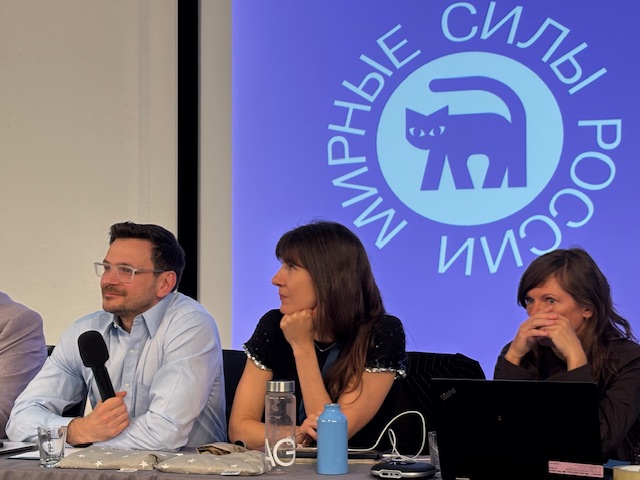
The Russian opposition abroad has founded its first political party. Over the weekend, around 120 delegates in Berlin elected 42-year-old Ilya Yashin, a long-time associate of the murdered opposition politician Alexei Navalny, as the head of the new party "Mirnaya Rossiya" (Peaceful Russia). Yashin was released from prison in Russia about two years ago following a prisoner exchange and left for Germany. It is the party of peace, freedom, and justice, according to a manifesto adopted at the founding congress. Russia’s fundamental interests are best served by good-neighborly relations, respect for human rights and civil liberties, and just relations between the state and its citizens in Russia; by renouncing war as a means of resolving international conflicts such as the one in Ukraine; and, as a matter of principle, by rejecting imperialist policies both domestically and abroad.
“Of course, we want to compete with this party for power in Russia and become a player in international relations,” Yashin explained on the sidelines of the conference, responding to questions from diplo.news, among others. One of its tasks, he said, is to engage in dialogue with the West—to politically represent Russians who oppose the war at all levels. “We want to establish our representatives in the parliaments of European countries, as advisors, experts, or members of joint parliamentary groups.” The goal of this public political work is to inflict tangible damage on Russian President Vladimir Putin and help bring an end to the aggression against Ukraine. However, the party is primarily addressing Russian citizens. “We want to give a voice to those who have been robbed of it,” said the newly elected party chairman.
Yashin acknowledged that it is difficult to operate from Europe and influence public opinion in Russia, because collaborating with the new party poses a risk to the freedom of Russian citizens. But it is not impossible—with the help of the internet, social media, and the many supporters. "I see that the Russian population is war-weary, that they have had enough of injustice and humiliation and the endless accumulation of coffins. What we offer Russia is peace, calm, stability, and justice." The goal is to return to their own country. "Although we were founded outside Russia, we are not an emigrant party; we are a Russian party, we are the party of healthy patriotism," Yashin emphasized.The opposition leader declined to comment further on the party’s funding, stating that it must remain confidential in the interest of its supporters, since the party is, after all, considered an extremist organization in Putin’s eyes. He said they are people from the private sector—not from the commodities industry—who have never before financed political campaigns.
Although Yashin founded the party, his election as party leader was not without controversy; he was elected by a narrow two-thirds majority over a female opponent. Some delegates criticized him, saying that as chairman he might seek to surround himself with hand-picked supporters, thereby undermining the democratic decision-making process. However, the sole chairmanship is to be reviewed after two years. According to Yashin himself, the delegates debated the party’s bylaws for five hours—true to the maxim that bylaw issues are always also questions of power. Many of the participants at the founding congress had previously been active members of Navalny’s organization; others were former lawmakers from Moscow and St. Petersburg, human rights activists, feminists, as well as Russians in exile with no political experience whatsoever. They traveled not only from all over Germany, but also from France, Sweden, the U.S., Hungary, and Switzerland.
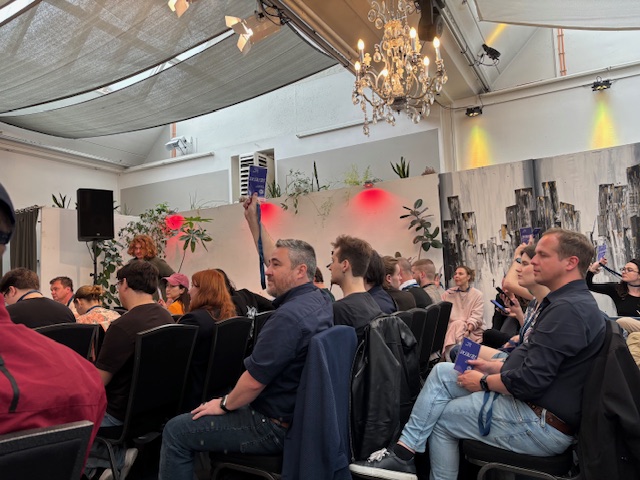
It was not yet clear exactly where the differences in substance lay. But it was clear that they were significant. “I see only people here with different opinions and ‘passionate hearts,’” explained one of the delegates, who described himself as a film director and political activist. “But the opposition doesn’t need internal strife. Our common enemy is Putin. Our strength lies in unity.” The organizing committee for the party's founding often only learned retrospectively what Yashin had done and decided, complained a younger delegate in a personal conversation, describing a kind of generational problem. The working methods of opposition figures in the nineties or early 2000s differed from those of the new generation, he emphasized. From 2001 to 2005, Yashin led the youth organization of "Yabloko," Russia's oldest opposition party, but left the party after power struggles with its chairman, Yegor Yavlinsky.
In an interview with journalists, Yashin himself positioned "Mirnaya Rossiya" in the "democratic center." However, he already perceives very different factions within the party—including social democrats, liberals, Christian democrats, and Greens. Can such diverse groups agree on a common party platform? The party plans to work that out in the coming weeks and months. At least, it already has a logo: it’s a cat—a symbol of a love of freedom and presumably intended as a counterpoint to the symbol of the Kremlin party “Yedinaya Rossiya” (United Russia), which uses the image of a bear to project strength.
gd
.JPG)
.jpg)