Trump is losing the Middle East
By Michael Backfisch
For decades, America’s protective umbrella was considered the ultimate life insurance policy for the Middle East. From Jordan to Qatar to Saudi Arabia, some 50,000 U.S. soldiers were stationed at various bases. There was a two-way security agreement with Washington: The United States supplies weapons and defends Arab countries—as well as Israel—in the event of an attack. In return, these countries purchase military equipment worth many billions of dollars and invest in the U.S. through their sovereign wealth funds. Major oil powers such as Saudi Arabia also agreed to align their energy policies with the needs of the American economy.
In the wake of the Iran war, the absolute trust the Arabs once placed in the defense capabilities of the world's greatest military power is crumbling. Countries around the Persian Gulf had begged U.S. President Donald Trump not to attack the Islamic Republic. But Trump, still intoxicated by the "I can do anything" feeling following the swift abduction of Venezuelan dictator Nicolás Maduro in early January, allowed Israeli Prime Minister Benjamin Netanyahu to talk him into the idea of a blitzkrieg victory against Iran. Get rid of the mullah regime, eliminate Iran's nuclear plans, dismantle its missile program, and neutralize its regional allies—that was the Israeli's deceptive formula.
But Trump came up against a wall with Iran’s resilience. The regime became more radical in the wake of the war. With its back against the wall, it set the region ablaze at will, attacking U.S. military bases, seawater desalination plants, power plants, and airports. By blocking the Strait of Hormuz—a vital waterway for oil trade—Tehran held the global economy hostage. The asymmetric war created a David-versus-Goliath scenario.
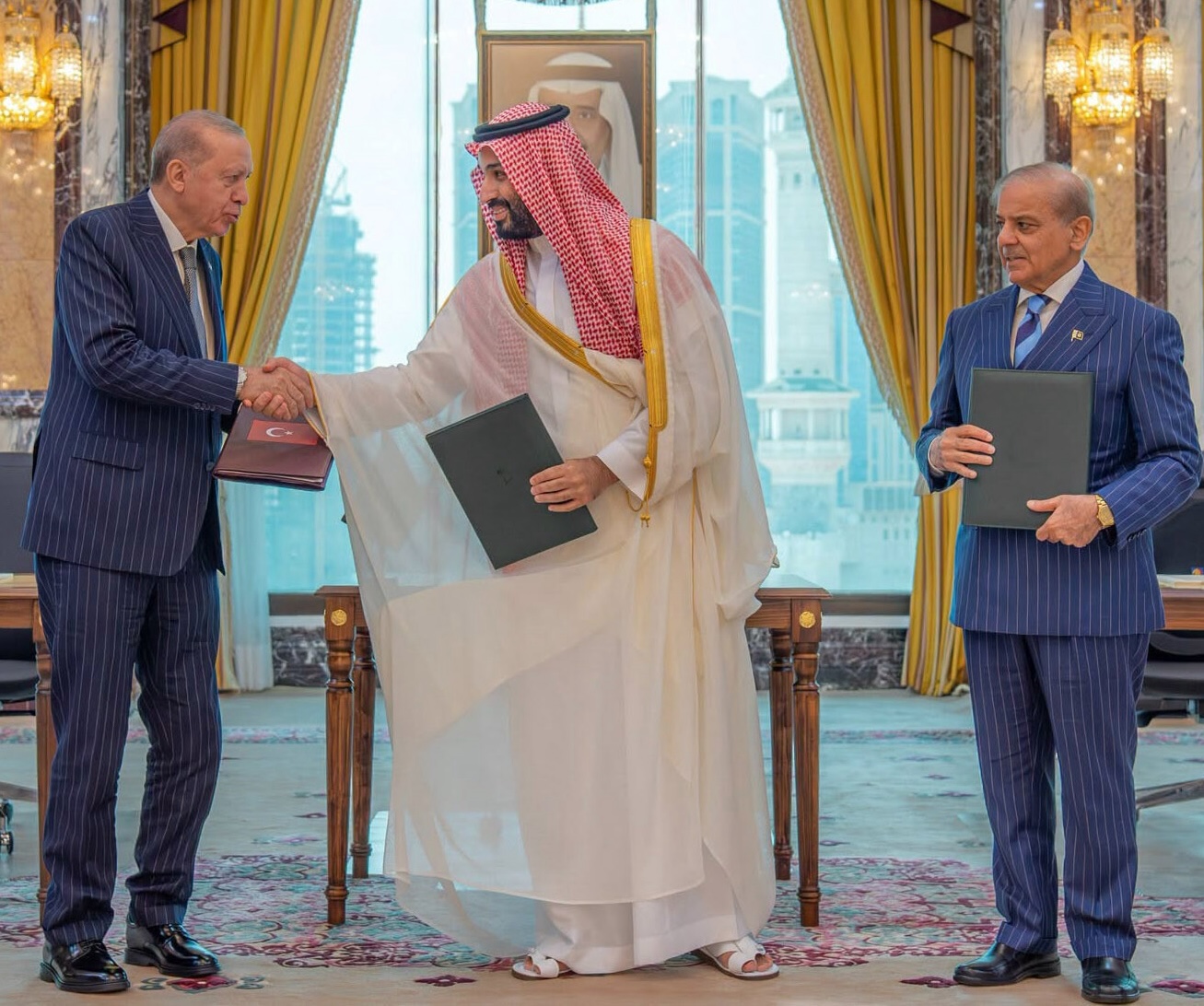
The countries of the Middle East are alarmed for two reasons. America, their supposedly all-powerful ally, has proven to be an unreliable partner in the face of Iran. Furthermore, Trump has plunged the Gulf into even greater instability. Against this backdrop, the defense pact concluded in Mecca between Saudi Arabia, Turkey, and Pakistan marks a new era. It brings together the only G20 economy in the Arab world, NATO’s second-largest army, and the only nuclear power in the Muslim world. The new alliance follows the NATO maxim that an attack on one country is an attack on all. What this means in practice, however, remains to be seen. It is by no means certain that Pakistan would intervene on Saudi Arabia’s side if the Houthi militia—linked to Iran—were to attack oil facilities in the Kingdom. Nor is it certain that the Turks and Saudis would come to the aid of the government in Islamabad if the border conflict between Pakistan and India were to escalate.
The alliance is designed to be more sustainable and sends several signals. To Washington, the message is: The region can no longer rely entirely on America and must take its security into its own hands. To Tehran, the three-way pact is intended to serve as a deterrent. Attacks on targets in the Gulf pose a threat to the economic survival of the region, which depends existentially on the export of oil, gas, fertilizers, and critical raw materials like helium. Iran would therefore have to expect a complex response. To Jerusalem, the alliance aims to make it clear that it is keeping a close watch on Netanyahu's expansive agenda of a "new Middle East order," which includes self-granted rights of intervention in Palestine, Lebanon, Syria, or Iran. With the airstrike on the Hamas diplomatic mission in the Qatari capital of Doha in September 2025, Israel crossed a red line for many in the Middle East. The fact that Turkey, in particular, with its sharp Netanyahu critic Recep Tayyip Erdogan, is part of the three-way agreement is unlikely to please the Israeli Prime Minister.
Saudi Arabia began loosening its ties with the U.S. some time ago. For just under a year, the kingdom has had a bilateral defense agreement with Pakistan, a nuclear power. Pakistani fighter jets and soldiers are stationed in the desert nation. This does not mean that the Middle East is decoupling itself from the United States in terms of security policy—it will continue to purchase American weapons. But it is diversifying. It is seeking new partners and is not shy about reaching out to Russia or China. This is already happening in the economic sphere. America’s absolute dominance in the region is eroding.
.webp)