Farewell to Moscow
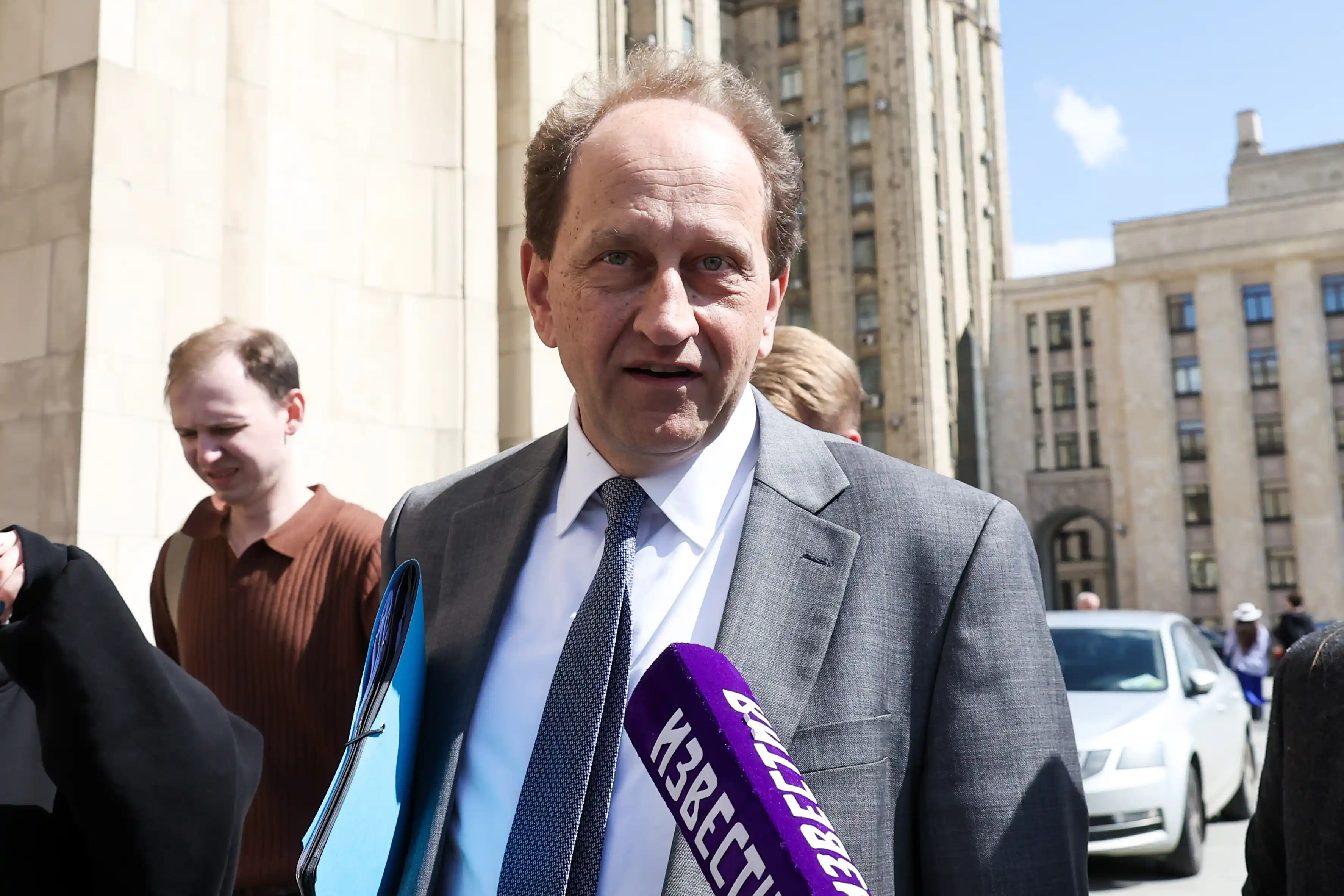
He probably held one of the toughest jobs the Foreign Office had to offer in recent years, and his next one won't be any easier: After three years, Alexander Graf Lambsdorff will soon exchange his ambassadorial post in Moscow for one in Israel. German-Russian relations have now reached an all-time low since the start of the war in Ukraine, in which Germany has sided with Ukraine by providing increasingly substantial financial and military aid. And as an unwavering supporter of Israel – despite the Gaza and Iran wars – Germany faces fierce international criticism. For Lambsdorff, a long-time MEP and FDP member of the Bundestag, Moscow was his first post at the head of a diplomatic mission. As a politician, he was one of the sharpest critics of the Russian invasion.
When he arrived in Moscow, there was hope that the Ukraine war would end during his term in office and that some form of constructive cooperation could be achieved, the 59-year-old explained in an online discussion with the German Council on Foreign Relations (DGAP). Instead, the war is now increasingly affecting Moscow, and Russia is becoming a “single-issue country” in which every political, economic, and social development is influenced by the war. “Every area we’re working on here is connected to the war.” Domestically, political repression is on the rise—although there are still dissidents. But anyone who does not conform must expect persecution.
At the same time, Lambsdorff observes increasing war weariness among the Russian population – apparently also caused by increasingly difficult living conditions. Due to international sanctions and the increasingly frequent Ukrainian attacks—particularly on energy infrastructure—long lines have formed at gas stations; the Black Sea region is becoming less and less attractive as a vacation destination for many, and the Crimean Peninsula is now virtually off the table.
The diplomat, whose ancestors once held high-ranking positions in the Russian government and military, described his dealings with his contacts in the Russian Foreign Ministry as impeccable on both a personal and professional level. However, he says he cannot detect any willingness to engage in serious talks about ending the war in Ukraine.
However, there is always time for diplomacy. The five-point plan agreed upon in London in June between German Chancellor Friedrich Merz, British Prime Minister Keir Starmer, and French President Emmanuel Macron provides a good foundation for this. The plan calls for an immediate ceasefire, no forcible alteration of borders, legally binding security guarantees for Ukraine, a freeze on Russian assets until reparations are paid, and a central role for Europe in the negotiations. Following this so-called E3 summit, a meeting of the ambassadors of these countries took place at the Russian Foreign Ministry, during which, according to Lambsdorff, the five-point plan was also discussed.
Regarding the frequently discussed nuclear threat to the West from Russia, Lambsdorff sees no indications—at least for the time being—of any such plans within the Russian administration. One reason for this could be pressure from China, which fears a high potential for escalation and proliferation resulting from the use of nuclear weapons.
When asked for his personal assessment of Russia, given his own German-Baltic family background, Lambsdorff said: "I like the country and its people, but not its politics." During his tenure, the ambassador was summoned to the Russian Foreign Ministry several times, including over disputes concerning Russian media in Germany and most recently due to a meeting between CDU parliamentarian Roderich Kiesewetter and Chechen separatist Akhmed Zakayev in Kyiv. Moscow considers the latter a terrorist.
Lambsdorff's successor this summer will be 64-year-old Clemens von Götze, a very experienced diplomat with various postings as ambassador, including in Brussels, Israel, Japan, China, and most recently in Mexico.
gd
.webp)