Another turning point
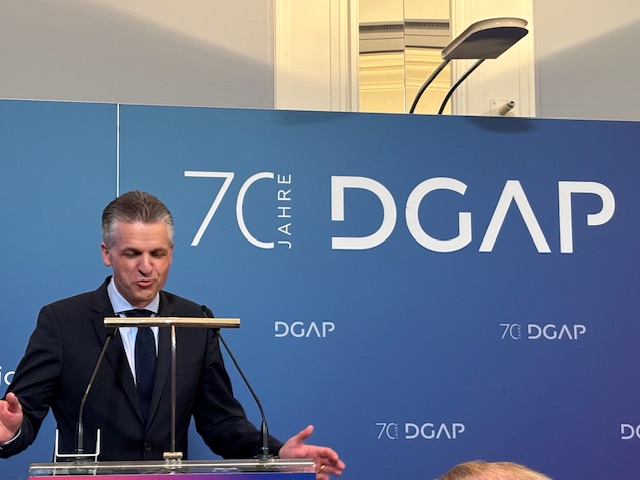
The federal government plans to make a decision by early August at the latest on a reform of Germany’s intelligence services that has been under discussion for years. The relevant legislation is to be submitted by then, and inter-ministerial coordination has begun, explained Thorsten Frei (CDU), Minister in the Chancellor’s Office, on Tuesday evening before the German Council on Foreign Relations in Berlin. The goal is to complete the process in the Bundestag by the end of the year. This involves not only granting more authority to the Federal Office for the Protection of the Constitution (BfV) but also, in particular, to the Federal Intelligence Service (BND), which is to be transformed into a true intelligence agency. According to Frei, this represents a paradigm shift that will enable the BND to operate on an equal footing with its partner services in the future.
In light of increasing hybrid attacks on Germany, including those from Russia, intelligence agencies must be empowered to defend the country effectively. To do so, they need the right tools. In the past, the BND was subjected to such “strict constraints” that, in essence, more lawyers were needed to oversee the agency than agents, engineers, or intelligence analysts. In the future, the BND is to be granted, among other things, greater capabilities for data storage and the use of artificial intelligence. Above all, it should be able to respond with countermeasures to attacks originating, for example, from servers located abroad. Frei called this “to some extent a genuine turning point,” which would have been completely unthinkable five years ago because there would “never, ever” have been approval for it in the Bundestag—and presumably not among the general public either.
“We must mature step by step in our foreign policy,” emphasized the CDU politician, who also serves as the Federal Government’s Commissioner for all three intelligence services (BND, BfV, and MAD). Whether facing hybrid threats or armed conflicts, he said, one must have the will to defend oneself and make it clear to the adversary that one will do whatever it takes. If there were any doubt about this, the adversary would dominate. For example, Russian President Vladimir Putin has always held the upper hand in escalation against the West. Germany must raise the cost for aggressors in the future. However, this also requires a society that embraces this mindset and supports the government’s stance.
A resilient society is equivalent to a weapon, emphasized Jürgen-Joachim von Sandrart, Lieutenant General (ret.) and member of the DGAP's new "Karl Kaiser Forum for Strategic Questions." Sandrart was referring not only to resistance against external threats but also internal ones, such as the AfD and their potential victory in the upcoming state elections in Saxony-Anhalt. "I consider the AfD to be a Trojan horse for Russia." Unconventional deterrence is necessary, for example against disinformation campaigns, through the targeted release of intelligence findings regarding aggressive intentions and methods in order to warn of impending attacks, according to a "White Paper" from the forum, which is intended to serve as a kind of reform workshop or think tank. The forum is co-chaired by former Defense Minister Annegret Kramp-Karrenbauer (CDU) and Saarland’s Minister of Finance and Science Jakob von Weizsäcker (SPD).
In June, Federal Interior Minister Alexander Dobrindt (CSU) inaugurated the Joint Center for Countering Hybrid Threats. It is intended to coordinate the work of existing defense centers against espionage, sabotage, disinformation, proliferation, and state terrorism at both the federal and state levels.
gd
.webp)