Former EU Foreign Policy Chief Borrell: "The principle of unanimity is killing us!"
By Roberto Castaldi, Director of Focus Europe Italy
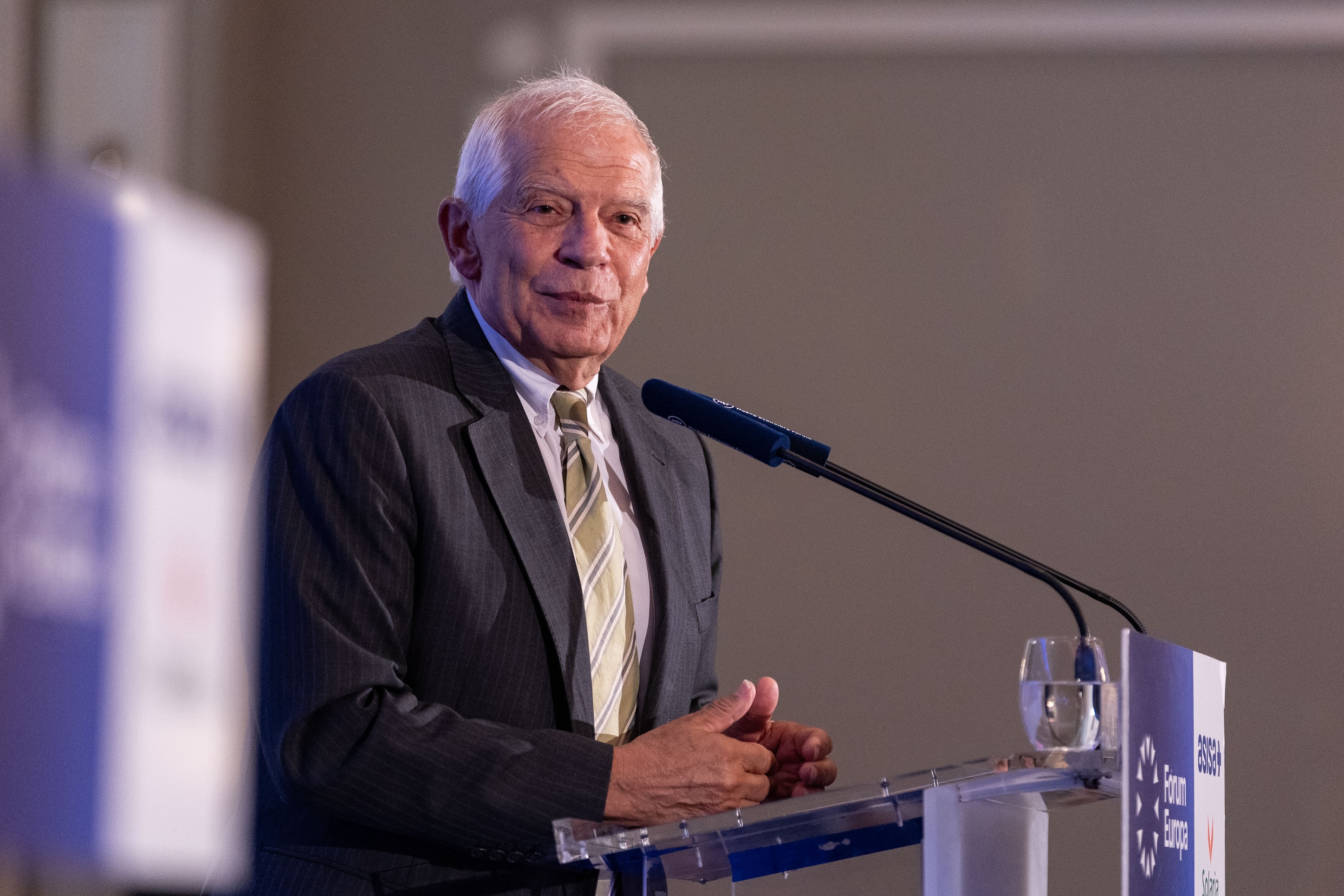
Migration, the war in Ukraine, pressure from Russia, competition from China, the new relationship with Donald Trump’s United States, and the European Union’s difficulty in speaking with one voice. These are some of the challenges that Josep Borrell, former EU High Representative for Foreign Affairs and Security Policy and Vice-President of the Commission, identifies as crucial for the future of Europe. Focus Europe Italia interviewed him in Ventotene, during the seminar ‘Challenges to European Democracy’, organised by the Jean Monnet Centre of Excellence fEUture at eCampus University in collaboration with the Action Committee for a United States of Europe, of which Borrell is High Patron. For the former head of European diplomacy, as well as former President of the European Parliament, one of the main sticking points remains the right of veto: “Unanimity is killing the Union,” he states, arguing that without greater decision-making capacity, the EU is unlikely to be regarded as a genuine geopolitical player.
In the interview, Borrell also identifies three major pressures on Europe: military pressure from Russia, commercial pressure from China and ‘ideological’ pressure from Trump’s United States. Added to these is an internal problem of representation and competences, which is particularly evident in security and defence matters, where the former High Representative takes issue with the growing role assumed by Commission President Ursula von der Leyen.
diplo.news is publishing the full transcript of the interview with the permission of its partner organization, Focus Europe.
What are the biggest challenges for the EU?
There are many. The issue receiving the most media attention is migration, certainly following the images from Ceuta. Migration is one of the most toxic issues that could dissolve the unity of the European Union. It is also a geopolitical issue. It connects us to the rest of the world, from which the migrants come. In the Mediterranean region, migration influences our relations with North Africa and sub-Saharan Africa, as well as with all the countries from which migrants originate.
A second geopolitical issue is defense. Two words come to mind: Ukraine and Trump. The new relationship that the US under Trump wants to have with Europeans is a huge change. In fact, it changes everything. We have lived very comfortably under the American security umbrella until now, which protected us and covered defense spending while we spent our money on social security. Those days are over.
And Russia is attacking us. Mainly in Ukraine, but given the attempted drone attack on Leipzig Airport, European countries are now also under fire. This is very serious. It is as if the Russians were bombing a European country, because sending a drone with a bomb is more or less the same as using an artillery shell.
What is your take on von der Leyen's statement that the EU will respond with determination and unity, and on her meeting with NATO Secretary General Mark Rutte to discuss the EU and NATO's response?
Why is she taking the lead on this? According to the treaties, the Commission President does not represent the EU in matters of defense and foreign policy. When von der Leyen speaks about security and defense, who is she representing? Not the Union, so only the Commission. But the Commission has no mandate in the areas of security and defense. And that is one of the EU's fundamental political problems: no one knows who represents the EU on the world stage when it comes to security and defense. According to the treaties, it should be the President of the European Council and the High Representative. Nevertheless, the Commission President talks about security and defense all day long.
The Commission is the EU's executive branch. In many member states, heads of government also play a major role in foreign and defense policy, even though there are foreign and defense ministers there as well. Can't you compare the two?
The Commission is the executive branch of the EU for its competences, not for the other competences. And security and defence and foreign affairs are not competences of the commission.
You once said: "If you are not at the table, you are on the menu." What does Europe need to do to have a seat at the table and maintain its independence?
Obviously, the EU must be more united, and agree on taking decisions that bind the Union without requiring unanimity. The principle of unanimity is killing the Union. No one views the EU as a geopolitical player because everyone knows full well that decisions require the consent of all 27 member states. When the Commission President speaks, she does not have the consent of the 27, nor does she represent them. The problem is who takes a stand, when, and how. For example, what is the position on the war in the Middle East? There is no EU position! Some member states blame Israel, and rightly so. Others stand behind Israel. Some member states believe that a genocide is taking place there.
Others believe that nothing has happened and that Israel is merely defending itself. There is no EU position, regardless of what a Commission President might say. The same applies to the war in Iran. Spain and others condemn the war. Others support it. The German Chancellor said the Americans would do the dirty work for us. What a diplomatic way to put things! So, is there dirty work that needs to be done? Other member states say this is a violation of international law that we cannot support.
How is the world supposed to perceive the EU as a geopolitical player if we cannot even take a common position on the most important conflicts of our time?
Are we facing resource-driven imperialism on the part of Russia, China, and the U.S.? Is the EU under attack from various sides—militarily by Russia, economically by China, and through a combination of both by the U.S.—tariffs and security threats?
We are under pressure on three fronts. First, we are under military pressure from Russia. What happened at German airfields shows that it is not just about Ukraine. There is military pressure on our borders. Second, we are under strong trade pressure due to China's export capacities. While this is not military pressure, many people believe that China is massively subsidizing its economy to engage in unfair competition.
Third, the ideological pressure from the U.S., which is maybe the most important one. When Vice President Vance says the U.S. would support all far-right parties in Europe, and when Trump believes that Europe is no longer an ally, this creates ideological pressure because Europe embodies precisely what Trump and his team hate most: democracy, freedom, and human rights. (The German-American tech billionaire, ed.) Peter Thiel and the ideologues of Trumpism claim that democracy and freedom are incompatible, that the two cannot coexist. Yet we have preached and lived by exactly the opposite: that democracy is the expression of freedom. So that is the most significant pressure we face: the ideological one.
We need more integration to cope with all these pressures.
Many analysts believe that nothing will happen due to the weakness of too many national governments facing elections. Will the 2027 election cycle effectively determine Europe’s future?
Certainly! Just consider that the next presidential election in France could bring a far-right president to power, that Alternative for Germany could become the party with the most votes, and—something that was unimaginable just a few years ago—could even form the government in Germany. What will become of European integration then? What will happen to the idea of Europe? And this doesn’t just apply to Germany and France. Until yesterday, this was the case in Hungary. Europe is very much shaped by election cycles. It’s concerning that the far right, which is not pro-European, looks like having a lot of support.
Therefore, migration can be a major factor weakening the EU. Following the events in Ceuta, 22 member states—led by Giorgia Meloni, a far-right head of government—wrote a letter blaming the Spanish government, using exactly the same language that Trump used:it is the fault of the Spanish government because they have a migration policy which is dangerous for us. Instead of supporting a country facing a hybrid attack, they blame it. Even the Commission was silent at the beginning and was quite reluctant to support the Spanish government.
We are unable to support a member state when it faces a problem—perhaps not an invasion, but a serious incident, a disaster, or a hybrid attack. There was no unity regarding the defense of the EU's external borders, which is exactly what Spain was doing. These 22 governments did not even seem to know that Ceuta is not part of the Schengen Area. Was there not a single advisor or cabinet member among 22 member states who pointed that out? I find that hard to believe. If they knew and wrote the letter anyway, that is even more disturbing.
In Germany, the leaders of the CDU and SPD are calling on the “Ursula majority” to sign a formal coalition agreement, and the European People’s Party (EPP) to avoid cooperating with nationalist parties. What are your thoughts on this?
The current Commission was elected by the European Parliament, by a centre-left coalition of popular, liberal, social democrat and green parties. This parliamentary majority elected von der Leyen on the proposal of the European Council. And now European laws are being approved by another coalition by the EPP and the far right. Only the Commission can propose legislation, and it knows who is going to support it or not. So don’t blame just the EPP for doing a coalition with the far-right. At the beginning nobody could consider a vote putting together the EPP and the far right. Now it has happened after all—and not on a minor issue, but on migration and asylum policy, which is a very important issue in Europe today.
What about Spain and the 2027 elections? Do you think the (conservative) People’s Party (Partido Popular, PP—Ed.) and the Socialists might abstain from voting to allow the other side to form a minority government if neither party secures a majority, thereby preventing the other side from being forced to ally with nationalist forces?
This has already happened in Spain in the past. The Socialist Party abstained to allow the PP to form a government. This led to the resignation of Pedro Sánchez, who disagreed with this stance. The Socialists were quite disappointed because they had handed the PP the opportunity to form a government for nothing.
Unfortunately, the stance of the People's Party in Spain is very confrontational. It is leaning to the right and moving closer to the positions of Vox. They are fighting for votes from the same electoral base.
There has never been a grand coalition in Spain modeled after the German system. Perhaps there will be one in the future. So far, it has only happened that the Spanish Socialists have abstained in favor of the People's Party forming a government. The reverse has never happened.
Do you think an alliance between Vox (the right-wing populist party) and the People's Party is possible, or do you believe the Socialists will ultimately abstain from voting to prevent it?
They already did once. It will depend a lot of the circumstances. If this would be the case, they could have done that on the regional elections. The socialists lost the last regional elections and in none of these cases they let the PP government alone. Nor did they offer the possibility to the PP to look for a kind of agreement. And maybe the PP would have refused it, but the proposal was never on the table. In important regions, like Andalusia the PP had to make a pact with Vox in order to get the majority. And the same thing happened in other communities. The position of the socialist party was let the PP govern with Vox. We are not going to support them not even by abstaining.
Isn’t it a contradiction when pro-European parties pressure another party to form an alliance—out of necessity—with (Europe-skeptic, ed.) nationalists?
Yes. But there is a Spanish particularity: the confrontation between the right and the left has deep roots that come from the civil war. This happened in Spain and maybe nowhere else. Germans accept the grand coalition of the right and the left. In Spain it’s difficult. It is also a matter of the current situation, which I don’t like. The polarization is increasing and it looks like being impossible to reach any kind of agreement on almost anything. The politics in the EU is much less confrontational and looks more for a common ground among different parties.