International Reactions to the Election in Saxony-Anhalt
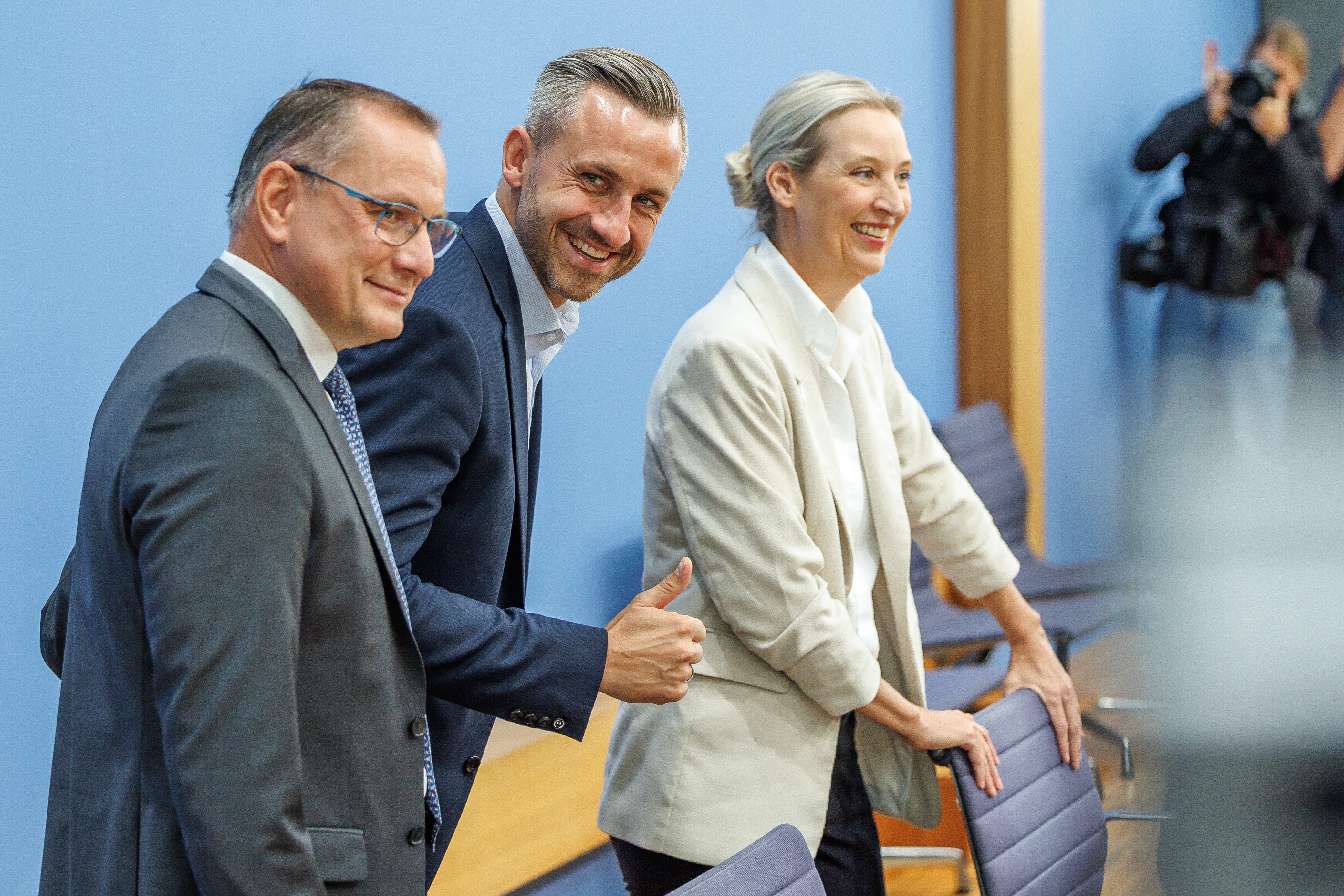
In Sunday’s election in Saxony-Anhalt, the AfD doubled its share of the vote to 43.8 percent; the CDU was the clear loser, with 17.2 percent. Also represented in the state parliament in Magdeburg are the SPD (9.3 percent), the Greens (8.9 percent), The Left (8.6 percent), and the BSW with 5.3 percent. The AfD and its lead candidate, Ulrich Siegmund, thus fall short of the absolute majority of 42 seats and are dependent on the votes of other parties. The CDU, SPD, Greens, and The Left rule out cooperation, but they themselves do not have a majority either. The election in eastern Germany attracted an enormous amount of attention—even abroad—for a state election. For the first time in the postwar era, a party classified as far-right by the Office for the Protection of the Constitution has the theoretical and practical opportunity to govern.
Mixed Reactions in the Right-Wing Camp
U.S. President Donald Trump quickly posted one of the first projections on his Truth Social account without comment. Herbert Kickl, leader of the Freedom Party of Austria (FPÖ), congratulated Siegmund via Instagram, describing the result as a "historic success" and stating that the voters had decided against the "firewall."
Also, former Hungarian Prime Minister Viktor Orbán celebrated on X, writing: "A great evening for Germany and Europe" and "Buckle up. This is just the beginning!"
Santiago Abascal, leader of the right-wing populist VOX party from Spain, posted on X: "Heartfelt congratulations to Alice Weidel and Ulrich Siegmund on this spectacular result, which brings great hope for Germany and Europe."
André Ventura of Portugal's Chega party commented on his X account: "The AfD has achieved a historic victory in the state of Saxony-Anhalt today."
Marine Le Pen of France's Rassemblement National and Italian Prime Minister Giorgia Meloni remained silent until Monday afternoon. Meloni generally describes herself as national-conservative, while others classify her party, Fratelli d'Italia, as post-fascist or far-right. Her coalition is divided: while Matteo Salvini of the Lega has congratulated the AfD, Foreign Minister Antonio Tajani of Forza Italia called the election result "extremely bad news."
Le Monde (France)
The center-left daily newspaper views the result as a defeat for Chancellor Merz. "The highly unpopular CDU leader made only one hesitant appearance in Saxony-Anhalt during the campaign, as his visit was deemed counterproductive by regional party officials. ...From this perspective, the shock triggered by tonight’s results could reignite debates about a possible change in the chancellor’s position,” writes Le Monde.
Neue Zürcher Zeitung (Switzerland)
"The pendulum in Saxony-Anhalt didn't just swing to the right; it swept past the center," comments the NZZ. Voters, it notes, have opted for a "fundamental change in policy." From the NZZ's perspective, a government coalition of the CDU, SPD, Greens, and the Left would be legitimate but difficult, and could ultimately strengthen the AfD. "The election result forces the parties to weigh up poor solutions." However, neither Saxony-Anhalt nor the Federal Republic would fall into a state crisis in the event of a long government formation process, as the current government can continue to govern.
Polskieradio24 (Poland)
The radio station is already calling it a "litmus test for democracy" before the final election results are even in. The outlet's guests are speculating about the potential impact on the Polish right and the European political landscape. They argue that the AfD's pro-Russian stance poses a threat to Poland and the region. The radio station cites Łukasz Grajewski, an employee at the Polish Embassy in Berlin and author of the book "Alternative for Germany or Threat to the World?", who gave an interview to WDR just a few days ago: "The AfD is a threat to the post-war order in Germany. This party wants something completely different from what we have in Germany today. These elections are about more than just marking a ballot."
Polish Prime Minister Donald Tusk commented on the reactions in his own country to the election victory on X that evening: "In Poland, only idiots or traitors could be happy about the AfD's triumph in Germany. There are quite a few of them in the Confederation and PiS."
New York Times (U.S.)
"The victory of the far-right in a German state sends a signal to Europe." The influential liberal U.S. outlet covered the election night with a live blog on its website. The result is part of a series of election outcomes in Europe where far-right extremists are winning. "In Germany, rising prices and high unemployment helped the far-right party receive more than twice as many votes as the center-right party of Chancellor Friedrich Merz," the newspaper notes. "Nevertheless, the result could cause problems for Mr. Merz if members of his party blame him for the defeat." A weakened Chancellor would diminish Europe's capabilities.
El País (Spain)
The daily newspaper focuses on the problems facing the federal government. While the SPD managed to get through the election with stable results, the Union is in crisis. "Chancellor Friedrich Merz didn't even take part in the campaign because he was so unpopular, not just in Saxony-Anhalt, but across the entire country," the paper wrote.
Haaretz (Israel)
The government-critical daily newspaper Haaretz primarily reflects Jewish voices from Germany in its English-language online edition. "I find it hard to recognize my home anymore," the paper quotes Charlotte Knobloch, President of the Jewish Community of Munich and Upper Bavaria. Josef Schuster, President of the Central Council of Jews in Germany, said he was "personally appalled by this election result." Ron Prosor, Israel's ambassador to Germany, described the result as "a flashing red warning light – not just for Germany, but for everyone who cares about Jewish life in Germany." In his view, political parties should not only refuse to cooperate with the AfD, but also with the party Die Linke.
These comments were compiled by Lars Beier (lab).
.webp)

%20(1).webp)