What Magdeburg Wants to Prevent, Berlin May Soon Face
Column by Milán Dóka
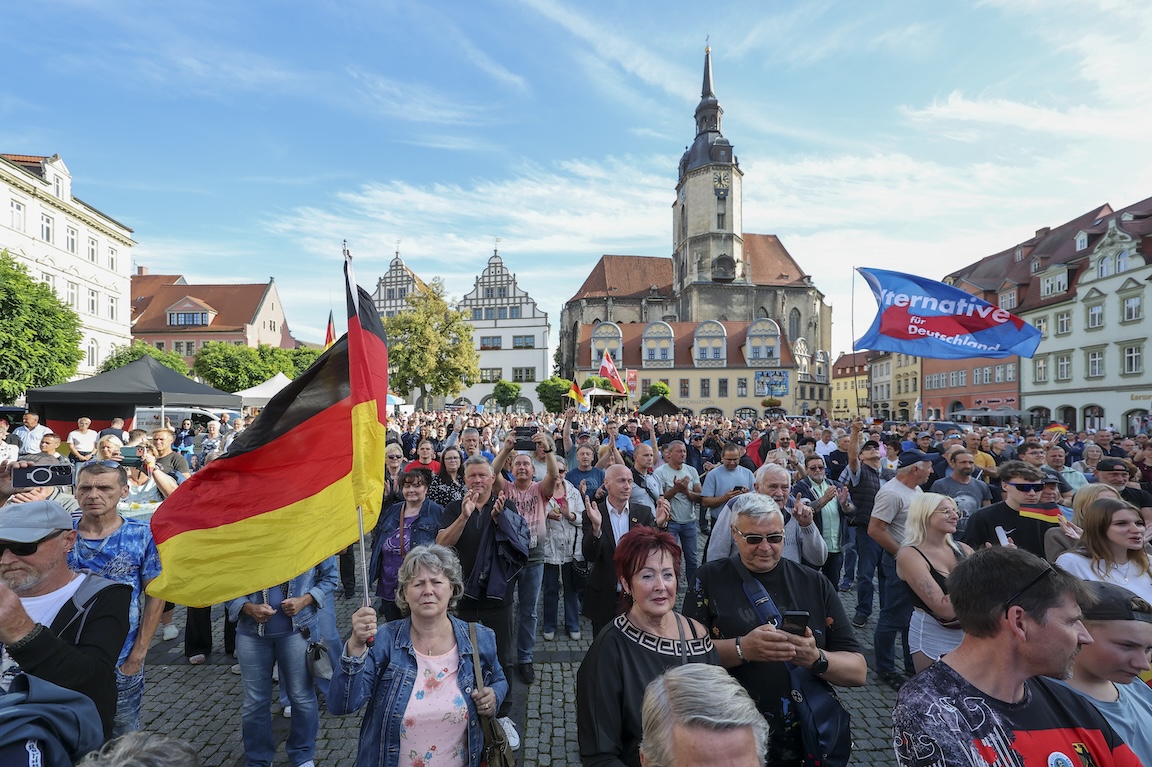
Will the dam break—and will the far-right AfD be able to form a state government for the first time? To put it with a slight exaggeration, this question is currently on the minds of the public far beyond Germany’s borders. And it is precisely this scenario that all other parties are trying to prevent with every means at their disposal. The CDU, which has governed Saxony-Anhalt until now and has now slipped to second place, laid the foundation for the much-cited “firewall” at its 2018 party convention, when it ruled out any cooperation not only with the AfD but also with The Left. According to the latest poll by Forschungsgruppe Wahlen (AfD 41%, CDU 23%, The Left 11.5%, SPD 8.5%, Greens 6%), continuing to govern would thus be impossible. Without The Left, however, it would be impossible to prevent the AfD from taking power: the votes of left-wing lawmakers would also be necessary, at least for the formation and functioning of a minority government.
But would this worst-case scenario really be the best solution for the CDU—and, beyond that, for Germany?
The AfD has long since ceased to be the strongest party only in the east; it is now the strongest party nationwide, and there is currently no sign that this trend will reverse. One of the main reasons for this is that, free from the burden of governing, it can constantly create new scapegoats and blame those in power for people’s problems without having to offer any real, viable solutions itself. The more uncertain the international situation becomes—and the more difficult the economic situation becomes as a result—the more appealing populism becomes.
As a Hungarian journalist, I have seen firsthand how Viktor Orbán’s system perfected this principle—and how Alice Weidel and her party are trying to learn from it today. However, there is a crucial difference between Fidesz and the AfD. Orbán secured a two-thirds majority on the ruins of an economic and political crisis and—as one of his first steps—changed the electoral law to begin building a (one-)party state and systematically co-opting the country. Germany’s proportional representation system and strong democratic institutions make such a development virtually impossible for the AfD or any other extremist party.
The trend is dangerous nonetheless. It is all the more difficult for me to understand why representatives of the political center believe that support for the far right will decline if the AfD is kept out of power at any cost. So far, the opposite seems to be the case. Those who are already predicting doom—should Ulrich Siegmund become the next Minister-President of Saxony-Anhalt—are overlooking one thing: If the other parties continue to try by any means necessary to prevent what may be inevitable in Magdeburg, that very strategy could eventually backfire on them in Berlin.
This cannot be a long-term response to voter dissatisfaction. If, on the other hand, the far right assumes governing responsibility in the country, this could eventually lead to its disillusionment. Then there will be no one left to blame solely: If, even as the ruling party, it fails to find solutions to people’s problems—just as it has so far failed to offer viable answers—a phase of disillusionment may begin. That is exactly what happened in Orbán’s system: in the end, there was no state propaganda machine left that could have suppressed this disillusionment. As a constructive opposition, the CDU, SPD, Greens, and Left Party would simultaneously have the opportunity to point out every government mistake and hold Siegmund accountable for every campaign promise he fails to keep.
Of course, it is often argued that an anti-democratic party can dismantle democratic institutions once it gains power. But honestly: what damage could an AfD government in Saxony-Anhalt cause that could not be undone later? If even Fidesz’s rule with a two-thirds majority in parliament, 16 years of time, and an electoral law tailored to its own needs was not permanent, why should we assume that an AfD governing in a German state with a simple majority or even as a minority government could irreversibly dismantle the democratic system? Even the AfD would hardly be in a position to establish a permanent dictatorship from Magdeburg and subsequently take over the entire federal system.
And I believe you could hardly give the AfD a better campaign issue than keeping them out of power with the help of the Left Party, of all parties. An AfD that eagerly exacerbates every conflict within a CDU-Left Party coalition while remaining excluded from power could continue to grow—not only in Saxony-Anhalt but also at the federal level. And if one day it becomes so strong that, even with the “firewall” in place, it becomes nearly impossible to form parliamentary majorities capable of governing in Germany, then there will indeed be cause for concern about German democracy.