The Crusade of Christian Nationalists
Interview by Gudrun Dometeit
In your recently published book “With God Against Democracy,” you write that Christian nationalism is one of the most dangerous ideologies in the world. What exactly do you mean by this term and what makes it so dangerous from your point of view?
It becomes dangerous when this ideology aligns itself with executive power, such as that currently held by the White House. Christian nationalism is the religious exaggeration of one's own country, one's own nation. While this has always existed in the U.S.—think “God’s own country”—the movement has radicalized in recent years. In the past, it at least still respected the rules of democracy. Now, however, it is linking its fantasies of omnipotence to someone who does not want his power to be constrained by the rule of law, the separation of powers, and checks and balances. A system-disruptor in the White House has aligned himself with a religious ideology—that is the new dimension of Donald Trump and his MAGA movement.
Is the U.S. setting the tone for a global trend?
In fact, in large parts of the world, we see how religions have become politicized or, conversely, how political ideologies have taken on a religious dimension. And this always comes at the expense of democratic principles. We see this in the connection between the Russian Orthodox Church and Putin’s dictatorship, or more recently in Viktor Orbán’s illiberal democracy. Religious extremists are a powerful anti-democratic force within the Israeli government. Hindu nationalism, political Islam—all of this is part of this trend. Unlike the sociologist Hartmut Rosa, who said that democracy needs religion, I say: Religion needs to be tamed by democracy. Otherwise, it tends to treat its values as absolute and to impose its concept of truth even in the face of resistance.
Isn’t the radicalization of Christian nationalism in the U.S. somewhat surprising, considering that religiosity, missionary zeal, and the ruthless pursuit of national interests are, so to speak, part of its DNA? Quite a few politicians, including U.S. presidents, have come from the preaching community. Have we simply always underestimated the religious background in this high-tech country?
The United States was founded by people, some of whom were deeply religious, whose ancestors had fled Europe because of their religious beliefs. Their historical background led them to realize that the United States would quickly descend into civil war if the various religious groups were to fight over political power. The separation of church and state was thus not a secular invention, but a self-imposed restriction by people—some of whom were deeply devout—who understood the destructive forces of power and religion. This principle was still respected under Ronald Reagan in the 1980s. At that time, a politically tightly organized religious right had already allied itself with a president who used this group as a power base. Reagan, however, did not fundamentally challenge the limits of the Constitution. As a result, Christian nationalists look back on a century in which they lost almost all the culture wars they instigated under democratic conditions—because their goals simply could not win majority support. Now, this minority relies solely on power and no longer on majorities.

Is it really a minority? How powerful should we imagine this movement to be?
In fact, it is a rapidly shrinking minority. Among evangelicals, the same trend is evident as among the so-called mainline Protestants—that is, Lutherans, Methodists, Anglicans, and others—who have embraced modernity, as well as among Catholics. Evangelicals still make up about 15 percent of the population today—compared to 25 percent about 15 years ago. They form the hard core of the religious right. Unlike other churches, they are very well organized and have a strong ability to mobilize. When they pledge support for a presidential or Senate candidate, they reach a completely different audience.
Trump is associated with all sorts of things but certainly not religious morals. Why, of all people, is the religious right backing him?
In 2016, he was still a makeshift solution; he was seen as the lesser of two evils. The leaders of the religious right handed Trump their wish list, and he—who didn’t really have an agenda of his own—promised to work through it. He delivered on some of it, most notably the new conservative majorities on the Supreme Court. In the 2023–24 primaries, Florida Governor Ron DeSantis—a model student of the evangelical nationalists—presented himself in a video as the result of the eighth day of creation. Trump, on the other hand, campaigned with the promise “I am your retribution.” This was the transformation from class nerd to system-breaker—that is, into someone who was supposed to channel the anger that had built up against an increasingly liberal society into political executive power. The goal is to turn the wheel of history back much further than any other Republican presidential candidate could have achieved.
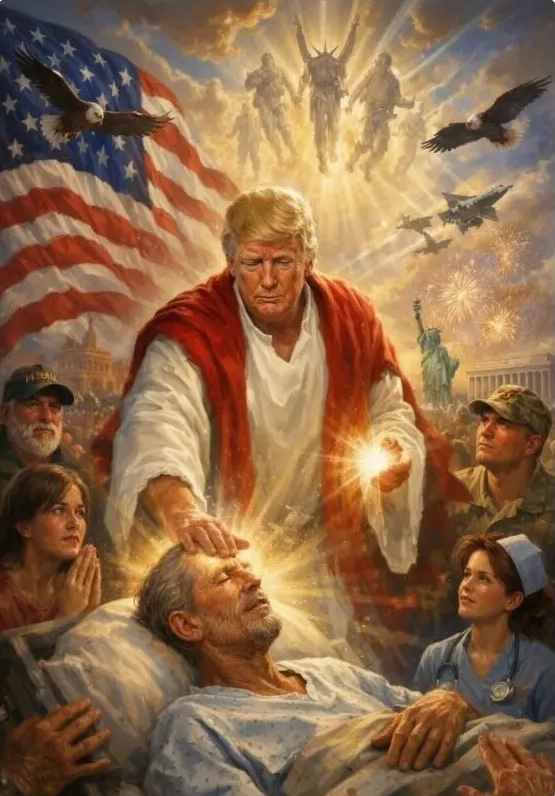
Meanwhile, as recent posts featuring Jesus-like depictions suggest, Trump apparently sees himself as a savior or healer. Does he really believe that, or is this the work of a gifted showman?
When Trump was elected in 2016, people felt compelled to interpret it in some sort of theological way. They found in the Old Testament the example of Cyrus, the Persian king who freed the people of Israel from Babylonian captivity, and came up with the idea that God sometimes chooses non-religious people to do good for the devout. From that moment on, Trump was able to be who he is. They have not even tried to convert him anymore, but have glorified him as the divine messenger who works through the agenda of the devout. This fit perfectly with Trump’s narcissistic personality. He was even supposed to stay just as he is, because he needed that brute force to implement after the 2025 election what the strategists had laid out in “Project 2025.” This will ideologically shift society further and further toward the worldview of Christian nationalists and create an authoritarian, and in some places even totalitarian, state. Meanwhile, Trump apparently can no longer distinguish between a messenger of God and the Savior himself, just as he has otherwise lost all sense of proportion and is losing touch with his supporters. The atrocities during the deportations of migrants were allowed to slide. But now that he is styling himself as the Messiah, a firestorm has erupted in the religious community, one he has obviously completely underestimated.
Trump had initially distanced himself from the conservative Heritage Foundation's “Project 2025". However, you write that over 50 percent of the proposals have now been implemented. So is it a clear roadmap after all?
Behind all the executive orders Trump has signed are people like Deputy Chief of Staff Stephen Miller and White House Budget Director Russell Vought, who helped draft the plan in meticulous detail and is now implementing it with precision. This includes the dismantling of government agencies, but above all the control of funds. Once Congress has approved the budget, it is solely in the hands of the White House, and the Director of the Office of Management and Budget can use the fine print of funding guidelines to support certain initiatives or hinder others. This is most evident in the education system, where the dismantling of the public system is achieved through the withdrawal of federal funds, while parallel structures such as Christian private schools and homeschooling are financially supported. In the long run, this will change society more than many other factors.
Who are the main proponents of Christian nationalism within the U.S. government? Secretary of War Pete Hegseth, who got crusader symbols tattooed on his body? And what exactly is on their agenda?
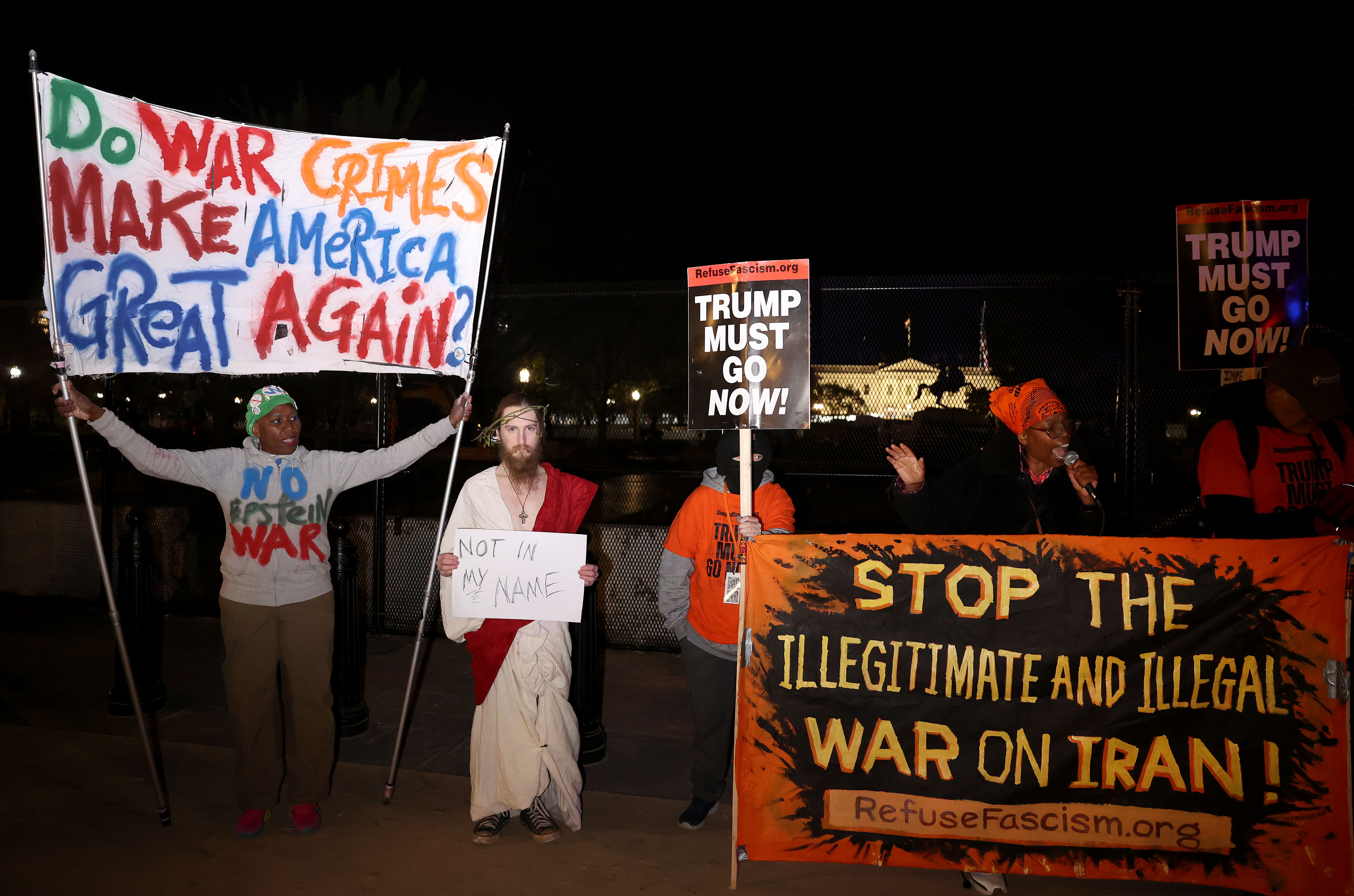
It is a balanced system of power consisting of an effective technocrat like Vought, who describes himself as a Christian nationalist, a brutal system-breaker like Miller, who is responsible for migration policy and the security apparatus, and a poster boy like Pete Hegseth, who commands three million soldiersand, in the name of the fight against wokeness, is reshaping the U.S. Army into a white, masculine army with a Christian ideology. The staging of the war against Iran as a religious war is being carried out on a massive scale by the Pentagon.
Hegseth belongs to a theocratically oriented network of Calvinist churches that want to reshape the U.S. into a society modeled on the Bible. The story of creation is linked to the claim that all orders and hierarchies were thereby established once and for all: the order of some peoples over others, the order of some races over others, the order of men over women, and clear hierarchies within families. This is how slavery and racial segregation were justified. Christian private schools and homeschooling were promoted so that children and young people would no longer be exposed to the theory of evolution. This scientific worldview is opposed because it challenges such eternal orders and is open to future changes.

So is historical revisionism a key feature of Christian nationalism?
Especially now, on the 250th anniversary of the United States, this is a crucial factor. Last year, a clear directive was issued to major foundations and museums to remove anything from their exhibitions that might tarnish the image of a glorious, shining history. In the military, Hegseth is ensuring that the role of the Confederate Southerners can once again be glorified, while anything that reminds us of the role of minorities and Black people in the army is being erased. At the same time, there is a rehabilitation of slavery taking place, for example within the church denomination to which Hegseth belongs. It is not denied, but it is pointed out that it existed as far back as biblical times and allegedly had its good sides as well. At the same time, Trump and Hegseth use threats of annihilation and vows of vengeance from the Bible to give the war against Iran a religious charge. This “biblicalism” combines in a devastating way with historical revisionism.
The theory of evolution has been the subject of repeated battles in the U.S., yet its opponents have never managed to prevail. Is there any resistance to the recent radicalization? What about the famous checks and balances?
In the past, the Supreme Court has usually set the limits. The country was always divided between the Blue States, the democratic coastal states with their metropolises, and the conservative Red States in the interior. The Supreme Court did not overturn the last laws criminalizing the teaching of evolution in the classroom until 1967. In 1987, it declared that teaching creationism in biology classes violated the separation of church and state. That was the moment when the movement of Christian private schools emerged, massively supported by the televangelists of the time. In the state-financed sector, the separation of state and church continues to apply. However, the conservative majority on the Supreme Court now argues that the states should decide for themselves. This has once again thrown open the floodgates to a competition among Republican states and governors to see who can most decisively tear down the separation of church and state.
But the subordination of women, for example — is that even realistic in a country where more women are in key positions of politics and business than in Europe?
At least half of the population lives in rural and small town areas. There is a shift in progress that is not visible in New York or Chicago, but is building up massive pressure in small and medium-sized cities. This includes the so-called “Trad Wives,” who spread an ultra-conservative image of women’s roles on social media. But the murdered conservative activist Charlie Kirk and his wife also propagated backward-looking family values at colleges in the heartland. The Tea Party, from which the MAGA movement evolved, had already specifically run candidates for local school boards in order to influence curricula or the selection of books in libraries in line with their views.
What role does Christian nationalism play in foreign policy and in particular in the war with Iran?
I can't remember any war that was justified as little rationally as this one. This is not only due to Trump's personality. No one has yet attempted to articulate coherent reasons, goals, or means. From day one, the war was staged in a religiously influenced way, as a struggle between good and evil. Before the war, Hegseth appeared at the National Prayer Breakfast virtually as a preacher and not as a minister, promising eternal life to all who “die for their unit, their country, and their Creator.” As far as I know, such overstepping of boundaries did not occur under previous Republican administrations. In this apocalyptically charged rhetoric, commanders are now also telling their units that they are part of the end-time battle of Armageddon and that the return of the Messiah is at stake. In other words, they are framing themselves as engaged in a holy war against Iran.
Does Israel and its involvement in this war play a special role in this context? After all, there is a widespread view among evangelicals that the founding of the State of Israel is part of a divine plan.
Within the MAGA movement, there have always been underlying tensions between two currents. On the one hand, there are over ten million Christian Zionists who, in addition to their own nationalism, always had a particular focus on Israel and believe that the end-time conflicts will take place in the Holy Land. In this worldview, the aim is not to create stability or to organize peaceful coexistence between Jews and their neighbors, rather, to put it bluntly, the prevailing idea is: The more chaos there is, the closer we get to the Messiah. This camp has already exerted massive pressure on previous presidents to attack Iran—as the realm of evil—alongside Israel. On the other hand, Trump was elected with the clear message that he would end all wars and not start any new ones. In doing so, he appealed to a group that is at least as large but is not interventionist, rather isolationist in orientation. The “America First” movement has its roots in opposition to the US joining the anti-Hitler coalition in World War II. This was a very Nazi-friendly, deeply anti-Semitic movement that presented itself as pacifist. Today, this includes influential figures like Tucker Carlson, but also open Holocaust deniers like Nick Fuentes. These tensions are now coming to a head with this war.
What should the world prepare for? The exploitation of the powerful U.S. military for more “holy wars”? At least some officers seem to be resisting this.
There are strong resilience forces in all areas, including the military. In recent months, many admirals, generals, and other top officers who openly disagreed have been replaced. There was massive opposition at the decision-making level to the selection of war goals in Iran and to Trump's announcement to destroy Iran as a civilization. Many former top generals are making it clear publicly: The military’s oath is to the Constitution, not to individual presidents—and certainly not to an overreaching president who disregards the Constitution.
Is proselytizing in Europe part of the ideology of Christian nationalism? How strong are the networks there?
There has always been an international network of nationalists. Even back in the Reagan times, televangelists were investing the massive profits from their satellite churches into building evangelical structures in Brazil. Former President Jair Bolsonaro is essentially a classic product of this strategic work from the 1980s. The anti-gay law in Uganda, which also provides for the death penalty under certain circumstances, has been massively influenced by Christian nationalists from the USA. In Europe, there are natural allies, for example, in the Russian Orthodox Church or among Polish National Catholics.
And in Germany?
I don't think they will try to build a MAGA movement in Germany, but they will promote victim narratives that give the impression that the true defenders of freedom of speech and religion are groups like the AfD or other far-right parties in Europe, which they must support ideologically and financially. Next week, a major event on alleged “persecution of Christians in Germany” will take place in Bremen. The organizer is the “Alliance Defending Freedom,” a classic religious right-wing organization in the U.S. with a strong branch in Europe. So what we are seeing is a self-victimization campaign by forces that claim to be persecuted by a secular state—organized by an American organization that has built up a structure in Europe, using millions of euros, that combines lobbying and media work with legal aid.
Is there a religious group within Germany that such organizations are trying to align themselves with? After all, there are also ultra-conservative splinter groups within the Catholic Church.
The AfD’s election platform for Saxony-Anhalt calls for the complete elimination of state subsidies for the major churches and, in their place, support for free churches and fringe religious groups. Major free church groups, such as the Baptists, have strongly distanced themselves from this. This shows that it is not at all easy to build a following here. But even pastors of very small free churches can be stylized as heroes of freedom of speech and religion with the right support, if they lend themselves to a narrative of victimhood. This is enough to delegitimize the rule of law, the major churches, and a society that draws boundaries against hate and incitement.
Is the USA on the path to a theocracy?
If the leaders of the radical wing of Christian nationalists have their way, yes. But there is also a positive scenario: through their radicalization, they have essentially severed all ties with the majority of society, including the moderate conservative segment. This is evident in the reactions to the brutal actions of U.S. Immigration and Customs Enforcement (ICE) and the Border Patrol. And presumably, if the midterm elections in November proceed freely, there will once again be a somewhat better-functioning separation of powers. If Congress is once again led by Democrats, instruments of checks and balances can also take effect again. At the moment, I look to the future with much more hope than I did six months ago. There are strong forces of resilience within the courts, in civil society, and in the federal structures of the U.S. that I had not expected to see with such clarity.
Especially in Germany, we tend to attribute all the evil to Trump himself. But isn’t it the case that the trends you yourself have described persist because they are much more deeply rooted? Couldn’t the Christian nationalist movement simply find another figurehead or another compliant enforcer?
Over the past century, there have always been periods when the religious right was at the height of its power, only to later sink into self-pity, internal strife, and resignation. For me, therefore, there is much to suggest that after Trump, the majority of society—which has likely become even more secular—will work together with the mainline churches to ensure that alliances like the one that led to Trump’s election in 2024 are not repeated anytime soon. Furthermore, there is no crown prince for Trump. J. D. Vance has become unpopular within his own movement; his criticism of the Iran War has severely damaged his standing in the inner circle. Secretary of State Marco Rubio, who presents himself as an interventionist, also lacks a message that would resonate with the MAGA crowd. Therefore, I currently see no strong successor on the horizon who could move the movement forward with less personality cult and irrationality. However, the conservative majority on the Supreme Court will remain in place for another generation. We must always reckon with the religious right, even here in Europe. It will always have a certain political influence, including through its economic resources. Even if it loses its alliance with the White House, it will still play a dominant role in the conservative states of the U.S.
Is the religious right actually an explicitly anti-Muslim movement or does that play a more subordinate role?
Anti-Muslim sentiment is always a factor, but since the rhetoric in recent years has been heavily directed against immigrants from the southern United States, it has recently played a role only on a regional level—for example, toward Somalis in Minnesota. With Hispanics, the paradox is that Trump actually fared unusually well among this group. Many believed they were safe from the announced deportations, some even became active campaigners, and were then suddenly deported by ICE and the Border Patrol.
So Trump’s recent verbal attacks on Pope Leo, who was born in the U.S., are not a contradiction to Christian nationalism.
Among white evangelicals, there has always been anti-Catholic, anti-Jewish, and anti-Muslim sentiment. Pope Leo's soft, clear language is the absolute antithesis of Trump's rhetoric. He has succeeded in leading the long deeply divided Catholic Church away from culturalist issues and to focus on two topics: the rejection of deportation policy and war. Trump's anger posts are actually the best thing that could have happened to the Pope. Trump has ignited a power struggle in a place where he can only lose. The white Catholics who voted for him by a large majority are thus being lost to him as supporters.

Arnd Henze is a journalist and TV editor at WDR. He reported regularly from the USA, and as a correspondent for the ARD Capital Studio on foreign and security policy. He studied theology in Göttingen, Heidelberg, and Berkeley and is an appointed member of the 13th EKD Synod.

%20(1).webp)