Winds of Change
By Milán Dóka
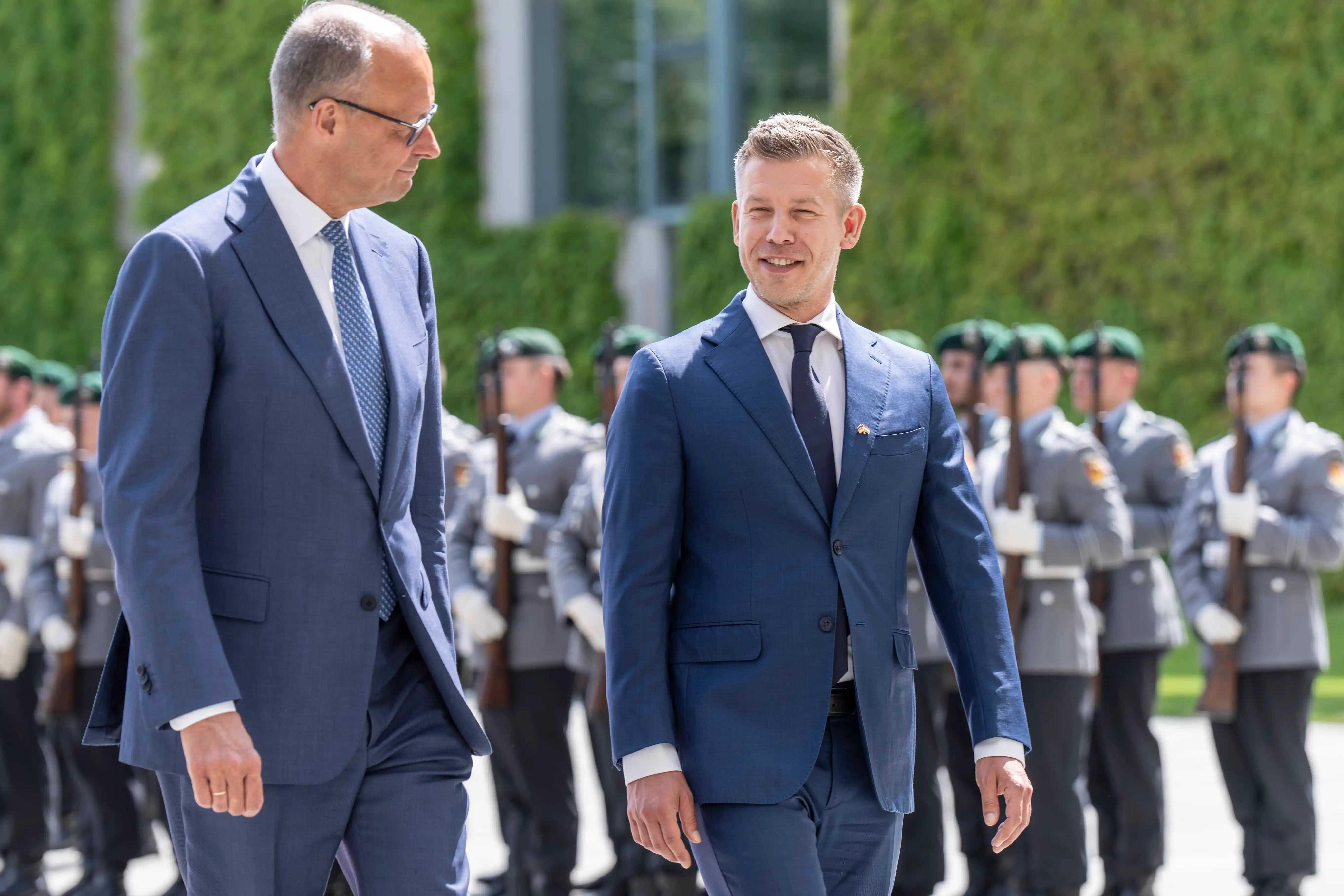
Hungary’s new Prime Minister, Péter Magyar, has just made his inaugural visit to Berlin, where he assured officials that his country would be a constructive partner in the European Union going forward and would not exercise its veto for the sake of it, but only when all avenues for negotiation had been exhausted. Nevertheless, the 45-year-old politician from the center-right TISZA party also pointed out differences from the EU’s mainstream position, such as on Ukraine policy: Hungary will send neither weapons nor soldiers to Ukraine in the future, he emphasized. German Chancellor Friedrich Merz praised Magyar’s election victory as “an inspiration for all of Europe.” It shows that the pendulum can swing not only in an illiberal-authoritarian direction but also toward the center. Magyar had previously visited Poland, Austria, and Brussels. Our author analyzes the first steps of the new Hungarian government.
After an overwhelming election victory, Péter Magyar formed a new government in record time and immediately began restructuring the political system that Viktor Orbán and his Fidesz party had created over the past 16 years. Key campaign promises included investigating alleged abuses of power and holding former decision-makers legally and politically accountable.
Immediately after the election, investigative authorities reopened several cases that had made little progress under the Orbán governments. This is not merely a matter of political accountability. Given the strained budgetary situation, the new government also hopes to recover embezzled public funds. To supplement the existing law enforcement agencies, a new authority is therefore to be created: the National Office for Asset Protection and Recovery. It is tasked with investigating corruption networks and recovering public assets that have been unlawfully misappropriated.
The Dispute Over the Rule of Law
The corruption allegations also had repercussions for relations with the European Union. Due to shortcomings in the rule of law, a significant portion of EU funds earmarked for Hungary was frozen, further exacerbating the country’s difficult budgetary situation. For years, the Orbán government was unable to lift the freeze. At the same time, its message remained contradictory: on the one hand, it claimed that the funds due to Hungary had already been redirected to Ukraine; on the other hand, it portrayed the EU’s conditions as warnings against mass immigration or cultural interventions.
Magyar, however, promised to bring the frozen funds back to Hungary. Shortly after taking office, he announced a political agreement with the European Commission during a joint appearance with EU Commission President Ursula von der Leyen in Brussels. According to the agreement, the funds are to be released as soon as Budapest implements the agreed-upon reforms. Thanks to his party’s constitutional-amending majority, the government should be able to pass the necessary anti-corruption measures with relative ease. This would also allow it to refute the narrative that the blocking of EU funds was motivated solely by ideology. Migration or other cultural policy issues play no role in the agreement.
Orsolya Rácz, an analyst at the Eurasia Group, believes the implementation of the agreed-upon reforms is realistic. With its two-thirds majority, the new government should be able to meet all the milestones. However, Rácz sees the tight timeline as the biggest risk: Member States must draw down funds from the European Recovery Fund (RRF) by the end of August. Whether the necessary reforms will be implemented in time and the funds will still be fully available thereafter is therefore an open question.
One potential point of conflict, however, concerns the head of state. President Tamás Sulyok is viewed by many representatives of the new government as closely tied to the previous political system. To prevent the blocking of key reform bills, the government—also drawing on experiences in Poland—is considering a constitutional amendment that would allow for his removal from office.
More Visegrád, a little less Russia
A shift in foreign policy is also becoming apparent. Magyar’s first trip abroad took him to Warsaw. He had already announced during the campaign that he intended to revitalize cooperation within the Visegrád Group. Relations between Poland and Hungary had deteriorated significantly in the final years of the Orbán administration, particularly following the recent change of government in Warsaw. At times, cooperation between Poland, the Czech Republic, Slovakia, and Hungary wielded considerable influence within the EU. Budapest therefore views a rapprochement as a foreign policy priority.
While cooperation with Warsaw appears relatively straightforward, talks with Czech Prime Minister Andrej Babiš and Slovak Prime Minister Robert Fico could prove more challenging. According to Rácz, however, Babiš is ultimately considered a pragmatic negotiating partner. In relations with Slovakia, on the other hand, the debate over the so-called Beneš Decrees remains a sensitive issue. Budapest is particularly critical of provisions that allow for expropriations based on collective blame following World War II.
It was also symbolic that Foreign Minister Anita Orbán accompanied her prime minister to Warsaw and, at the same time, initiated the replacement of the Hungarian ambassador to Poland. According to information from diplomatic circles, other ambassadorial posts within the European Union could also be filled. The Hungarian ambassador to Berlin, Péter Györkös, has been in office since 2015. The minister also set a new tone toward Russia. Following a drone attack on Transcarpathia—which once belonged to Hungary and is located in the far west of Ukraine—she strongly condemned the Russian aggression and summoned the Russian ambassador. In doing so, the new government clearly distanced itself from its predecessors’ policy toward Russia.
Despite the shift in foreign policy, Hungary remains heavily dependent on Russian energy supplies. While the government emphasizes its intention to gradually diversify its energy supply, an EU decision simultaneously obligates member states to phase out Russian oil and gas imports by 2027. During his visit to Berlin, Magyar also discussed this with German Chancellor Friedrich Merz. Whether Hungary can meet the deadlines remains to be seen. However, given the tense situation on global energy markets, Rácz expects a certain degree of flexibility on the part of the EU.
Grounds for Disagreement
Another potential point of contention is Ukraine. Budapest has made its approval of further steps in the EU accession process contingent on progress regarding the rights of the Hungarian minority in Transcarpathia. Magyar emphasized in Berlin that language rights, in particular, are the subject of ongoing negotiations. Merz expressed understanding for Hungary’s concerns but made it clear that neither support for Ukraine nor the opening of further accession chapters should be permanently blocked. A meeting planned for June between Magyar and Ukrainian President Volodymyr Zelenskyy could therefore be of particular significance.
Disagreements with Brussels remain possible on migration policy as well. Regardless of the agreement on the frozen EU funds, another proceeding against Hungary is still ongoing. Due to violations of European asylum law, the European Court of Justice imposed a fine that costs Budapest one million euros per day until it aligns its regulations. So far, it is not clear on which points the new government might deviate from its previous course. It expressly intends to maintain border security.
At the same time, Budapest faces another challenge: Starting June 12, the new European Pact on Migration and Asylum will take effect, which provides for a solidarity mechanism to address future migration flows. Member states are expected to provide relief to countries particularly affected at the EU’s external borders—by accepting asylum seekers, making financial contributions, or providing other forms of support. The Hungarian government has already made it clear that it does not intend to accept refugees or make compensation payments. This leaves primarily the alternative solidarity measures provided for in the pact. However, it remains unclear how these might be structured in concrete terms and what contribution Budapest will ultimately make.
At the same time, the government is even planning further restrictions. For instance, the recruitment of guest workers is to be limited. According to Rácz, however, this could entail significant economic disadvantages. In numerous sectors, there is already a shortage of domestic workers to meet labor demand.

.webp)