Trump Misreads Iran
Column by Michael Backfisch
Donald Trump lives in a parallel universe. If the U.S. president has any say in the matter, the war with Iran is as good as over. He claims that after weeks of American-Israeli attacks, the Islamic Republic is effectively finished. It has neither an air force nor a navy, he asserts. Iran has only the choice between a quick surrender, being bombed “back to the Stone Age,” or economic collapse via a U.S. naval blockade.
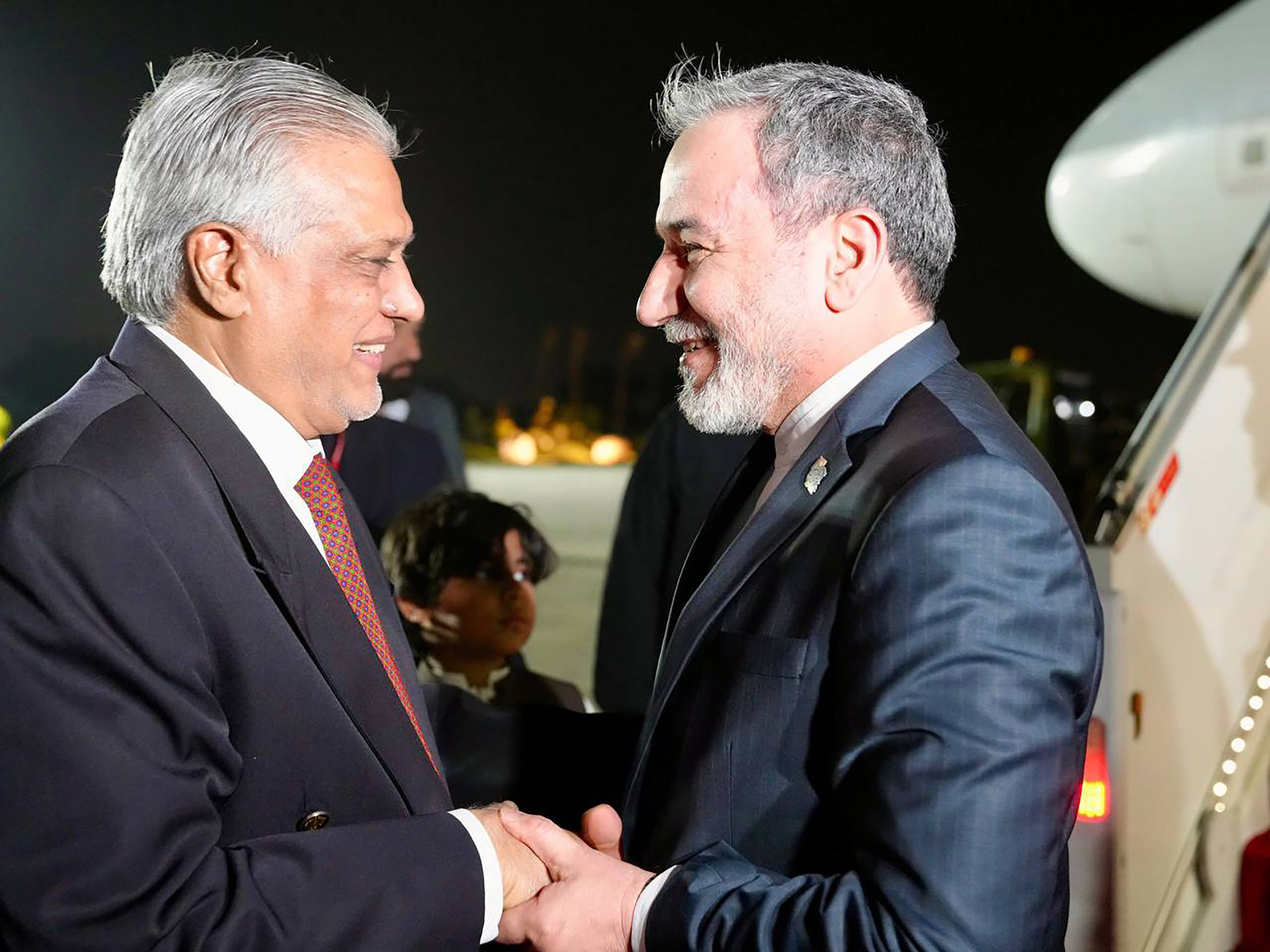
Yet, a good eight weeks after the start of the war, the regime is still there. And it is behaving more nationalistic and radical than in the era of the late Supreme Leader Ali Khamenei. Iranian Foreign Minister Abbas Araghchi even allowed himself the luxury last weekend, during his trip to the Pakistani capital Islamabad, of snubbing U.S. Special Envoys Steve Witkoff and Jared Kushner, who were waiting with their suitcases packed.
Trump has failed with his concept of coercive diplomacy: Threats may have worked as business tactics in the cutthroat New York real estate market of the 1980s and 1990s, when Trump was chasing mega-deals. But when it comes to the political leadership in Tehran, the U.S. president is hitting a brick wall. The influential Revolutionary Guards are standing up to the most powerful man in the world. They shrug off his ultimatums and set conditions for talks.
Two completely different negotiation styles are colliding. Trump wants a quick agreement on his terms with maximum intimidation. He craves the spectacular headline that celebrates him as a magical conflict resolver and peacemaker. He rants, raves, and thunders—but he achieves nothing. He is caught in a whirlwind of self-deception, wishful thinking, and delusions of omnipotence. He misreads Iran.
In contrast, the leaders in Tehran are pursuing a long-term strategy. They negotiate with meticulous attention to detail, are tenacious, and have endless patience. This is evident in the 2015 international nuclear agreement, which was preceded by two and a half years of talks. The agreement spanned more than 160 pages and included five technical annexes. Huge delegations of specialists established the limits of Iran’s uranium enrichment, monitoring by the International Atomic Energy Agency (IAEA), and sanctions relief. Trump’s idea of concluding a nuclear deal with Iran through a fast-track process is the delusion of an egomaniac who refuses to face reality.
The American president's miscalculation is complex. For instance, Trump fails to recognize that the Islamic Republic looks back on a history of resilience and endurance. In the first Gulf War from 1980 to 1988, it withstood Iraq—heavily armed by the United States—while suffering severe losses. Today, the regime is fighting for its survival in a similarly desperate situation.
Given the sheer scale of military capabilities, there is a world of difference between Iran and the overwhelming military might of the United States and Israel. It is a battle the Islamic Republic cannot win. And yet, Iran has settled into an asymmetric war—carrying out targeted strikes against targets in the Persian Gulf and calculated escalations.
Despite the massive damage caused by weeks of attacks by the United States and Israel, the regime still possesses a considerable arsenal. The “New York Times” quotes American intelligence officials and military personnel, who estimate that Iran retains around 40 percent of its combat drones, more than 60 percent of its missile launchers, and up to 70 percent of its pre-war missiles. Western security circles estimate the stockpile at several thousand drones and missiles.
The underground “missile cities” scattered across the country play a key role. Videos released by the Iranian Revolutionary Guard show massive convoys of trucks carrying missiles, missile launchers, and drones on their beds. These weapons depots are buried up to 500 meters underground and are often located beneath mountainous terrain. Even for the Americans’ bunker-busting bombs, the terrain is difficult to reach. An Iranian missile launch from underground can happen quickly: the trucks drive just a short distance out of the “missile city,” the missile is fired, and then they return underground.
Military operations with drones are even easier. The missiles can also be installed and fired in open fields. Destroyed launch pads — relatively small, simple structures — can be repaired within one to two hours.
Several hundred speedboats are another key weapon in Iran’s arsenal. These vessels can race across the sea at speeds of up to 200 kilometers per hour and are virtually undetectable by satellites and radar. When they launch their “Mosquito” attacks on oil tankers and cargo ships, panic quickly spreads among shipping companies and insurance firms. The boats in the “Mosquito” fleet, ranging from 14 to 17 meters in length, can be easily hidden along Iran’s 1,700-kilometer coastline. This is not only due to their manageable size but also because the Revolutionary Guards have established underwater bases.
Added to this is the blackmailing exploitation of the Strait of Hormuz, a key chokepoint for global oil trade. “The Iranians don’t need an endless supply of military equipment. It’s enough for them to fire on Dubai or Doha twice a week to instill fear and terror in the markets,” says Hans-Jakob Schindler, head of the Berlin-based think tank Counter Extremism Project. The fear that oil, fertilizers, petrochemical products, or helium can no longer be supplied from the Persian Gulf has become the mullah regime’s most important instrument of power. It is holding the global economy hostage.
Trump’s strategy of economically bleeding the Iranian regime dry through a naval blockade is unlikely to succeed. Tehran will counter by deliberately escalating tensions and playing on fears of a global recession. It would be wiser for Trump to entice the Iranians to reopen the Strait of Hormuz by offering concessions. For example: lifting the naval blockade and/or allowing minimal uranium enrichment for civilian nuclear energy and medical research under full international supervision. According to the U.S. news portal Axios, the Iranians themselves are said to have submitted a new proposal that calls for the reopening of the Strait of Hormuz, the lifting of the naval blockade, and a ceasefire that is as long-lasting or permanent as possible. However, nuclear talks would only begin at a later date.
According to Danny Citrinowicz, the former head of the Iran division of Israeli military intelligence, there is only one reasonable option for resolving the conflict. The U.S. government will eventually face the “inevitable choice: escalation or concessions,” writes the Middle East expert. Even a limited military strike is unlikely to force Iran to surrender. “It is more likely to trigger an escalation and exacerbate the crisis it is actually intended to contain.” The sooner Washington recognizes “that pressure without a political goal is a strategy with no way out, the better the chances of avoiding an endless conflict.”
Henry Kissinger, Secretary of State and National Security Advisor under U.S. President Richard Nixon, had provided a razor-sharp analysis of his administration’s misjudgment in the Vietnam War. “We waged a military war; our opponents waged a political one. We sought physical attrition; our opponents aimed for our psychological exhaustion,” Kissinger explained. “In doing so, we lost sight of one of the basic rules of guerrilla warfare: The guerrilla fighter wins if he does not lose. The conventional army loses if it does not win.” The current war with Iran is based on a similar asymmetric conflict. Yet in the Trump administration, it seems, no one can recall the Kissinger doctrine.

.webp)

%20(1).webp)