A Confident Chancellor
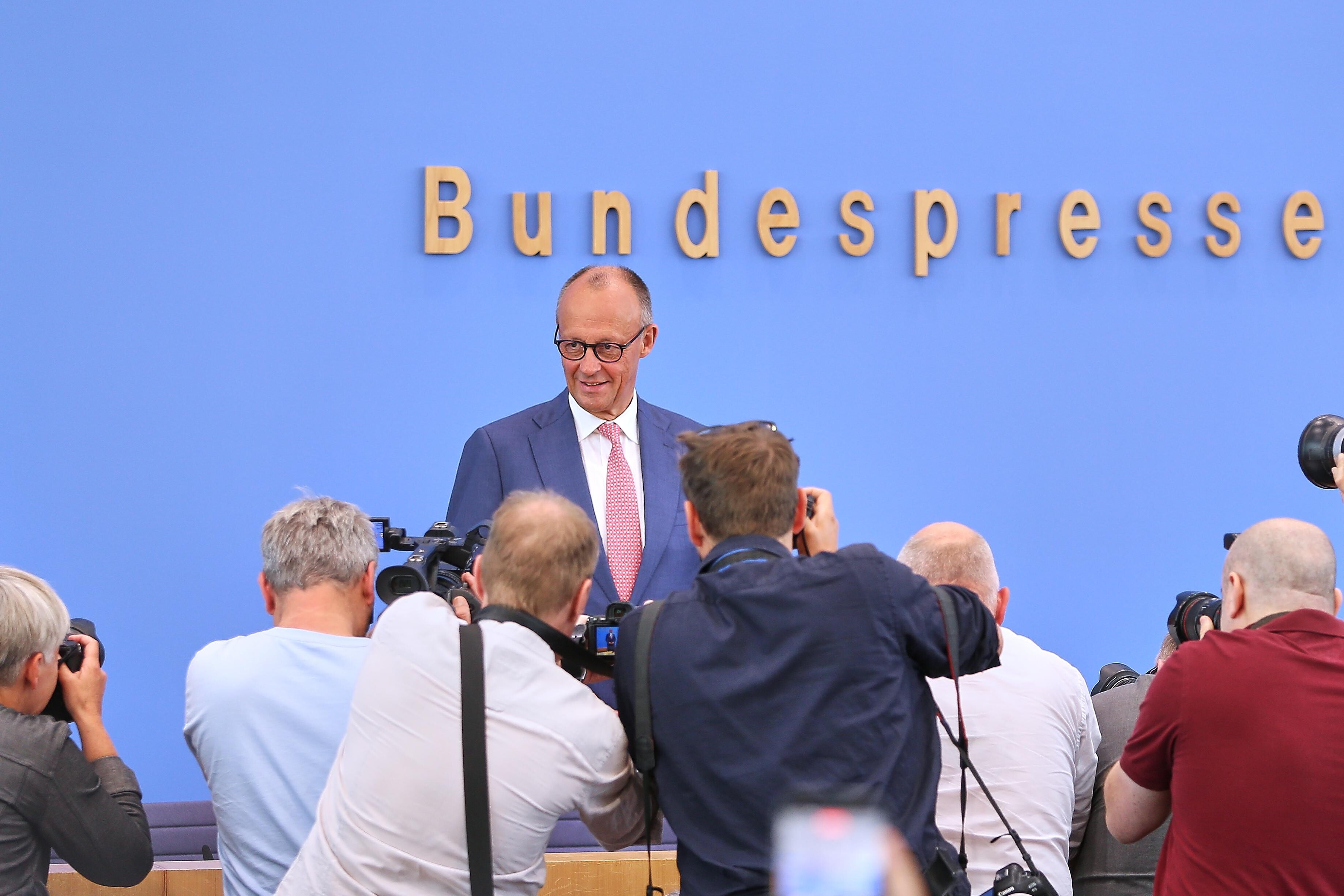
Climate change, pension reform, health insurance, economic competitiveness, and—time and again—the AfD’s performance in the upcoming state elections this fall—foreign and security policy played only a minor role at Chancellor Friedrich Merz’s (CDU) second summer press conference, held Wednesday in Berlin with the German capital’s press corps and foreign correspondents. And this despite the fact that Merz has repeatedly and gladly described himself as a “foreign chancellor.”
Speaking at the Federal Press Conference, he said he did not view this description as criticism, but rather as accurate, since external and internal security could no longer be separated from one another—for example, in migration policy. After 30 years of discussion, the National Security Council has been established within the Chancellery as an institution that comprehensively defines security policy. This also includes issues such as protecting the population from heat waves.
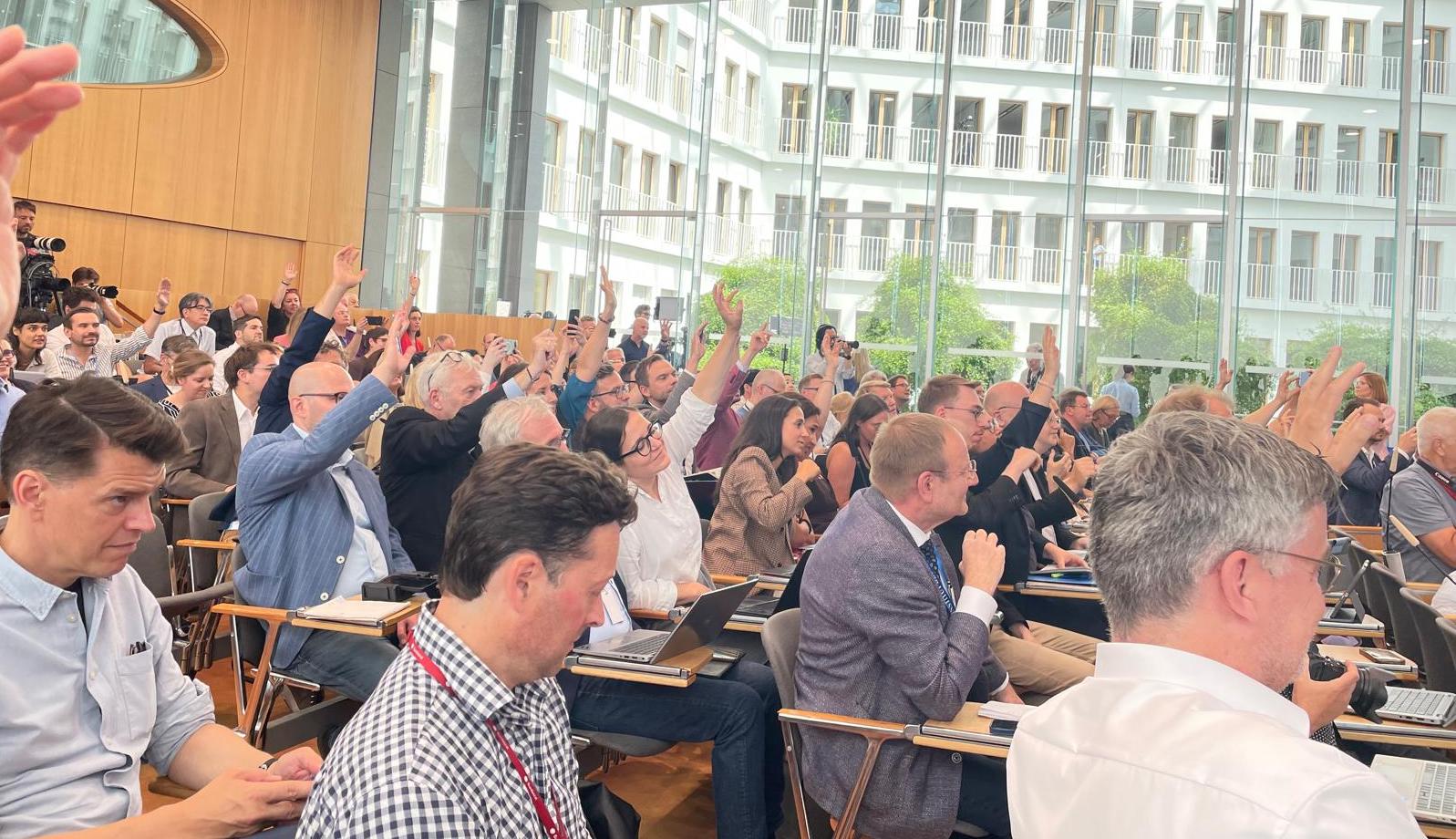
Overall, the CDU-SPD coalition has found its footing; relations are good on a personal level as well, and the ministries are working well together. Speaking in the packed hall, the chancellor also spoke highly of the cooperation with the two SPD leaders, Finance Minister and Vice Chancellor Lars Klingbeil and Labor Minister Bärbel Bas.
Merz also expressed satisfaction with his government’s achievements to date in European policy. From the very beginning, he had placed great emphasis on a stronger role for Germany in the European Union. “I believe we have succeeded well in this.”
Contributing to the overall success of European policy—this is a goal shared by the entire federal government. There is now a consensus on completing the European single market and restoring the competitiveness of European industry. The European Commission has now been tasked with carrying out this work. Nevertheless, Merz made it clear that there is still ample room for improvement. With 100 million more inhabitants than the United States, the EU could be much stronger, he cautioned, if it cooperated more effectively. And this goes far beyond strategic defense cooperation.
In this context, he praised the recently announced submarine deal between Canada, Norway, and Germany, under which German shipyards and suppliers will benefit from contracts worth tens of billions. “I am ending the first half of 2026 with the confidence that we will continue to pursue sound policies for Germany in the second half of the year as well.”
In light of massive hybrid threats such as sabotage or attacks on German data networks originating from Russia, Merz stated that he is concerned about Germany's defense capabilities. As a country located at the geostrategic center of Europe and a primary target of hybrid warfare, he said, Germany owes it to its people to restore its defense capabilities. However, he noted that his level of concern is not currently increasing. "We are in the midst of a rapid catch-up process to restore our defense readiness." He added that there is no disagreement on this issue within the federal government.
The chancellor said he assumes—also in light of the recent NATO summit in Ankara—that there is a sufficiently strong deterrent within NATO, although Europeans are aware that they need to do more. “NATO must become more European so that it can remain transatlantic,” he quoted a now-frequently used statement by NATO Secretary General Mark Rutte.
Regarding the recently announced sum of approximately five million dollars from the US State Department, intended to promote US democracy, the rule of law, and freedom of the press in Europe, Merz emphasized that under German law, it is illegal to fund political parties in Germany from abroad. He stated that he assumes "our friends" around the world will abide by these legal rules. Critics have raised suspicions that this money could be used to support right-wing populist parties like the AfD. According to the State Department, only non-partisan organizations are to be funded. Germany does not interfere in American elections, Merz said, and conversely, it does not want Americans to interfere in German elections.
He emphasized that his stance on the AfD is clear. He intends to do everything in his power to prevent this party from gaining a governing majority in the upcoming state elections. In response to a question from a Dutch correspondent, he said that Germany has nothing to learn from the example of the Netherlands, where Geert Wilders’ far-right party was part of the government last year and the coalition collapsed shortly thereafter. “If a far-right party were to enter a government in Germany, it would have a completely different significance than if that were to happen in another EU country. That also has to do with our history.”
Merz intends to continue fighting for his proposal for associate EU membership for Ukraine and the Western Balkan states. The next round of negotiations with Ukraine is set to begin today (Wednesday). Incidentally, Ukrainian President Volodymyr Zelenskyy has not rejected the proposal, but there is a domestic political issue there. The term “associated membership” was chosen by his predecessor in 2013, when Ukraine was offered an association agreement with the EU. For that reason, the term does not carry particularly positive connotations. On the substance of the matter, however, there is no disagreement.
His intention is to offer Moldova, Ukraine, and five Western Balkan countries a concrete prospect of accession. No new member has been admitted to the EU for 13 years, even though this had been promised to a number of countries. Either the promise must now be withdrawn—which would be the worst solution—or progress must be made step by step, for example through associate membership without voting rights in the institutions. He has met with a great deal of support for his proposal among those involved and in the European Council. He acknowledged, however, that the processes are complicated and many hurdles still need to be overcome. But he said he intends to do everything in his power over the coming months to ensure that Europeans remain credible. “If we lose our credibility, we lose more than just that credibility; we also lose these countries. Geostrategically, that would be the worst thing that could happen to us Europeans.”
The chancellor reacted calmly to his poor poll numbers—according to the ARD Deutschlandtrend, only 13 percent of German citizens are satisfied with the chancellor’s work. He acknowledged that they were a concern and that it might be necessary to adjust his communication strategy. “But I see the poll numbers, if you will, more as an incentive to continue the work, to do it well, to communicate it effectively, and to explain it clearly.”
gd