Lufthansa CEO Carsten Spohr: “We Have to Play in the Global League”
By Ewald König
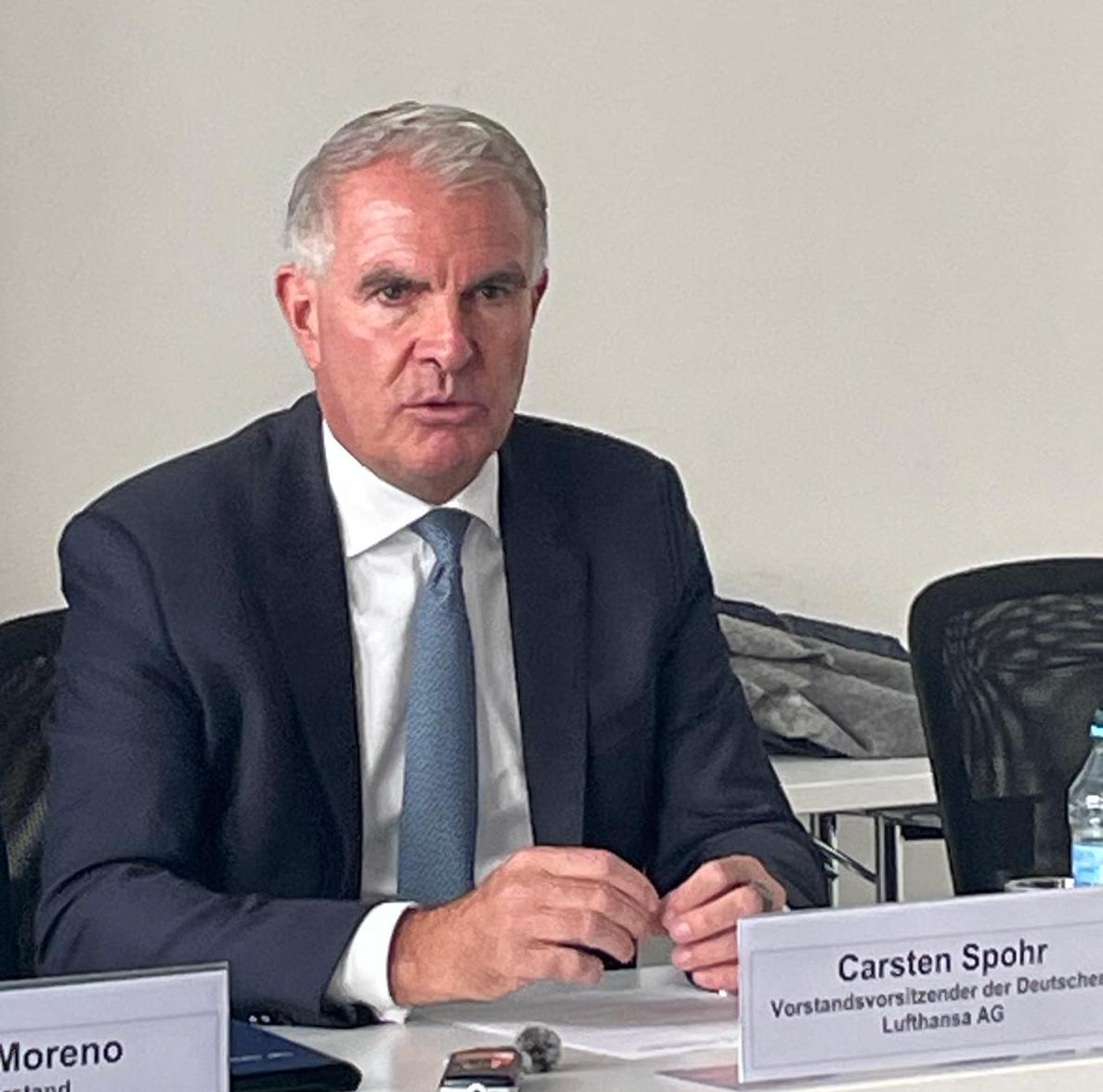
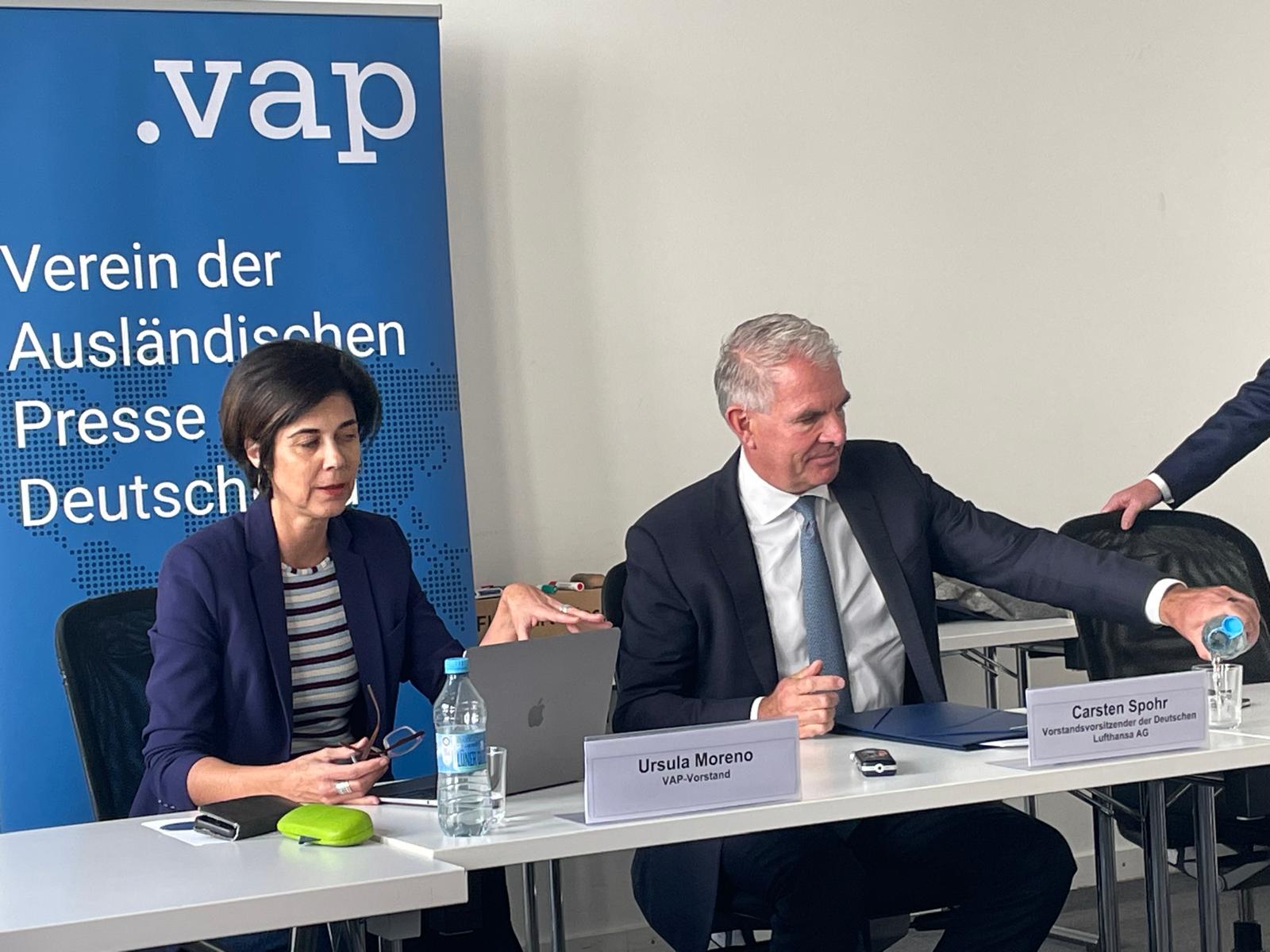
CEO Carsten Spohr wants to position the group, with its 110,000 employees, to be increasingly international. Among German companies, Lufthansa ranks 20th in terms of size. Internationally, however, the group plays in a different league: This year, the group expects revenue of 40 billion euros for the first time and operates around 850 aircraft. This makes Lufthansa the number four among global airline groups.
“We wouldn’t be number one in Europe if we had limited ourselves to Germany,” says Spohr in a conversation with diplo.news and a group of foreign media correspondents. “With Lufthansa alone, we wouldn’t have a global presence at all anymore.” Aviation is an industry that requires a certain scale to remain competitive.
A Catchment Area Unlike That of Other Airlines
Unlike many international competitors, Lufthansa cannot rely on a vast domestic market centered around a single metropolis. New York, Chicago, and Atlanta; Paris and London; as well as Istanbul, Dubai, and Doha all have large catchment areas that benefit their respective airlines. Lufthansa must therefore organize its competitiveness differently. The answer lies in diversification.
In addition to the passenger business, Lufthansa Cargo and Lufthansa Technik are among the Group’s main pillars.
Seven hubs in the future
Added to this is a network of several hubs. Until now, there were six hubs; following the Portuguese government’s latest decision a few days ago, there will be seven in the future. Lufthansa was awarded the contract to acquire a stake in the Portuguese airline TAP, defeating competition from France. The Lisbon hub will be expanded. Connections to Brazil and other South American destinations are of great interest to Lufthansa. The goal: to enable growth and economies of scale without becoming dependent on a single market.
Europeanization as a growth driver
Lufthansa has largely managed to become independent of the German domestic market. According to Spohr, only about one-fifth of the business comes from Germany, while four-fifths comes from the rest of the world. The largest market outside Germany is the U.S., followed by Italy. Lufthansa recently expanded its presence there with the acquisition of another airline.
Spohr also views the decision to expand into Portugal as a sign of the Europeanization of major network airlines. The former national flag carriers—British Airways, Air France, and Lufthansa—have increasingly become internationally oriented groups.
Lufthansa also aims to grow outside of Europe. According to Spohr, its subsidiary Lufthansa Technik is one of the world’s largest providers in its industry. New international locations, including in the Philippines, are intended to strengthen the company’s global footprint. Through its cargo business, Lufthansa Cargo connects Asia and the U.S., among other destinations, across the Pacific.
This international expansion builds on a long tradition. According to Spohr, cargo transport played a role alongside passenger transport even when Lufthansa was founded in 1926. Today, diversification into different business areas and markets is an essential part of the Group’s strategy.
Record order volume for new aircraft
Despite the size of the group, Spohr is not satisfied with its profitability. In the medium term, the operating margin is expected to rise to eight to ten percent. To achieve this, management is focusing on synergies within the group and closer cooperation among the individual companies.
At the same time, Lufthansa is investing in the modernization of its fleet. Over the next 100 weeks, 100 new aircraft are scheduled for delivery. According to Spohr, the group has ordered a total of 250 aircraft—an order volume on a scale never before seen at Lufthansa.
Digital connectivity will be improved in the new aircraft. The rollout of Starlink satellite internet is to be expanded gradually. By the end of the year, 50 aircraft are expected to be equipped with this technology, and over the next three years, the entire fleet of approximately 850 aircraft will be outfitted.
“We have to be better at what makes us more expensive”
The investments are also part of an effort to consistently reposition Lufthansa as a premium carrier. “Like any company with its cost base in Germany, we have to be better at what makes us more expensive,” says Spohr. Lufthansa cannot compete with the cost structures in Istanbul or other international aviation hubs. It must therefore meet its standards through quality, reliability, and service.
Energy costs, the growing locational disadvantages in Europe, and the differing competitive conditions are causes for concern. European airlines must bear additional burdens that their competitors do not face.
A critical look at Dubai, Qatar and Istanbul
Spohr cites emissions trading as an example. Anyone flying from Frankfurt to Singapore is subject to the relevant European regulations. These rules do not apply to flights via Dubai or Istanbul. European airlines must also meet requirements regarding the use of sustainable aviation fuels that their competitors do not face.
Spohr therefore calls for a level playing field. The European aviation industry has invested heavily in environmental protection, innovation, and technology in recent years. If policymakers expect these efforts, they must ensure that they do not result in one-sided competitive disadvantages.
The consequences are already visible in the route network. The market share of European airlines on routes to Southeast Asia was still nearly 60 percent in 2010 and has since declined to about 40 percent. At the same time, airlines from the Gulf region and Turkey have expanded their market position.
According to Spohr, Lufthansa currently serves only Bangkok and Singapore in Southeast Asia. With Kuala Lumpur, a new destination in the region is set to be added for the first time in more than ten years. For Spohr, this is an example of how significantly global traffic flows are shifting. A growing proportion of connections between Europe and Asia is being routed through the hubs in the Gulf and on the Bosphorus.
German regions falling behind
Spohr also sees a need for action within Germany. High aviation taxes, aviation security fees, and other location-related costs are making many routes increasingly unprofitable. The cost base for aviation in Germany has doubled since 2019.
This doesn’t just affect the major airports. According to Spohr, economically strong regions such as Friedrichshafen and Paderborn are no longer connected to the air transport network. For an export-oriented economy, this is a problem—especially for small and medium-sized enterprises that rely on international connections.
Demand for air travel is increasing
Meanwhile, Spohr believes that demand for air travel continues to rise. He notes that aviation is one of the world’s fastest-growing industries—second only to the IT and AI sectors. Lufthansa expects global air traffic to double over the next twenty years.
In addition, the passenger mix is changing: even in business class, there are now more leisure travelers than business travelers. Credit card data also shows that spending on travel has become more significant since the pandemic. “Actually, we should rename ‘Business Class.’”
Lufthansa as part of European sovereignty
For Spohr, the significance of aviation extends beyond the business itself: “We need strong European airlines.” European sovereignty does not mean self-sufficiency. Europe does not need to be able to defend itself entirely on its own or supply all its own energy to strengthen its independence. The key is to remain connected to the world. This role becomes even more important in a world marked by geopolitical tensions.
One example of this is air traffic between the U.S. and China. There are only about fifty flights per week between the two major powers. Lufthansa alone, by contrast, flies to the U.S. about fifty times a day. This comparison illustrates how strongly political tensions and limited transportation links can influence economic exchange.
For a corporation with approximately 110,000 employees and annual revenue of 40 billion euros, therefore, it takes not only a strategy but also a clear social mission. Lufthansa describes this mission with the guiding principle: “Connecting people, cultures, and economies in a sustainable way”.
“Austrian is the most punctual airline in Europe”
According to Lufthansa’s CEO, AUA is the most punctual airline in Europe. Why is that? The Austrians are good at what they do, and Austrian’s flight attendants receive excellent reviews. However, like other airlines, AUA is too small to survive on its own.
Austrian has every reason to be pleased that it ranks at the top in punctuality and service. “But performance alone isn’t enough—you also need scale,” said Spohr. “If Austrian were on its own, it would have very different concerns. That’s why we’re glad to have AUA with us.”
In the case of the Austrian airline with its “fairly manageable fleet,” the saying “small is beautiful” applies: “The employees know each other. In Vienna, many issues are resolved pragmatically. These are things that could never be solved that way in a large system like Frankfurt, London, or Paris.”
Air traffic in Vienna is shrinking
But there is also a sad reason. Air traffic in Vienna isn’t growing—it’s shrinking. The airport—just like the one in Berlin—is so empty that flights can depart on time. The airport suffers from the locational disadvantage of high aviation taxes in Austria. Austria is less well-connected than it was in the past. That’s why there’s still room in Vienna and flights can depart on time.
Spohr further explained that Lufthansa wants to evolve from a “group of airlines” into an “airline group.” “This isn’t just a play on words; it definitely has implications.” A group of airlines may have a common owner, but perhaps nothing else in common. “However, we want to operate in such a way that the passenger—more than half of whom already use two of our brands when transferring—experiences it this way: When they book as a customer and earn their miles, they’ll interact with the group, but the moment they board an aircraft—that is, when they become a passenger—the individual airline takes center stage. We want to maintain that distinction with great sensitivity. When you fly Swiss, you feel like you’re in Switzerland; when you fly Austrian, you feel like you’re in Austria. “I am absolutely committed to preserving the diversity that characterizes Europe within Lufthansa as well.”