Azerbaijan does not want to be defined solely as a supplier of energy to Europe
Op-ed by Kamala Mammadova
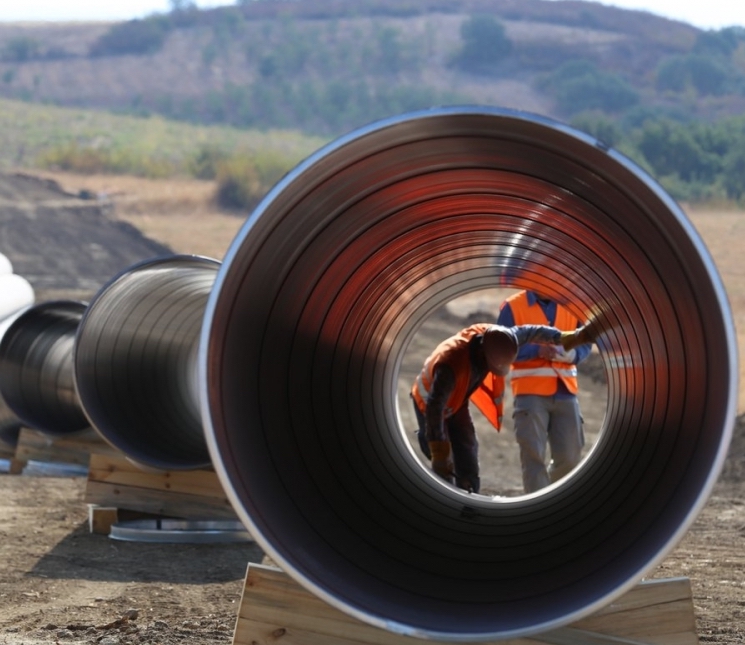
The war in Ukraine, instability in the Middle East, and disruptions to global supply chains have forced European countries to rethink their concept of security. Security is no longer defined solely by military capabilities or defense policy, but also encompasses energy supply, transportation routes, logistics networks, resilient supply chains, digital infrastructure, technology, and access to new markets.
For Germany, this change is particularly significant. Berlin is striving to diversify its energy sources, strengthen alternative transport routes and expand its economic partnerships. This is where Azerbaijan’s strategic importance becomes apparent.
More than just gas
To this point, Germany has viewed Azerbaijan primarily through the lens of energy supply. This comes as little surprise. Azerbaijani gas reaches European markets via the Southern Gas Corridor. Diversifying energy supplies has become increasingly important since Europe’s energy landscape has undergone fundamental changes. However, Azerbaijan does not want its relations with Europe to be defined solely by its role as an energy supplier.
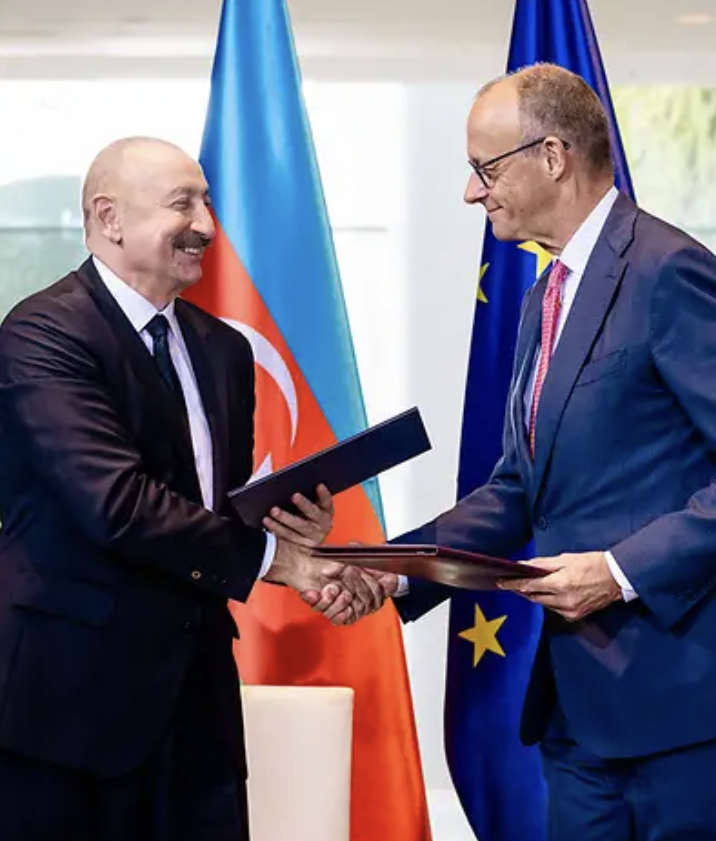
Consequently, the new Joint Declaration covers a broader agenda: natural gas, renewable energy, green and low-carbon hydrogen, energy efficiency, infrastructure, digitalization, industrial modernization, science, and new technologies. The Joint Declaration was signed in Berlin on July 21, when Azerbaijani President Ilham Aliyev visited Federal President Frank-Walter Steinmeier and Federal Chancellor Friedrich Merz. It sets out the strategic agenda for the bilateral partnership as well as the agreement on a German-Azerbaijani Economic Council.
Energy in Exchange for Market Access
Germany has the technologies, industrial expertise and investment capacities that Azerbaijan needs in a new phase of its economic development. This is where the interests of both countries meet. Germany is seeking diversification. Azerbaijan is looking for technology, investments and reliable long-term partners. Relations are gradually moving beyond cooperation in some areas towards a long-term partnership based on a wider range of strategic interests.
How the Middle Corridor is changing the map
Geography is also becoming increasingly important. New trade and transport routes are changing the connections between Europe and Asia. The Middle Corridor, which connects China and Central Asia to Europe via the Caspian Sea and the South Caucasus, is particularly promising.
Azerbaijan lies at the center of this network. Baku has an international seaport, rail connections to Georgia and Turkey, an extensive road infrastructure, and the Alat Free Economic Zone. Azerbaijan aims to turn its geographic location into an economic advantage and position itself as a logistics hub between Europe and Asia.
This is becoming increasingly relevant for Germany. The experiences of recent years show how vulnerable trade and transportation networks can become when they rely too heavily on a limited number of routes. Against this backdrop, the Middle Corridor is more than just an additional transportation option. It could become part of a new economic architecture connecting Europe with Eurasia.
In an interview with First News Media, the Azerbaijani ambassador to Germany, Nasimi Aghayev, pointed to the growing interest among German logistics and transportation companies in the development of the Middle Corridor, including potential participation in the expansion of the international seaport in Baku. This would turn Azerbaijan into a hub.
How do German companies benefit from this?
Political statements set the tone for bilateral relations; however, their sustainability depends on economic substance. The new German-Azerbaijani Economic Council is intended to make economic dialogue more systematic.
Opportunities for cooperation extend far beyond the energy sector. Renewable energy, industrial production, digital technologies, transportation and logistics, agriculture, infrastructure, and future technologies are all potential areas of cooperation.
Projects in the territories recaptured by Azerbaijan also offer opportunities for German companies. Here, the German business community can participate in a comprehensive transformation process. Azerbaijan sees great potential for renewable energy in Karabakh and Eastern Sangesur. Solar and wind energy, smart grids, energy storage, water management, waste processing, electromobility, and energy-efficient construction are among the areas where German expertise will be relevant.
Peace Becomes an Economic Factor
The changing political landscape in the South Caucasus is another reason why Berlin should pay closer attention to Baku. For decades, the conflict between Azerbaijan and Armenia had shaped the political and economic realities of the region. That landscape is now beginning to change.
Germany has welcomed the progress in the peace process between Azerbaijan and Armenia. Friedrich Merz described the agreements reached between the two countries as a historic step and emphasized that a lasting peace in the South Caucasus is not only in the interest of the region, but also of Germany and the European Union.
This will allow new transportation links and new markets to emerge and enable investors to plan for the long term. Peace in the South Caucasus is therefore not only a matter of regional security but also a matter of European connectivity.
The Greatest Challenge is Information
However, the new partnership faces an obstacle that cannot be resolved either through infrastructure projects or by the Economic Council: mutual perceptions. In Germany, Azerbaijan is still often viewed through the lens of the South Caucasus conflict. Public discourse about the country does not sufficiently reflect the changes of recent years.
There is an “information barrier” between Azerbaijan and German society that limits mutual understanding and knowledge of one another. This barrier cannot be removed through diplomatic campaigns. What is needed is ongoing engagement, academic exchange, professional contacts, encounters between journalists and experts, cultural projects, and direct personal relationships. Societies must be given the opportunity to understand one another beyond moments of political crisis. Strategic relationships do not arise solely at the government level.
Pragmatic Interests
Germany and Azerbaijan do not have the same political worldview and do not have the same interpretation of international issues. But what increasingly unites them is the pragmatically growing overlap of strategic interests.
Germany needs reliable energy partners, new trade routes and more resilient connections to Central Asia. Azerbaijan needs access to European markets, German technology, investments and long-term economic partners.
Germany has an interest in a stable South Caucasus, and Azerbaijan wants to transform regional stability into economic development. Germany is looking for new opportunities for its companies. Azerbaijan is looking for partners for its economic transformation.
Progress in the peace process between Azerbaijan and Armenia may open up further economic opportunities in the region. How far the cooperation will go remains to be seen. The dialogue between Berlin and Baku is expanding.
Incidentally, Germany and Azerbaijan have historical ties. German settlers arrived in what is now Azerbaijan in the 19th century, contributed to agriculture and industry, and left a lasting legacy. This heritage, too, can serve as another bridge between the two societies.

The author is an Azerbaijani journalist and media executive. She is the editor-in-chief of 1news.az, one of Azerbaijan’s leading online news platforms, and is involved in the Peace Bridge Initiative, a cross-border dialogue platform for Azerbaijan and Armenia.