Packaging as an indicator of domestic and foreign policy
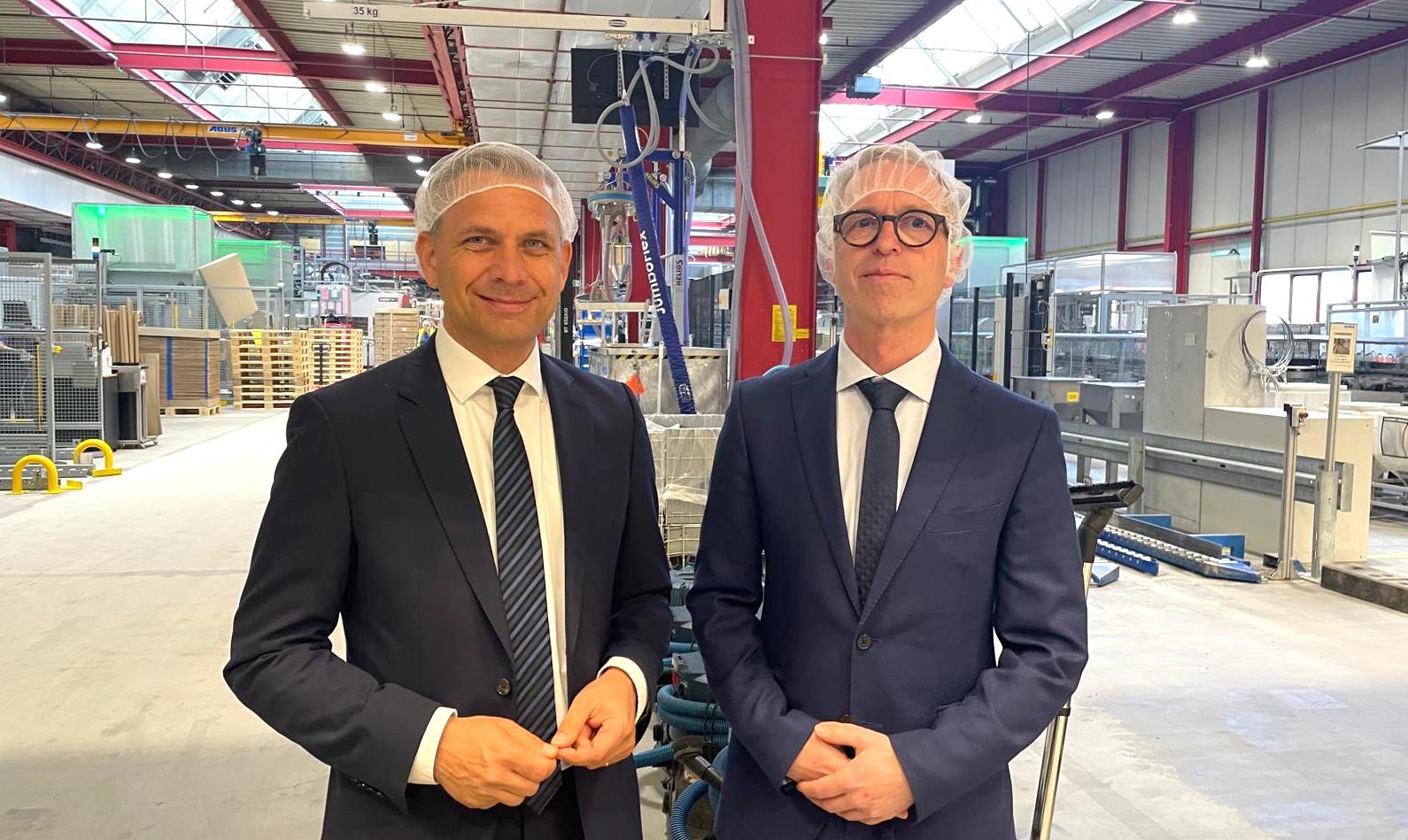
Price hikes, delivery bottlenecks, and material shortages are among the effects of global crises that are felt all the way down to the supermarket shelves. When Austrian Minister of Economic Affairs Wolfgang Hattmannsdorfer (ÖVP) recently visited Berlin, this connection became strikingly apparent. In addition to talks with his German counterpart Katherina Reiche (CDU), the itinerary included a visit to Austrian packaging company ALPLA in Berlin-Marienfelde — a global industry leader with production sites in 45 countries and more than 24,000 employees.
There, Hattmannsdorfer met Georg Pescher, managing director of ALPLA for Germany, Belgium and the Netherlands, as well as president of the Plastic Packaging Industry Association (IK). The conversation painted a gloomy picture of the current economic situation. “We are seeing prices rise to unprecedented levels,” said Pescher. Raw material costs have at least doubled compared to pre-crisis levels, and in some cases, costs have risen by up to 60 percent within a few weeks. This trend is affecting the entire supply chain—with immediate consequences for end consumers.
“Products are becoming significantly more expensive”
The result: Rising prices for consumer goods are inevitable. At the same time, companies are coming under pressure due to higher upfront financing costs, which creates additional risks for market stability. “Final products will become significantly more expensive, and consumers will bear the cost,” says Pescher.
For Hattmannsdorfer, these developments are a wake-up call. International conflicts such as the war in Iran or geopolitical tensions showed Europe's dependencies. “We must focus more strongly on resilience and sovereignty, especially in critical infrastructure,” the minister emphasizes. When it comes to food and beverage packaging, a crucial question is whether Europe is capable of manufacturing the necessary products and precursors itself.
For an export-oriented country like Austria, the situation is particularly sensitive. About 60 percent of economic output depends on exports, with roughly one-third of that going to Germany. Given its close ties with Germany, the economic development of the Federal Republic is therefore “crucial” for Austria. Small Austria invests about 40 billion euros directly in Germany, while large Germany invests 60 billion euros in Austria.
Criticism of the EU and Donald Trump
The minister was critical of the European Union. The planned increase of 2,500 civil servants in Brussels sends the wrong signal in the current situation. “We need fewer officials and not more.” Germany, Austria and several other EU member states oppose the plan.
Instead, he argues, we need to accelerate efforts to reduce bureaucracy. Overregulation—for example, in the plastics sector, where some rules are even contradictory—jeopardizes competitiveness and drives industrial companies out of Europe.
Energy prices remain a central issue. By international standards, these price levels represent a massive competitive disadvantage. Hattmannsdorfer therefore calls on the European Commission to accelerate the expansion of trans-European energy networks and provide stronger support to industry. “Otherwise, we will lose on a massive scale. Energy prices are a major competitive disadvantage.”
The minister also sees Europe under pressure in global competition. While the EU is recording an average growth rate of just one percent, growth in the U.S. is three times higher, in China four times higher, and in India as much as seven times higher. Competitiveness must be the top policy priority for Europe. “Unless there is a radical shift in thinking, Europe will die a beautiful death.”
His criticism of Donald Trump is particularly sharp. Trump’s policies, he argues, have contributed significantly to rising prices and economic uncertainty. “Trump has brought inflation upon us. The American president is responsible for everything becoming more expensive here and for the enormous challenges we face in terms of competitiveness and the budget.”
“You can see what populists do,” says Hattmannsdorfer. “It should be an eye-opener to see what happens when populists like Trump—but also his allies in Europe—are in charge and pursue harmful policies.” The consequences are also being felt in Europe, as evidenced by the packaging of products in the supermarket.
ekö

.JPG)