“A humanitarian intervention that millions of Iranians have asked for”
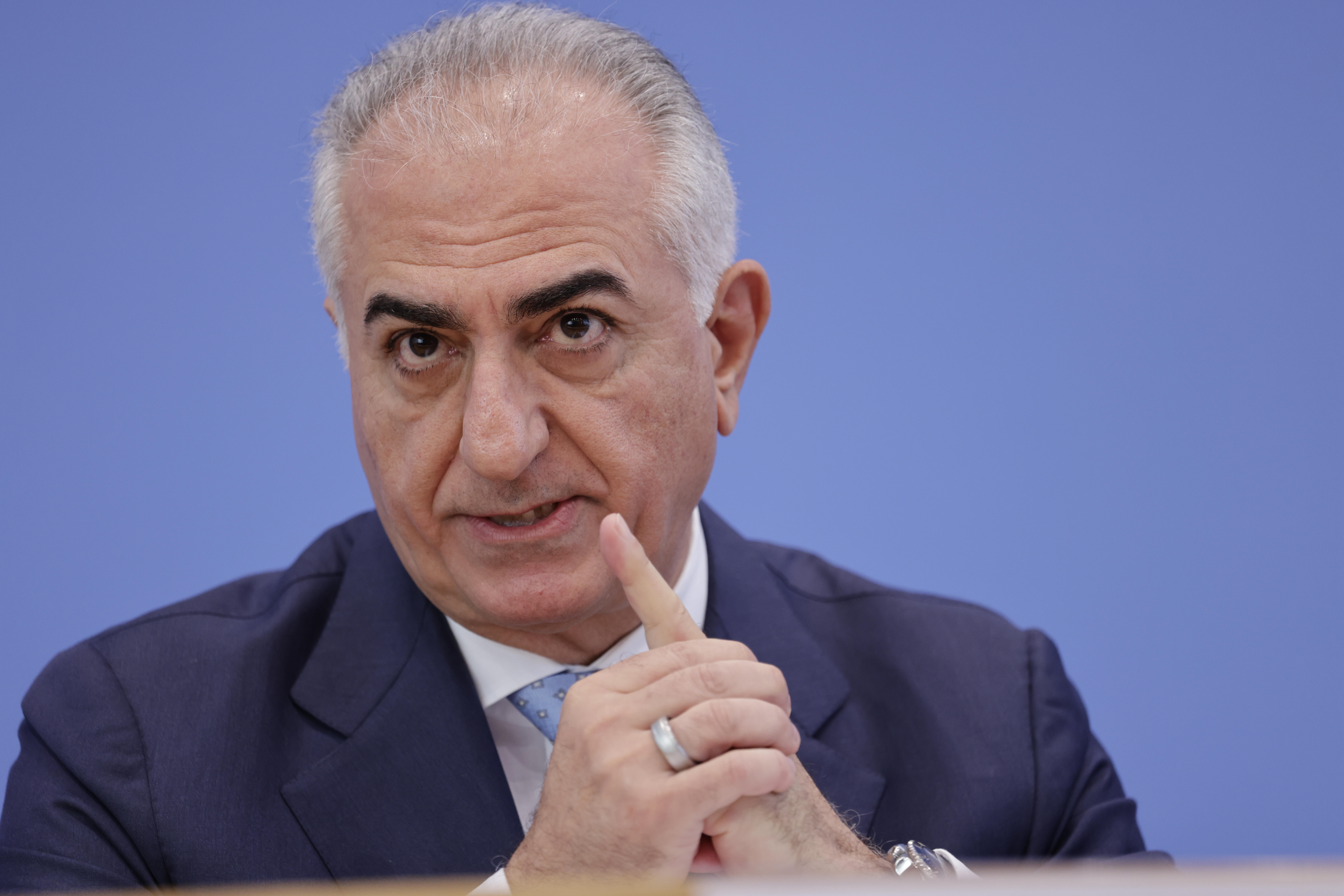
Reza Pahlavi certainly cannot complain in Berlin about a lack of attention to the political situation in Iran, which he had lamented just moments earlier. Rarely has the hall of the Federal Press Conference, where government press conferences are usually held and which is not open to the general public, been so well-attended. And it’s not every day that crowds of photographers gather around a politician who actually holds no office and is, moreover, quite controversial.
Pahlavi, eldest son of the Shah who was overthrown in 1979 and now one of the most famous opposition politicians in the Iranian diaspora, appealed for help during a visit to Germany on Thursday to bring an end to the mullahs’ regime once and for all, while also criticizing Western indifference to the regime’s crimes. “The question is not whether change is coming to Iran. The question is how many more Iranians must die while Western democracies stand idly by,” he told journalists at the Federal Press Conference. 20 other political prisoners have just been sentenced to death and are awaiting execution. In the newspapers, he reads a lot about the tragedy of war, but little about the carnage on the streets of Iran. Europe claims to stand for human rights, democracy, and justice. “But its politicians ignore the crimes against my people and instead criticize the humanitarian intervention that millions of Iranians have asked for.”
What Pahlavi calls a humanitarian intervention refers to the U.S.-Israeli attacks since February 28 on Iran’s leadership, military bases, and energy infrastructure. A school was also hit, killing over 170 people, mostly children. But how does Pahlavi know that millions have called for the attacks? The 65-year-old has lived mostly in exile in the U.S. for nearly 50 years; the internet in Iran has been down for weeks, and polls are hardly reliable. Millions, he says, also chanted his name at demonstrations in Iran, and “tens of millions” of Iranians have asked him to be their voice and, for example, to spread their visions in Germany. Gen Z is among his biggest supporters. He insists he is not here to promote himself. Pahlavi is clearly striving to legitimize his claim to a leadership role in the opposition.
In January, the monarch’s son had called on the U.S. to intervene militarily in his former homeland, and he is defending that intervention in Berlin as well. He argues that the purpose of outside assistance is to enable Iranians to return to the streets without being shot on the spot. He maintains that airstrikes on infrastructure and the repressive apparatus are necessary and serve primarily to protect lives. “Because the more resources the regime has to oppress people, the more victims there will be.” Of course, we mourn every civilian casualty, every instance of “collateral damage.” “But we do not apologize for calling for freedom. Or should we say, oh, the regime will kill us if we ask for freedom, so we’d better not ask for it?”
Reza Asghari, a CDU member of the Bundestag and professor of economics, agrees that the Iranian people alone will not be able to overcome the tyrannical system. “There have been several uprisings in the past 17 years. Every one of them was brutally repressed.” Asghari, who himself fled Iran for Germany via East Berlin at the age of 17 during the Islamic Revolution of 1978–79, therefore considers targeted strikes on the Revolutionary Guards’ military bases to be a sensible approach. According to the CDU politician, the argument that US interventions for the purpose of democratic regime change have rarely been successful in the long term is not valid. “Iran is not Libya, not Iraq, and not Tunisia. The educated middle class is still very strong. And democracy is not just a form of government but also a culture. If this culture does not exist in a society, then you cannot simply introduce democracy through a regime change. Iran is much further along in that regard."
Pahlavi’s main objective during his visit appears to be criticizing the Europeans and attempting to rally them behind a regime change in Iran. For 47 years, he argues, Europe has tried in vain to change the behavior of the mullahs in Tehran. “European governments must stop appeasing the regime.” The oppressors must not be legitimized through negotiations. He also does not place too much hope in the U.S. talks with Iran. Even if a deal is reached, it will not stabilize the situation permanently. Diplomacy has had its chance, but has repeatedly suffered setbacks. And Germany, of all countries, knows only too well where appeasement leads. “I ask you, on behalf of a nation, to stand on the right side of history, on the side of justice.” No one expects ground troops—the Iranians are handling that themselves—but Europe should exert more pressure for the release of prisoners or the commutation of death sentences; it could close embassies and crack down on money laundering.
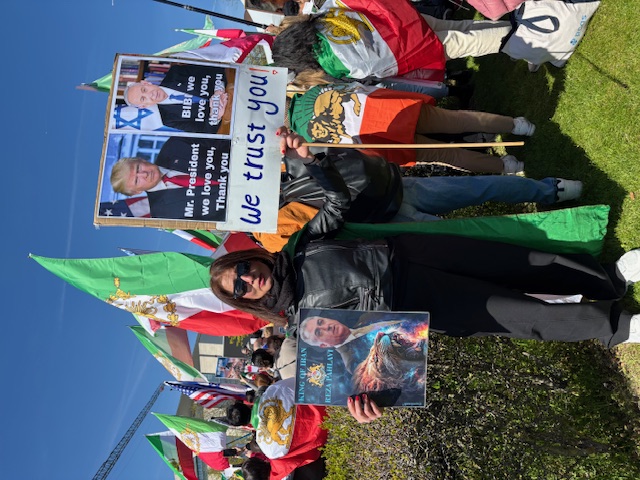
While the Crown Prince is still speaking, the first supporters are already gathering in the government district, with a view of the Reichstag and the Chancellery, under drumming music and in an ever increasing sea of flags. According to police estimates, there were around 10,000 participants in the end. “He is our only chance, I trust him. All other so-called opposition figures are somehow connected to the mullah regime,” explains a 53-year-old native Iranian from Essen, who has been living in exile for 34 years. She holds up a poster thanking the U.S. and Israel and a photo bearing the inscription “King Reza Pahlavi.” Three other Iranian women, who traveled all the way from Kassel, are in agreement regarding the war, which they refer to only as “help from abroad.” Without it, they argue, National Socialism in Germany could not have been overcome either.
Other Iranians in exile can hardly share such enthusiasm. “Neither the Islamic Republic nor Reza Pahlavi represent the Iranian people,” stated a protest letter sent in advance of the visit by the Hamburg-based Iranian National Unity Movement. Reza Pahlavi’s political positions and public appearances do not contribute to strengthening a democratic, pluralistic, and united alternative; rather, they deepen divisions within the opposition. “We also view with particular concern political stances that legitimize war, military escalation, or foreign intervention, or that ignore their consequences. The people of Iran have already paid for the consequences of such developments with their lives.” Pahlavi’s critics also demonstrated in Berlin, albeit in far smaller numbers. Up to five million Iranians live in exile worldwide, over 319,000 in Germany—often highly politicized, but fragmented into right-wing, left-wing, monarchist, and ethnically and religiously oriented groups.
However, Pahlavi has shown that he has influence and the power to mobilize masses - like no one else in opposition before him, says CDU politician Asghari. “That is crucial. That is why I believe it is important that we support him.” In January, Pahlavi had called for an uprising in Iran, which was attended by millions, and in February for a rally in Munich, which was attended by 250,000 exiles from all parts of Europe. Union politicians from the Bundestag faction, including the chairman of the Foreign Affairs Committee, Armin Laschet, and members of the SPD faction, met with the Iranian for talks, while others held back. Government spokesperson Stefan Kornelius had previously emphasized that Pahlavi was coming to Berlin as a private citizen, so there would be no meeting.
Pahlavi criticizes that he had actually intended to explain to the government what the transition would look like following the collapse of the current regime in Tehran. He argues that the regime has never been as fragile as it is today, and that the opportunity to defeat it may be a once-in-a-lifetime chance. Members of the military, the security forces, and even the bureaucracy are looking to get out, he claims, and foreigners are being hired for the dirty work on the streets because they can no longer rely on their own people. A transitional government led by him would make Iran a stabilizing force in the Middle East, immediately and permanently ending its nuclear ambitions—as well as its support for terrorism and proxy wars in the region.
Critics of Pahlavi complain not only that he has appointed himself leader of the opposition, but also that he has failed to distance himself from his father’s long-standing regime (1941–1979), whose notorious secret police, the SAVAK, persecuted and tortured dissidents. They suspect that he secretly intends to reintroduce an authoritarian monarchy. “Of course, Iran was not a democracy at the time,” says Asghari, “but the Pahlavis laid the foundations for modern Iran, introduced women’s suffrage, promoted worker participation in factories, and drove massive investments in infrastructure and industrialization, as well as the establishment of modern universities.” The Shah’s system could have been reformed, he argues, and the subsequent revolution was a major national mistake.
The Iranians must decide for themselves in elections what is the best system for them, Pahlavi stresses in Berlin, repeating what he has been saying to his critics for months. “My only role is to lead the transition and put people in a position where they can even make their choice.” He wants to lead his people to freedom. That doesn't sound immodest.
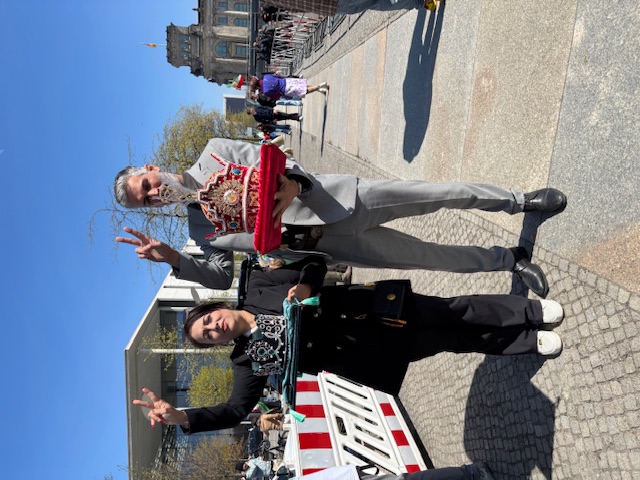
An exiled Iranian couple who had traveled all the way from London on Thursday are not only backing the freedom fighter but apparently also hoping for a long-term political role for the heir to the Peacock Throne. At Berlin’s Platz der Republik, they proudly displayed homemade crowns—one purple and one black—one “for our king” and one for his wife.
gd

%20(1).webp)