When People Become Bargaining Chips
By Gudrun Dometeit
Feeling powerless, knowing you are in the hands of a state authority that does not judge based on questions of individual guilt or innocence but seeks to intimidate and deter, is not a pleasant feeling. In March 2024, I set out for Kazan, the capital of Tatarstan, a Muslim republic about 800 kilometers southeast of Moscow. The republic had long enjoyed a certain degree of autonomy, with its own Kremlin, a monumental mosque, bilingual street signs, and monuments honoring the composer of the Tatar national anthem. I planned to attend an international event, then speak with university faculty and representatives of the German minority, among others, and continue on to Moscow three days later by night train.
But on the evening of my departure, two young men in jeans and sneakers suddenly showed up, quickly produced their IDs to identify themselves as police officers, and demanded that I get into an unmarked car and go with them. Why? I already knew why. I refused to get into their car and instead took the car I had ordered, whose driver was already waiting in front of the hotel. At a remote police station, I was subjected to a roughly three-hour interrogation by what had by then become three security officers. The accusation: I had no accreditation as a journalist—or at least not the correct one. No one said exactly what I needed it for or where I was supposed to have obtained the proper one. I had officially registered, had openly requested permits, and had traveled on a journalist visa. I’d probably spent a little too long chatting with students at a new IT park.
During the interrogation, I couldn’t help but think of Evan Gershkovich, a reporter for The Wall Street Journal, who had been arrested a year earlier on a reporting trip to Yekaterinburg on charges of alleged espionage and taken to the notorious Lefortovo Prison in Moscow. Would they level such an absurd accusation against me as well? Thank God they didn’t. I was released with a fine equivalent to less than 20 euros, to be paid during my stay. Not without being told that I should consider this a sort of “yellow card.” At the last second, my heart pounding, I caught my train to Moscow. At the time, on the advice of a lawyer and following a conversation at the German Embassy in Moscow, I wrote nothing about the episode—which, while unpleasant, was in no way comparable to Gershkovich’s experiences. Other journalists were facing even greater difficulties, and tensions between the West and Russia were escalating almost daily.
Americans as bargaining chips in the power game
“Behind the scenes, a diplomatic hostage game had long since begun between Russia and us,” says Gershkovich at an event at the dpa headquarters in Berlin. The U.S. reporter was sentenced to 16 years in prison in July 2024 and, one month later—after 16 months in prison—was exchanged for Vadim Krasikov, the Berlin Tiergarten murderer and FSB agent. “Russia began detaining Americans and using them as bargaining chips.” The U.S. reporter has now written a highly recommended book (“This Cursed Beautiful Land”) about that time—it is thought-provoking, gripping, and personal, offering insights that go far beyond the harsh reality of daily life in prison.
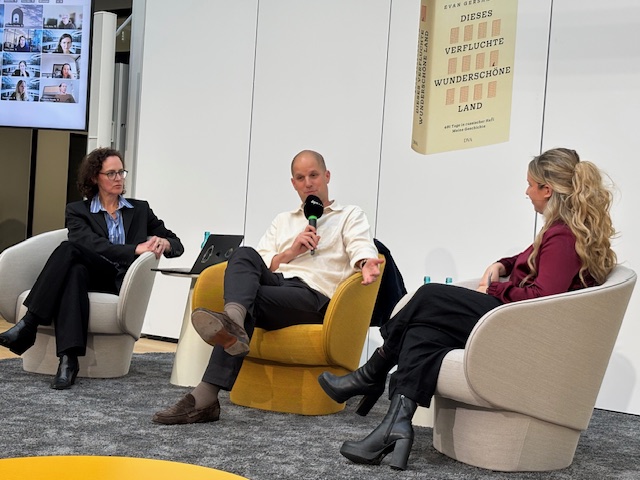
Before Russia’s invasion of Ukraine in February 2022, foreign journalists still enjoyed relative freedom, the 36-year-old says of his time as a correspondent. Starting in 2017, he worked for The Moscow Times, the French news agency AFP, and finally for the American Wall Street Journal. The worst that could happen, he says, was being expelled from the country if the censors took issue with something. The Kremlin had wanted to give the impression of being a “normal country.” After the invasion, harsh censorship measures were imposed, along with a ban on using the word “war” in favor of “special military operation.” Domestic media outlets and journalists faced heavy fines if they violated the restrictions, or ended up in prison. Those who could left the country. At first, foreign correspondents were still debating whether the authorities would crack down on them with the same severity. “But no one—I really mean no one—expected them to go this far,” says Gershkovich.
At Lefortovo Prison, which is under the jurisdiction of the Russian domestic intelligence service, the FSB, the U.S. reporter quickly realized that he was apparently being held for a hostage exchange. He said he had not been tortured, and his guards had spoken openly about the exchange. Letters and care packages from family and friends, regular visits from his lawyers and the U.S. ambassador, and even borrowing literature critical of the Kremlin from the prison library were all permitted. And yet his state of mind fluctuated between elation and despair. This included an “overwhelming sense of guilt” at having walked into a trap. And the realization that he was a pawn in a chess game. “I knew that I enjoyed by far the best conditions in the Russian prison system, and I never forgot that I was a bargaining chip who had to be kept in pristine condition.”
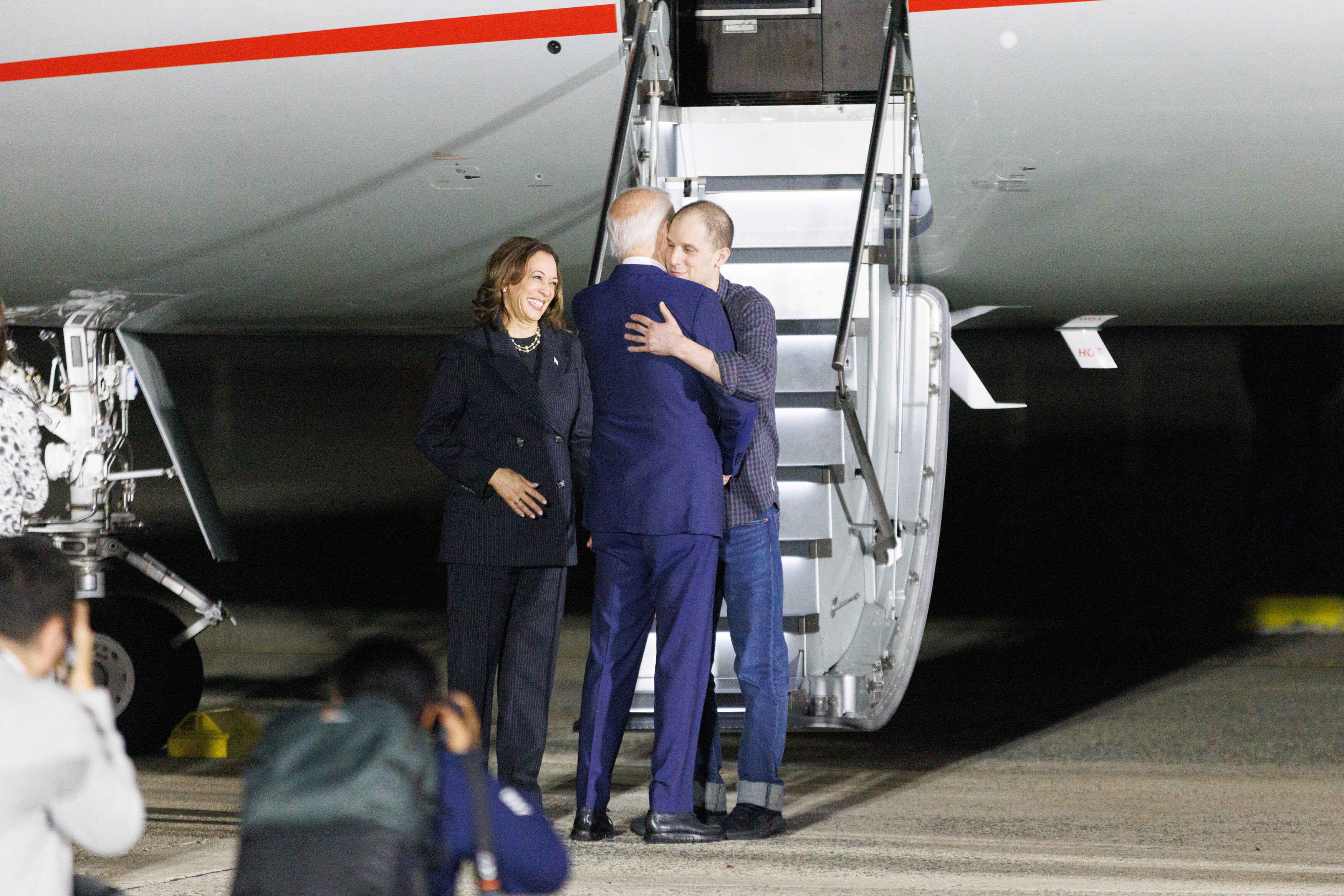
Gershkovich did not expect to be released anytime soon—especially when he learned that Russia’s most prominent opposition figure, Alexei Navalny, had died in custody in February 2024. He was to be exchanged for Krasikov, along with Gershkovich and former U.S. soldier Paul Whelan, who had already spent five years in prison. The U.S. administration under Joe Biden and the German government led by Olaf Scholz ultimately reached a new deal: Krasikov and six other Russians from several European countries in exchange for 16 Western citizens and Russian dissidents. “I thought I’d be in prison for a really long time because I didn’t expect Berlin to ever agree to this deal.” Krasikov had been sentenced to life in prison in Germany for murder.
In his cell—No. 85, 2nd floor, Wing 3—Gershkovich began recording his thoughts, events, and conversations in a diary—the very material from which his book is made. With remarkable precision and often with humor, he describes daily life in prison, his cellmate Serjoga and his jokes—which sometimes take some getting used to—the guards, whom they give nicknames, and how to prepare plov using an electric kettle. The reporter, the son of Russian-Jewish parents, learns prison slang and a better command of Russian than he ever spoke in his parents’ home in the U.S. He conducts conversations with guards and investigators more like interviews, striving, in his own words, to maintain an impartial journalistic perspective. “As a good journalist, it’s your job not to reduce people to platitudes or stereotypes. From the outside, the FSB looks like a monolith. But then you meet individual people with nuanced views and different reasons for working for the intelligence service. I found trying to understand them fascinating. And I also wanted to challenge my own prejudices.”
Russia's inability to break free from history
A large part of the book’s appeal lies in the fact that, despite spending 491 days in Russian custody, the author does not resort to tirades of moral outrage or accusations. Some passages even sound more like a declaration of love. He writes that, when he first started his job in Moscow, he often felt closer to many Russians than to Americans. “Although I had grown up elsewhere, there was something about this country that immediately drew me in; it felt like a world I had known for a long time. Its history was more tragic, but I sensed that it was also more down-to-earth; its people were able to go with the flow of events around them while still maintaining a depth that seemed familiar and comforting to me,” the book states.
He admits in the interview that he has mixed feelings about Russia. The title of the book is telling in this regard. The country is “cursed,” he says, because it is incapable of breaking free from its history, because attempts at lasting reform have consistently failed, and because, apparently, a large majority of Russians have long since disengaged from politics, says Gershkovich. He therefore does not expect a major uprising in the near future. He believes that Navalny’s death has destroyed any hope for a freer Russia. However, he says it would be too simplistic to focus solely on the government and brand it as a brutal dictatorship. “Nevertheless, I naturally went to Moscow back then with no illusions about the state of the country.”
The beauty of Russia—Gershkovich associates it with his Russian-speaking family home and with “the best years of his adult life.” In Russia, he met his partner and made good friends. He loves the way you can have discussions with Russians—about love, death, or honor—which is very different from how it is in the U.S. “Ultimately, a country is much more complex than just the actions it has committed. I tried to bring Russia closer to readers by describing its people, rather than simply declaring it a terrible place.”
After his detention, however, it took Gershkovich half a year to overcome its effects—panic attacks, anger, and insomnia—with the help of therapists. He self-critically admits that foreign correspondents, especially those in war zones, are often adrenaline junkies who lose sight of the danger in their pursuit of a story. “Like frogs in a pot of water who don’t notice when the temperature is slowly rising.” He certainly won’t risk being detained again, especially because of the distress he caused his family. Gershkovich now lives with his girlfriend Mascha in Berlin, the city he had actually planned to move to even before his detention.
According to Gershkovich, Russian President Vladimir Putin declined to grant him an interview. And if he were to get the chance after all, what would his first question be? “I’d like to ask him where he sees his country in 10 or 15 years, and where economic growth is actually supposed to come from. Because he only talks about Russia’s greatness through territorial expansion,” Gershkovich replies. “Some Russian entrepreneurs say,” he adds, “that they feel like they’re on a plane that’s about to crash at any moment and that they can’t get off.”
It’s a surprisingly matter-of-fact, professional response—one that doesn’t carry any undertones of resentment over the time he’s lost. Over the months following his return, he says, he’s transformed from the Vanya he was in prison back into Evan—the now award-winning U.S. reporter—and his Russian side has gradually receded. “Sometimes, though, I imagine that we’re all standing around the fire again at the dacha in Peredelkino. Petya, Polina, and Josh are laughing about something. Masha is slicing fresh cucumbers and tomatoes. I’m tending the grill.”

Evan Gershkovich, This Cursed Beautiful Land
DVA/Penguin Random House (This Cursed Beautiful Land/Crown Publishers, NY),
496 pages, hardcover 28 euros