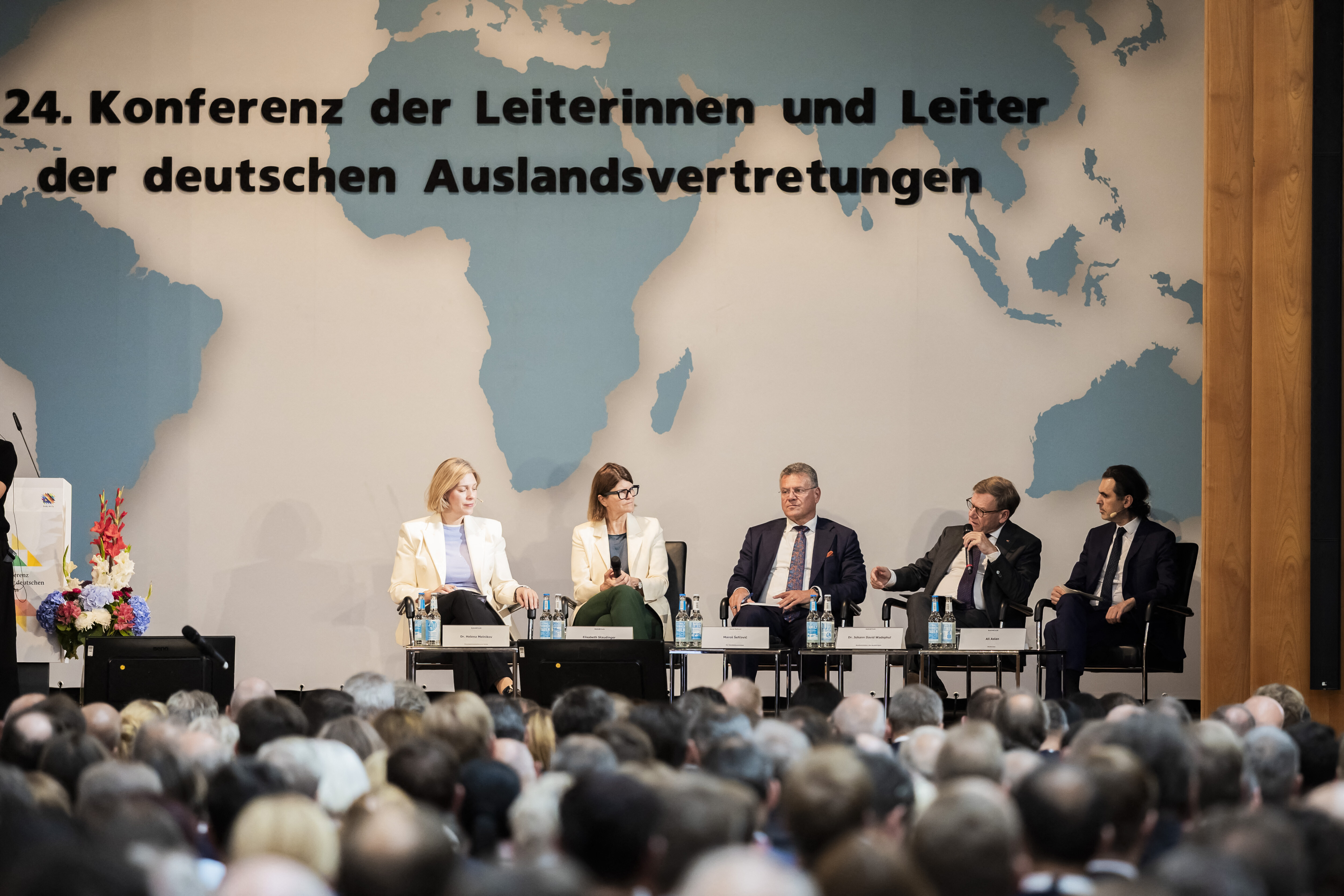
Christoph Heusgen: “The transatlantic certainty is over”
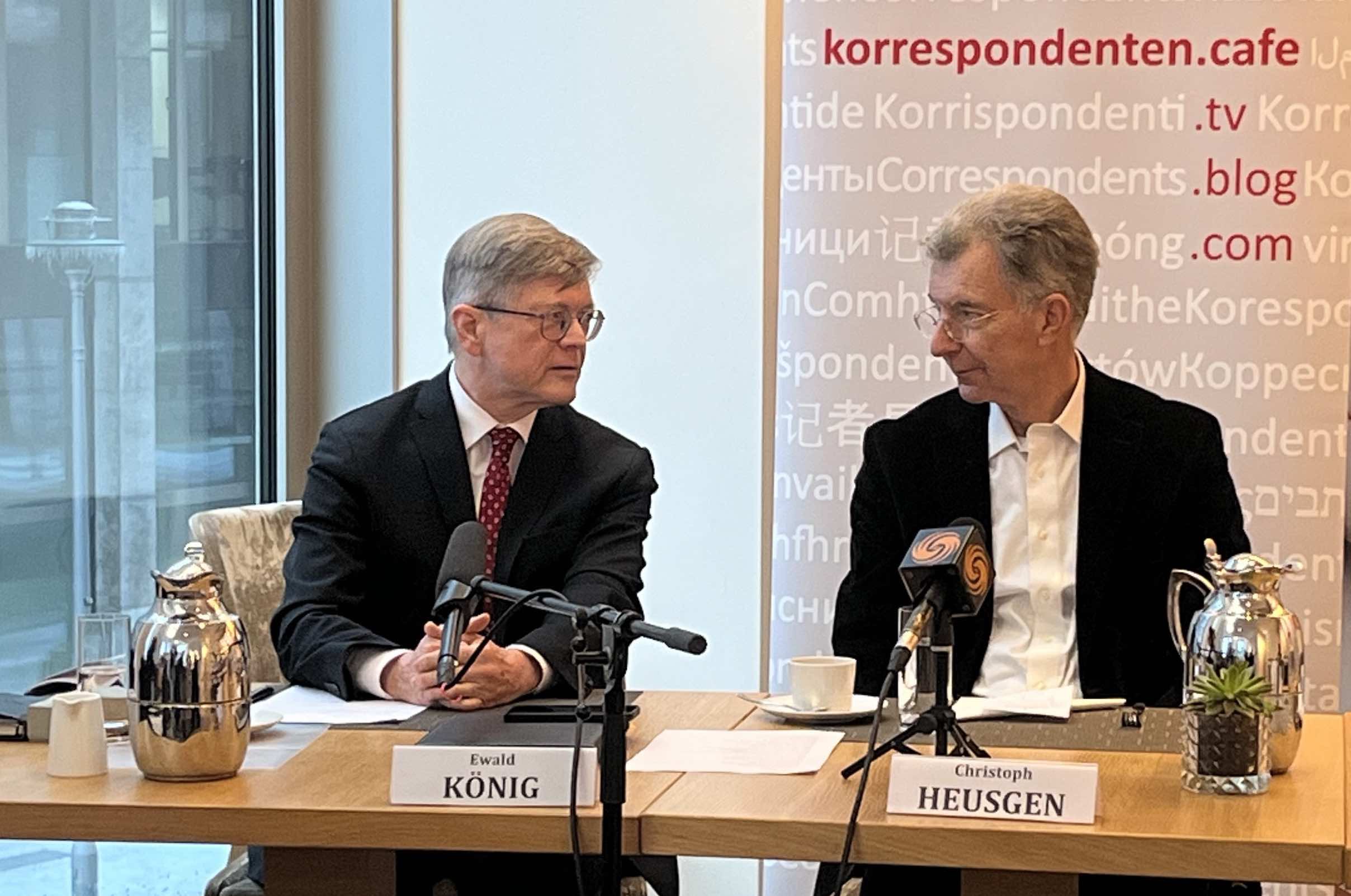
“Listen, Christoph, you have to understand, we are business people. And in business, one day you're friends and the next day you're enemies.”
These were the revealing words of Jared Kushner, coordinator in the White House and son-in-law of US President Donald Trump, to German Ambassador Christoph Heusgen. This conversation from 2017 initially came as a shock to Heusgen, but as an envoy of German Chancellor Angela Merkel, it opened his eyes to what could be expected from the US.
Christoph Heusgen, former foreign policy advisor to Angela Merkel and long-standing representative of Germany to the United Nations, may no longer be chairman of the Munich Security Conference, but he remains a highly respected expert in geopolitics. His analyses are also in demand among foreign correspondents. Heusgen was a guest for the fourth time at korrespondenten.cafe, a format produced by diplo media gmbh. Excerpts from the conversation can be seen on diplo.international on TV Berlin.
His review of the World Economic Forum in Davos and preview of the Munich Security Conference (February 13 to 15) not only provided a candid assessment of the past year, but also served as an urgent warning to Europe.
A turning point for the US: shared values are a thing of the past
For Heusgen, US Vice President J.D. Vance's speech at last year's Munich Security Conference marks a historic turning point. What was expected was a familiar call for higher European defense spending. Instead, Vance launched a frontal attack on Europe for alleged deficits in freedom of expression and freedom of the press, and openly supported right-wing populist forces such as the AfD. Heusgen sees the fact that Vance met exclusively with AfD leader Alice Weidel on the sidelines of the conference, and not with Chancellor Olaf Scholz or other members of the government, as a deliberate political signal.
Donald Trump's subsequent appearance with Ukrainian President Volodymyr Zelensky in the Oval Office made it clear that the transatlantic community of values no longer exists in its previous form. “We no longer share the same values with this America,” said Heusgen. The decades of reliability in the partnership are over.
Heusgen illustrated his diagnosis with a personal reminder from 2017, when he held talks at the White House on behalf of the Federal Chancellor and was bluntly explained by Jared Kushner how politics would be conducted as a business in the future. What shocked him back then has now become an indicator of how to deal with the USA under Trump. For Germany and Europe, what Merkel said after her first frustrating encounters with Trump in the fall of 2017 still applies: “We must prepare ourselves for the fact that we can no longer necessarily rely on our most important partner.”
Heusgen's conclusion: Europe must finally prepare itself to stand on its own feet in terms of security and defense policy. The US remains important, for example in terms of equipment and nuclear deterrence – but dependence is a strategic risk. “We depend on America for deterrence. But it is extremely important that we also become increasingly independent in defense.” The consequence, he said, is that “Europe's hour has come. Europe must take on more responsibility.”
Europe can be defensive: Finland as a role model
Heusgen sees encouraging examples in Europe itself. At the World Economic Forum in Davos, Finland's President Alexander Stubb gave an impressive account of how well his country is prepared for defense even without the US: conscription, strong reserves, functioning homeland security. Finland is also the happiest country in the world. Military readiness and quality of life are therefore not a contradiction.
Russian President Vladimir Putin continues to believe that he has the longer lever in the war against Ukraine. Heusgen, however, warns against an overestimation of Russia's strength. The losses are enormous, recruitment is becoming more difficult, the sovereign wealth fund is largely depleted, the economy is fixated on armaments and structurally weakened. Demographic problems are further exacerbating the situation.
Heusgen describes Ukraine's capacity for suffering as extraordinary. Giving up is not an option for the population – torture, violence, and deportations under Russian occupation are too present. “Ukrainians know what happens when they give up. They have experienced what happens to the population under Russian rule, with violence, kidnapping of children, and torture, and what happens to those who, for example, do not want to take Russian passports.” As he knows the Ukrainians, they will not give up despite the losses, even though it is getting harder and harder.
"What Putin may not be told by his own people is that the situation in Russia is not as rosy as he always portrays it. I received statistics from a good diplomatic colleague. It says that last month, for the first time, the number of Russians killed was greater than the number of newly recruited Russians." There are major problems with recruitment.
China as a beneficiary of the war and strategic challenger
China is in no way moderating Russia, but is benefiting from its growing dependence. Russia is becoming an “armed gas station” for Beijing. At the same time, China is using the West's distraction caused by the Ukraine war to expand its influence in the South China Sea and vis-à-vis Taiwan.
Although Heusgen believes that a short-term military attack on Taiwan is unlikely, he warns of scenarios such as a blockage. China's political system is increasingly tailored to Xi Jinping – a risk not only for the region.
“Frontal attack on the United Nations”
Heusgen is particularly concerned about the weakening of the rules-based international order. As a former UN ambassador, he sees the United Nations under massive pressure from both inside and outside—ironically from the US, which was once its most important architect and is now undermining its foundations. New, informal power circles without democratic legitimacy, such as the “Peace Council,” are a frontal attack on international law and the United Nations.
For Heusgen, one thing is clear: despite all its shortcomings, there is no alternative to the United Nations. The trend away from the rule of law toward the law of the strongest must be actively combated.
No prospect of peace in the Middle East
Heusgen sees no cause for optimism in the Middle East. Neither the Israeli-Palestinian conflict nor the situation in Iran show any realistic prospects for stability. The Israeli government's rejection of a two-state solution, the ongoing settlement of the West Bank, and the power of Hamas make political solutions virtually impossible. A regime change in Iran also seems unrealistic.
Europe's answer: unity and new alliances
Despite all the problems, Heusgen is counting on Europe. The EU has shown, for example in the dispute over Greenland, that it can act effectively as a bloc. In the future, closer cooperation between like-minded democracies will be necessary—a new edition of the “Alliance for Multilateralism” that brings together states committed to human rights, the rule of law, and open market economies. His final appeal: Europe must take responsibility, show presence—including in the Global South—and believe in its own strength. “Europe's hour has come,” said Heusgen.
ekö
.JPG)
.jpg)