The militarization of space and Europe's race to catch up

Navigation, communication, weather forecasts, commodity trading, financial systems, traffic flows, disaster relief—hardly anyone realizes how much today's world depends on information obtained from space. “Everything that really helps us understand what is happening in the world is based on satellite information,” said Nicolaus Hanowski, Head of Earth Observation Mission Management at the European Space Agency (ESA) in Berlin. "We know exactly where ships are moving. Our satellites measure the levels in oil tanks.“ And even the food supply in Ukraine cannot do without data from satellites, because they continuously monitor crop yields. ”If I were to interrupt the data streams," said Hanowski, who is responsible for the Copernicus program of the ESA and the EU, “disaster management, coastal and maritime surveillance, fisheries, forestry, and agricultural management would very quickly come to a standstill.” The ESA produces ten times as much data as NASA. Europe is by far the world leader in Earth observation.
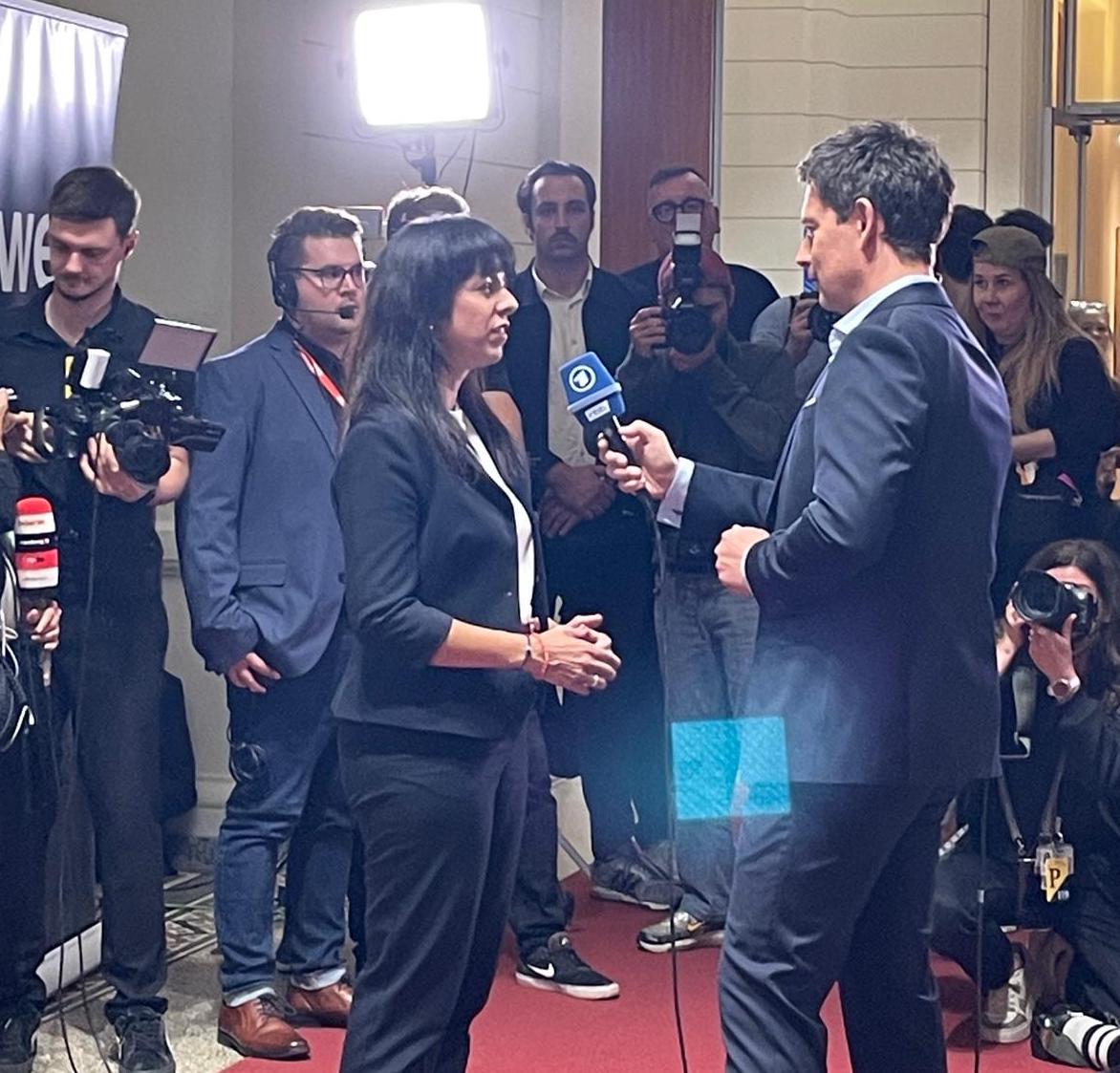
Hanowski took part in an event organized by diplo.news and the Diplomatic Council, at which former German Ambassador Heinrich Kreft presented the book “Space Security: Extending Europe's Defense into Space” (published by Diplomatic Council Publishing). In it, Kreft and 22 other European authors focus primarily on the increasing militarization of space. Satellites no longer serve exclusively civilian purposes, but increasingly military ones. At the same time, they are highly vulnerable, and protecting them is difficult and costly. They could be spied on, blinded, disrupted, and destroyed from the ground, the air, and space. Kreft cited last year's “incidents” of two German military satellites by Russian satellites and the permanent disruption of GPS signals over the Baltic Sea as examples. The vulnerability became clear at the latest with the disruption of Starlink satellites, which Elon Musk had made available to Ukraine in 2022. This also deactivated a control system for wind farms in the North Sea. “When satellites fail, entire societies fail,” Kreft explained.
The days of peaceful, purely scientific cooperation in space are largely over. Space is becoming increasingly strategically and militarily important. It is no surprise who is driving this development: The US, China and Russia. According to Kreft, the US remains the leading power, technologically, militarily and commercially. Since Donald Trump's first term in office, they have viewed space as a combat zone, with clear doctrine and the expansion of capabilities. China is catching up very quickly, with space being central to the country's status as a world power and to its military modernization. Russia is a destabilizing actor with established capabilities and a focus on prevention and destruction. ". And all three prepare for conflict in space. Open or at least implicitly."
Despite flagship projects such as the Copernicus Earth observation system and the Galileo navigation system, as well as significant additional investment, including from the German government, which plans to provide €35 billion for security-related space projects by 2030, Kreft believes that Europe is reacting far too slowly to such developments. There is no common doctrine, no common deterrence logic, no clear command structures. Europe is dependent on others, primarily the US, for launch vehicles. Elon Musk dominates the launch vehicle market, essentially launching a rocket with dozens of satellites every 28 hours. Europe also needs launch sites on its own continent; transporting rockets to Guyana in South America takes far too long when satellites need to be replaced. Europe must also develop deterrence capabilities to prevent the destruction of satellites. “Europe must be able to detect threats, to attribute attacks, and to respond proportionally, not aggressively, but convincingly.”
You can read the full transcript of the event under this link: “Security in space — How we defend Europe in space”

.webp)