Generating energy under geopolitical pressure: Can nuclear fusion help?

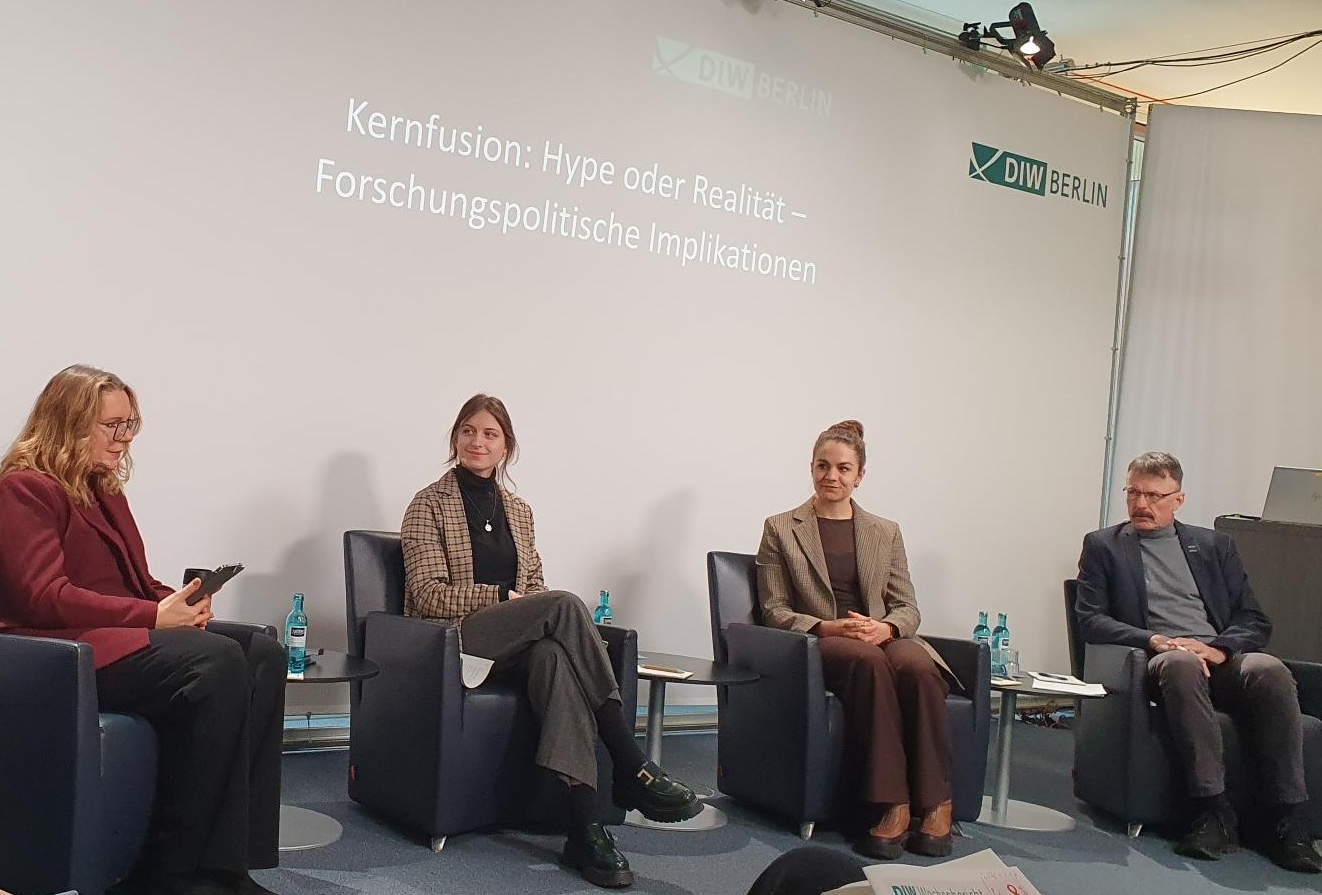
“Energy issues will remain with us in a dimension that we cannot even imagine yet,” predicts Robert Wolf from the Max Planck Institute for Plasma Physics (IPP) – but nuclear fusion does not seem to offer much promise of salvation. This was the impression conveyed at a conference held by the German Institute for Economic Research (DIW) on the future of energy supply, where critics warned against exaggerated expectations.
Right at the start, Claudia Kemfert, head of the energy department at DIW, said that nuclear fusion would become the new energy supplier “in a few years” — but that has been the case for decades. The energy promise was missed; despite decades of investments, nuclear fusion remains irrelevant in the energy sector. “Nuclear fusion is likely to come too late, perhaps in 2040 or 2050,” said Kemfert. “But by then we will be so far along with the energy revolution that it will no longer play a role. ”
According to the scientist, nuclear fusion is less an energy policy issue than an issue of innovation and technology policy. Kemfert believes that nuclear fusion will not be able to make a significant contribution to the desired climate neutrality by 2045. There are too many technical questions unanswered, and the economic uncertainties are too great.
But fusion research is certainly useful for innovations and technological advances in niche products. It helps with the development of magnetic research, laser technology, new high-performance materials and advances in simulation, plasma physics and high-vacuum technology. These technologies are already being used in industry and medicine today. Nuclear fusion is therefore also considered a driver of innovation with spillover effects.
The event in Berlin brought together scientists and industry representatives. The focus was on the question: Can nuclear fusion—not to be confused with classic nuclear fission—make a realistic contribution to the energy transition? Or is it simply too late? The debate was controversial, with differing views on the role of nuclear fusion clashing. Not only Claudia Kemfert, but also Charlotte Dering from the Technical University (TU) of Berlin, co-author of the DIW study, emphasized that the use of nuclear fusion for energy is not foreseeable.
The conference focused not only on largely unresolved technical and economic issues, but also on regulatory questions. In several countries—the US, the UK, and Japan—fusion is not regulated under traditional nuclear law, but under industrial or radiation protection law. A corresponding adjustment is also being discussed in Germany.
If nuclear fusion were nevertheless useful as an energy supplier one day, it would have several advantages over conventional nuclear energy. When it comes to safety issues in particular, it is emphasized that there is no self-sustaining chain reaction in nuclear fusion as in nuclear fission. If the energy supply is stopped, the reaction ends. As a result, a scenario such as a reactor accident (Maximum Credible Accident) is physically considered virtually impossible.
Activated structural materials also have significantly shorter half-lives than highly radioactive waste from nuclear fission, which means that long-term final storage problems could be avoided.
Global energy demand will continue to rise due to industry, data centers, and artificial intelligence, but nuclear fusion remains irrelevant in terms of energy economics despite decades of investment. The DIW considers the German government's goal of connecting the world's first functional fusion reactor in Germany to be unrealistic.
One argument put forward by proponents is that, against the backdrop of the new geopolitical landscape, nuclear fusion promises extensive energy security even in turbulent times. They also point to US President Donald Trump, who has also entered the fusion energy market. With his Trump Media and Technology Group (TMTG), he also wants to launch the world's first commercial fusion power plant in six years.
Sophia Spitzer from the Marvel Fusion start-up, which cooperates with Siemens Energy and Colorado State University, asked: “Where is our vision?“. The start-up has raised 380 million euros in capital from private and public donors. A prototype is planned for the beginning of the 2030s, “with which we want to exceed the energy generation threshold for the first time. And in the mid-30s, a commercial power plant will be built,“ Spitzer is convinced. Germany has already missed out on so many developments and now has the chance. " 'How long will it take?' and 'When will it finally happen?' are typical German questions. In America, people would ask: What do I have to do to make it happen? We have to get started!"
ekö

.jpg)