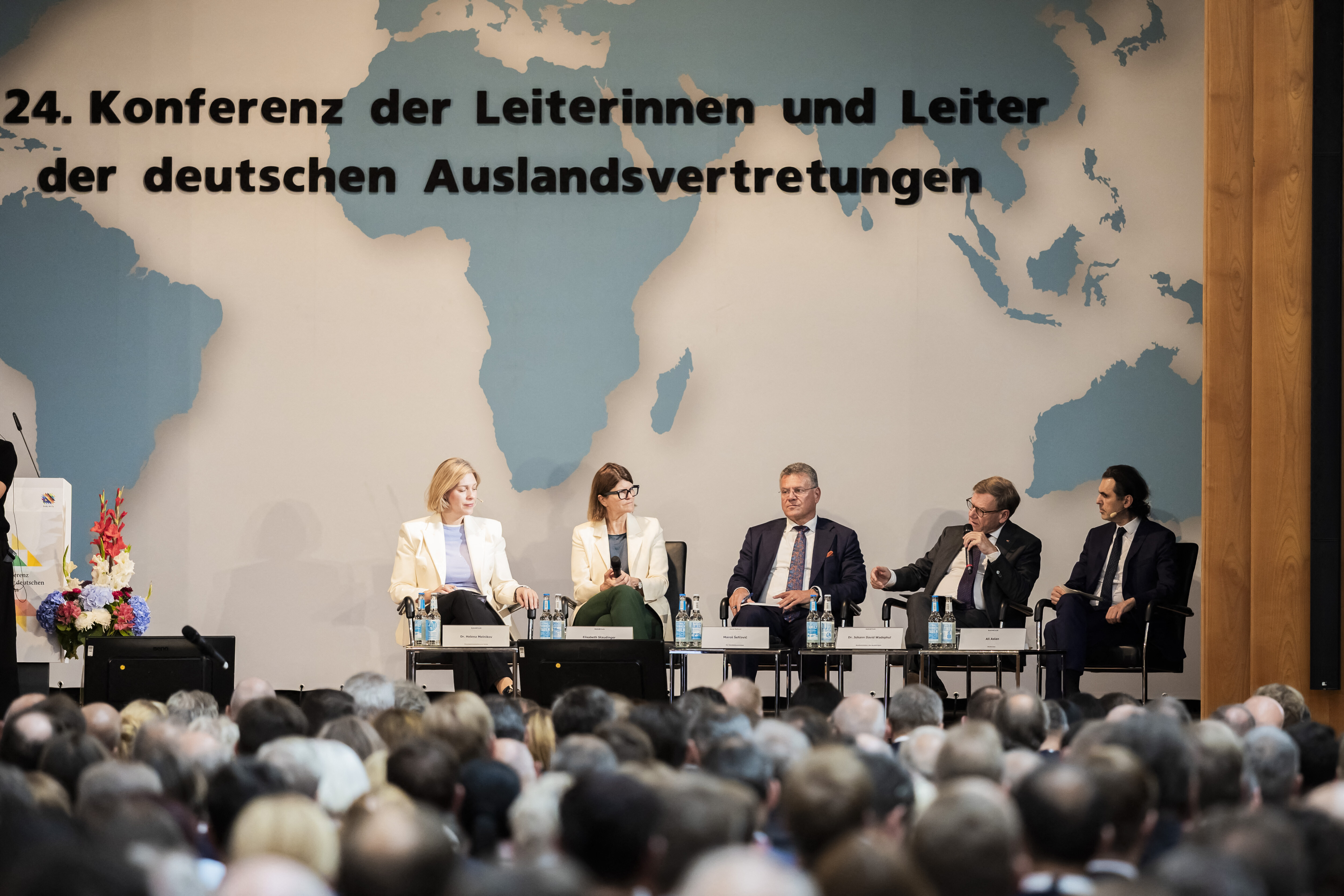
Estonia has opened a business hub in Berlin

Estonia wants to represent its economic interests more strongly in Germany in the future, and the embassy in Berlin is to play an important role in this. Foreign Minister Margus Tsahkna opened an “Estonian Business Hub” at his country's Berlin representative on Thursday evening. The center is intended to be a new platform for export promotion and technological cooperation not only with Germany, but with the whole of Central Europe. There are already similar business centers in London, Paris, Riga, Washington, Seoul and Singapore, which were set up with the help of the Estonian Ministry of Foreign Affairs. “The new business hub in Berlin will bring companies from both countries together, promote cooperation and show how closely innovation and diplomacy are linked today,” emphasized Tsahkna at the newly renovated embassy in Berlin's Tiergartenviertel.
Economics Minister Katherina Reiche (CDU) also took part in the opening — at least briefly between budget consultations and coalition talks. She emphasized that Germany could learn from the Baltic state's extremely lively business climate. Estonia is a pioneer of digital innovation, not only in the private business sector but also in terms of its government institutions. Cabinet meetings there have been paperless for years, and according to Estonian sources, government services are completely digitized. According to Reiche, in order to increase its competitiveness, Germany still needs to do some homework and press ahead with its internal reforms. However, the EU Commission also needs to reduce bureaucracy, impose fewer burdens, and make decisions more quickly.
Like the other international centers, the Berlin hub is consciously closely linked to the embassy and is intended to demonstrate how much the Estonian government supports its companies in becoming more visible on international markets. Ambassador Marika Linntam cited Singapore as an example, where the Estonian company CryptoSwift used the embassy's premises during the Token2049 international blockchain conference for an exclusive networking event with industry leaders. In Washington, defense company Vegvisir found access to important government institutions via the local business hub and was able to establish a North American development partnership. Seminars, workshops and networking events are also planned in Berlin.
In addition to Finland and Sweden, Germany is one of the most important export markets and trading partners of the state with 1.4 million inhabitants. In terms of its population, Estonia has the highest start-up density in Europe, and also an unusually large number of “unicorns” — companies valued at more than one billion euros in relation to the number of inhabitants. The world-famous success stories include the taxi alternative Bolt, the video calling service Skype acquired by Microsoft and now discontinued, and the online money transfer service Wise. The state is also promoting the establishment of companies with fast digital processes and favourable taxes.
gd

.JPG)