Fighting by any means necessary
By Milán Dóka
Following his election victory in 2010 and backed by a two-thirds majority, Viktor Orbán set about reforming one of his first major projects: the electoral system. Constituencies were redrawn – clearly to the advantage of his own party, the national-conservative Fidesz (Hungarian Civic Alliance). This was accompanied by measures such as the so-called ‘winner’s bonus’ and the right to vote for newly naturalised Hungarians living in neighbouring countries, which also helped the governing parties. In this barely proportional electoral system, Fidesz was thus able to secure a two-thirds majority in parliament time and again with around 45 per cent of the vote.
This system was bolstered by further measures: extensive control of the media market, the use of state resources in election campaigns, outsourced campaigns via GONGOs (government-organised non-governmental organisations) and pressure exerted by state institutions on opposition parties. Observers from the Organisation for Security and Co-operation in Europe (OSCE) therefore concluded that the parliamentary elections of 2014, 2018 and 2022 did not fully meet the criteria for democratic elections.
Hungary was thus long regarded as an electoral autocracy: parties did not compete on a level playing field, yet the elections themselves were free (“free but not fair elections”). Now, however, with Orbán facing a serious challenge for the first time in years from Péter Magyar, leader of the pro-European Tisza (Respect and Freedom Party), he appears ready to go even further to remain in power.
From electoral autocracy to dictatorship?
After 14 years in government, Fidesz fell behind in the polls for the first time at the end of 2024. Since then, the Tisza Party has been able to extend its lead – with just under four weeks to go before the election on 12 April, polls suggest it is ten to fourteen percentage points ahead. At the same time, the government’s well-oiled campaign machine is stalling, and the weak economic situation leaves little scope for generous election handouts.
Orbán is responding to this with a new political enemy: Ukraine. The conflict with the country, which has been waging a defensive war against Russia for four years, has recently escalated significantly. At the end of January, the Druzhba oil pipeline was damaged once again during a Russian attack. The Ukrainian side did not immediately repair them this time. Budapest seized on the incident in its communications, describing it as an attempt by Kyiv to influence the Hungarian elections through an “oil blockade”. The government reacted promptly: Foreign Minister Péter Szijjártó initially blocked an EU loan package of 90 billion euros for Ukraine. Shortly afterwards, Hungarian authorities stopped a Ukrainian cash transport convoy and seized cash and gold worth around $82 million. According to Oschtschadbank and the Austrian Raiffeisen Bank, it was a legal bank transport from Austria to Kyiv, carried out regularly since the start of the war, of which the Hungarian authorities had been informed.
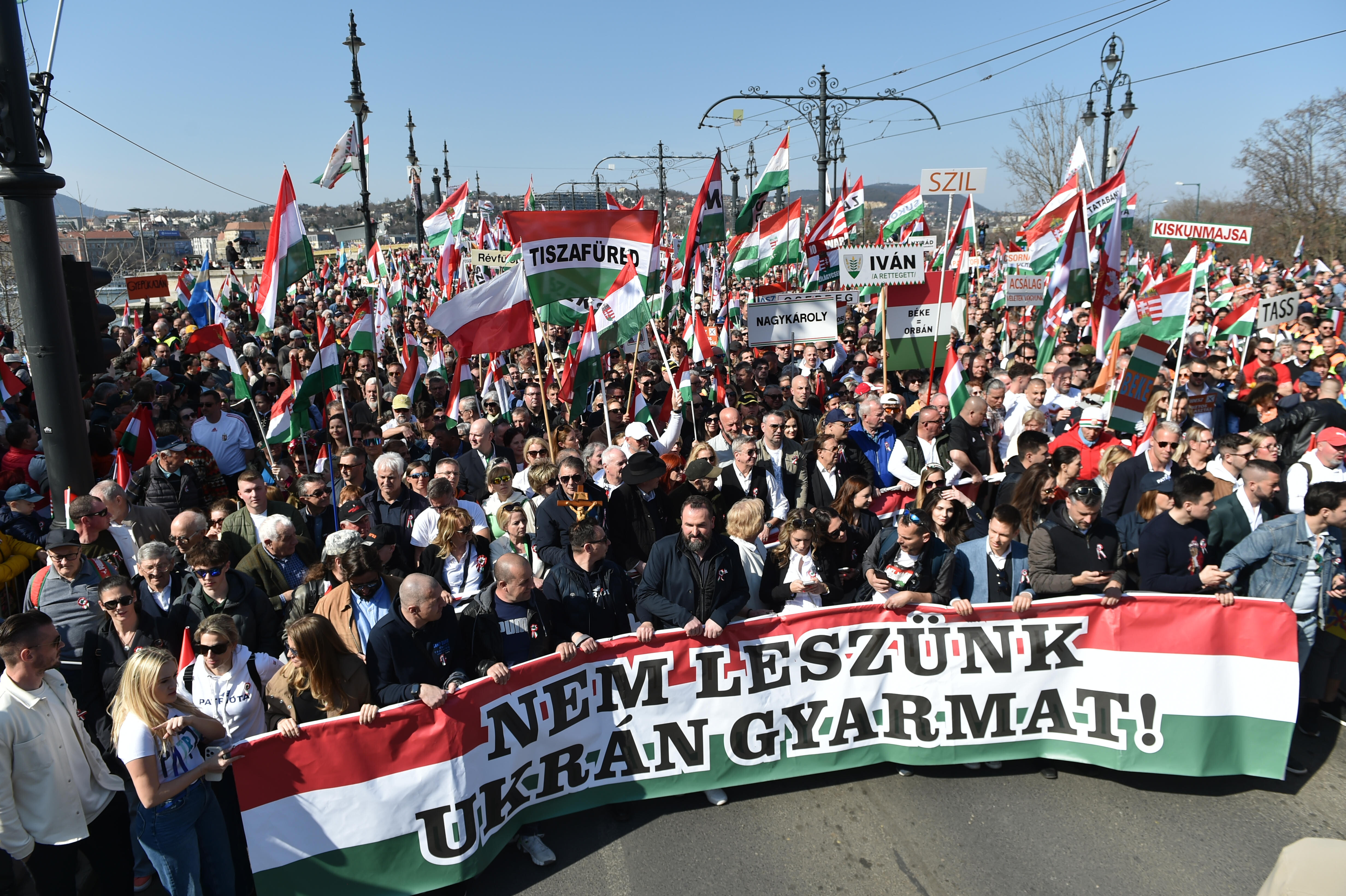
Government statements now even refer to Ukrainian actors threatening Orbán and his family – including President Volodymyr Zelenskyy. The impact of these messages was evident at the Fidesz rally on National Day: Demonstrators carried banners with the inscription “We will not become a Ukrainian colony.” The events are part of a clear narrative: Ukraine is said to be threatening Hungary’s sovereignty, seeking to influence the elections and topple the government. Shortly after the cash transport was seized, it was suggested that the money might have been intended for the opposition. Orbán himself spoke in an interview of intelligence reports claiming that Ukrainian authorities were funding the Magyar movement. In Hungary, accepting foreign party donations is a criminal offence – even if this alone does not justify banning a party. Politically, however, this narrative could still be sufficient to refuse a handover of power in an emergency – citing an alleged Ukrainian influence operation.
From Moscow with Love
Information from American secret services also indicates that a three-person Russian group is supporting the Fidesz election campaign. They are said to belong to the military intelligence service GRU and have been in Budapest since January – according to media reports, holding diplomatic passports and benefiting from diplomatic immunity. The methods are reminiscent of Russian influence operations in Moldova: paid influencers, automated social media networks, bot farms, artificial intelligence and disinformation. The group is said to report to the deputy head of the Russian Presidential Administration and former Prime Minister Sergei Kiriyenko, who also coordinated the operation in Moldova and is part of Vladimir Putin’s inner circle.
The Russian embassy in Budapest also took part in the election campaign and engaged in verbal battles with opposition leader Magyar on social networks. The political message from Moscow was particularly clear by President Putin himself: Hungary is entitled to Russian energy resources — as long as it continues its current policy.
Russia's interest is clear. Moscow wants to keep a government in power that regularly blocks joint action against Russia within the EU and thereby indirectly supports Russian war aims in Ukraine. In Moldova, a similar operation ultimately failed, though the result was a close call. For the Kremlin, the Hungarian elections are far more important strategically. Even experts such as Zalán Alkonyi, a Russia analyst at the pro-government Mathias Corvinus Collegium (MCC), speak of one of the largest verifiable Russian influence operations in Europe.
How is the European Union responding to this?
So far, mainly with silence. Brussels obviously wants to avoid any impression of interfering in the Hungarian election campaign. But what would happen if Russian influence operations actually contributed to a close Fidesz victory — amplified by the distorted electoral system? An even more delicate scenario would be a victory for the Tisza Party, which the government refuses to recognise, citing alleged Ukrainian interference.
The EU’s set of tools for dealing with such scenarios seems ill-suited to the task. Freezing EU funds has had little effect so far. For 16 years, Orbán has been pushing back political red lines without the member states being able to stop him. The Article 7 procedure to suspend certain membership rights is also at a standstill – a withdrawal of Hungary’s voting rights would be politically almost impossible to enforce at present, not least because of Slovakia.
This institutional weakness undermines the EU in its geopolitical competition with authoritarian powers. Budapest continues to block common positions – through vetoes as well as through its political messaging. Even more worrying, however, is the signal this sends to other political forces in Europe that are becoming increasingly populist whilst simultaneously serving Moscow’s interests more and more.
The author, Milán Dóka, is a freelance Hungarian journalist based in Berlin.
.JPG)
.jpg)