The Battle for Space
By Heinrich Kreft
Until the 1970s, space travel focused on the moon and the competition for national prestige between the two superpowers USA and Soviet Union. After early successes by the USSR (“Sputnik”), the USA finally won the race with the manned moon landing. As part of the policy of détente and after the end of the Cold War, there was also a phase of cooperation in space, symbolized by Soviet-American coupling manoeuvres in space and the joint operation of the international space station ISS. But 55 years after Apollo 11, the rivalry in space is rapidly intensifying again.
Space is no longer a purely scientific area, but a strategic arena in the global power struggle. In addition to the traditional players USA and Russia, China has become a leading space power, and India has also made significant progress in recent years. The national security strategies of the USA, China and India attach central importance to space travel for security and defense, but also for the national economy. A quote from US President Donald Trump exemplifies the new superpower competition: “You can't be number one on earth if you're number two in space. ”
Can Europe, with its diverse space agencies and companies, keep up in this international competition? With Copernicus and Galileo, the European states are among the leading nations in the fields of Earth observation, meteorology and navigation. However, there are significant deficiencies in manned space travel, in the construction of large satellite constellations (such as Starlink), in security and defense, and in the commercial use of space in general. The role played primarily by satellite communications in the Russian-Ukrainian war and NATO's dependence on US capabilities in this area, combined with growing doubts about the reliability of the USA, should shake up European (space) policy.
The growing importance of the space economy
But it is also about Europe's positioning in a key future field, which Mario Draghi highlighted in his 2024 report on European competitiveness. The global space industry exceeded 600 billion US dollars for the first time in 2024, according to the latest Space Report from the US Space Foundation, a non-profit organization that regularly publishes analyses and data on the development of the space industry. For 2032, the organization predicts a market volume of one trillion US dollars.
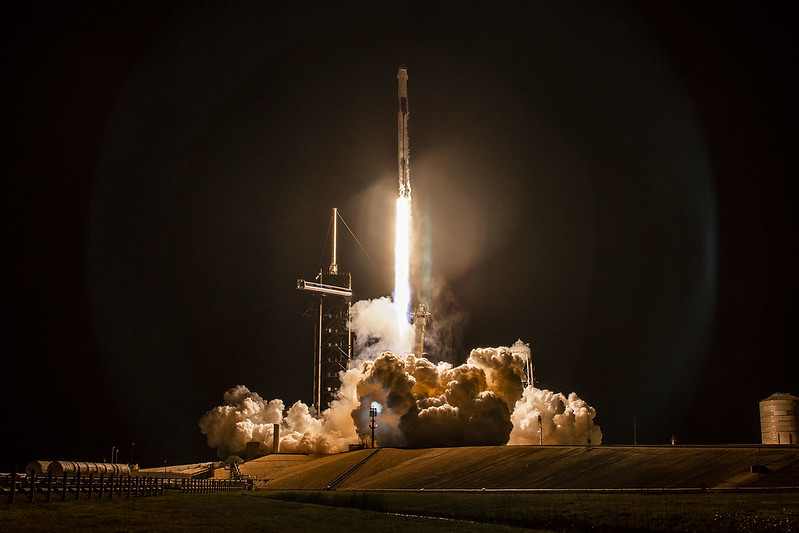
In 2024, commercial providers accounted for 78 percent of the global volume, while government programs accounted for the rest. Government spending on space rose by 6.7 percent to a total of 132 billion US dollars. The USA alone invested 77 billion of this in national security and civil space programs. Among private space companies, SpaceX stands out. Elon Musk's company alone carried out 165 of the 306 so-called orbital launches worldwide in 2025 (as of December 15), which successfully put payloads into orbit. This year, such a rocket launch took place every 28 hours.
Europe, once a leader in this area, has so far only had three successful orbital launches with Ariane 6 from Centre Saptial Guyaniais (CSG) in Kourou, French Guiana this year. There are also three launches of the small Vega-C from Italy. After all, this means that Europe once again has its own access to space, which was lost due to the late entry into service of Ariane 6 and the retirement of the predecessor model in 2023.
China as the US's biggest rival
In the USA, it is primarily private companies that have driven innovation forward in recent years. In addition to SpaceX, this includes Jeff Bezos' Blue Origin company and a larger number of lesser-known start-ups, but Boeing, the former market leader, also continues to do good business with NASA. The secret of the USA's success is a mix of government leadership and private-sector innovation, which dates back to the opening of outer space to private actors during the presidencies of Ronald Reagan and Barack Obama.
China has risen to become the US's biggest rival, and at record speed. Since the 2000s, the country has made tremendous progress, with its own space programs, manned missions, lunar and Mars expeditions, and its own space station (Tiangong). Beijing scored a triumph in 2019 with the first-ever landing on the far side of the moon.
Russia, a pioneer in space travel, is also still an important player, particularly in the field of manned space travel and satellite technology. The USA and Russia are still cooperating on the joint space station ISS. While the US plans to cease operations by 2030 at the latest, Russia plans to detach its own modules and use them as the nucleus of its own space station.
With little attention from the global public, India has built up an efficient and cost-effective space industry, which is best known for satellite launches and scientific missions. In 2023, India became the fourth nation to successfully land an unmanned spacecraft on the moon.
With the European Space Agency (ESA), the EU's space program, and numerous national space agencies and private partners, Europe is a significant player, but compared to the other players, it is more of a medium-sized player with some strengths and considerable weaknesses. Europe has a strong industrial base, particularly in satellite technology, space technology, and scientific research. Internationally, the ESA works closely with international partners, primarily NASA and Elon Musk's SpaceX, and, until Russia's attack on Ukraine, Roscosmos. The focus has been on science and sustainability with satellite constellations (e.g., Galileo navigation system), Earth observation (Copernicus), and space research.
Militarization of space
Today, space has become a terrain where power, technology and sovereignty overlap. Communications, navigation and reconnaissance satellites form the critical infrastructure of modern societies and are therefore both a target of attack and an instrument of power. Controlling space means control over information flows, global mobility, and military deployability. However, the militarization of space began not just in this century but in the early phase of the Cold War. The start of Soviet Sputnik in 1957 already marked the entry into a new strategic era. Orbit became an extended front line between the superpowers. Spy satellites, ballistic missiles and early warning systems fundamentally changed the strategic balance. With the end of the war, this dimension seemed to lose importance for a short time. But digitization, global networking and increasing dependence of civil and military systems on satellite data have brought space back into security logic. Today, it is regarded as the “fifth domain” of military operations management — in addition to land, sea, air and cyber.
The 1967 Outer Space Treaty, which prohibits the deployment of weapons of mass destruction in space, was unable to prevent this initially creeping and now open militarization of space. The political will of the leading space nations is lacking in the political will to adapt it urgently to new technological developments. Without this willingness, even the United Nations cannot limit militarization. The world organization is more successful in preventing collisions in increasingly overcrowded orbit and limiting space debris. Over a million objects — old satellites, rocket parts, debris from anti-satellite tests — are orbiting the Earth. Such debris recently hit a Chinese spaceship and prevented the crew of the Chinese space station from returning to Earth.
The strategic importance of space lies in its function as a multiplier of military and economic power. Communications satellites secure the command structures of modern armed forces, navigation systems such as GPS (or GALILEO) enable precise weapons management, and Earth observation systems provide real-time data for reconnaissance, climate policy and crisis management. Anyone who controls access to orbit has a decisive dimension of power and command in the modern world order.
Europe also needs offensive capabilities
In this new geopolitical constellation, Europe must also learn to think about and defend its security in orbit. Like all developed countries, it is increasingly dependent on critical infrastructure in space. Satellite networks have become the Achilles heel of modern societies. Satellites can be disturbed, dazzled, manipulated, and kinetically destroyed. Russia not only switched off its satellite communications a few hours before its attack on Ukraine, but also showed that it also had this capability by kinetic destruction of its own satellite a few weeks earlier. In doing so, Moscow has accepted to endanger the lives of the ISS crew, including its own cosmonaut. Russian activities are now directly directed against parts of the European space infrastructure. For example, Moscow has positioned reconnaissance satellites in close proximity to Bundeswehr and western state systems and is tracking INTELSAT satellites, which are also used by the German Armed Forces. “Russia's behavior,” according to German Defense Minister Boris Pistorius, “is a fundamental threat to us all, especially in space. It is a threat that we can no longer ignore.”
In principle, space travel can be used in two ways. For example, weather data is of great value for both agriculture and the military. And this also applies to many other data and capabilities. At the same time, space infrastructure is highly vulnerable and must therefore be protected as best as possible. This requires, among other things, hardening satellites and building redundancies and the ability to replace lost infrastructure quickly and autonomously. However, since this can only partially ensure the sustainable functioning of critical space infrastructure, attacks must be prevented by means of a credible deterrent. This then also includes offensive capabilities.
More money, more strategy to catch up
One of Europe's weaknesses is financing, which still comes from public funds worldwide in 85 percent of cases. SpaceX also receives the majority of its orders from NASA and the Pentagon. While Europe has so far spent just 0.07 percent of its GDP, i.e. around 14 billion euros per year, on its space activities, the USA is investing around five times as much. There are also significant differences between European nations. So far, Germany has only used half as much funding as France, which is also the leading space nation in Europe. With the space security strategy published in November 2025 and developed jointly by the Federal Foreign Office and the Federal Ministry of Defense, Berlin is closing a strategic gap, because other states — including the USA, France, Great Britain and Spain — have already had their own strategies for security and defense in space for several years.
For the first time, the strategy creates a basis for a national space security architecture with the goals of protecting space infrastructure, strengthening its resilience and building defense capabilities in space. The focus is on protecting German satellites and ground segments, expanding space surveillance, secure communication and capabilities to deter attacks in and from space. The strategy aims to build a strong German pillar in NATO and the EU and to intensify cooperation with partners. At the same time, the planned investments should also strengthen the German and European space industry. Up to 45 billion euros are planned for space-related projects by 2030 — around 35 billion euros from the Ministry of Defense and around 10 billion euros from other departments, including the Ministry of Research, which now also has space travel in its name.
A corresponding signal at European level was sent out by the ESA Council of Ministers, which took place in Bremen on 26/27 November. There, the 23 member states of ESA have set the course for Europe's role in space: financially, technologically and politically: At 22.1 billion euros, the space agency receives the highest three-year budget to date. Germany has increased its contribution by almost 30 percent to 5.1 billion euros and thus remains the largest contributor. Almost all proposed projects by the Director General were approved, including the “European Resilience from Space” programme. With the ERS program, ESA is explicitly given a mandate for security and defense, as the satellites intended for this purpose are primarily intended to provide military reconnaissance data.
Space is a key to Germany's and Europe's future — it strengthens our industry across industries, secures technological sovereignty, opens up new business models and makes a growing contribution to our security.
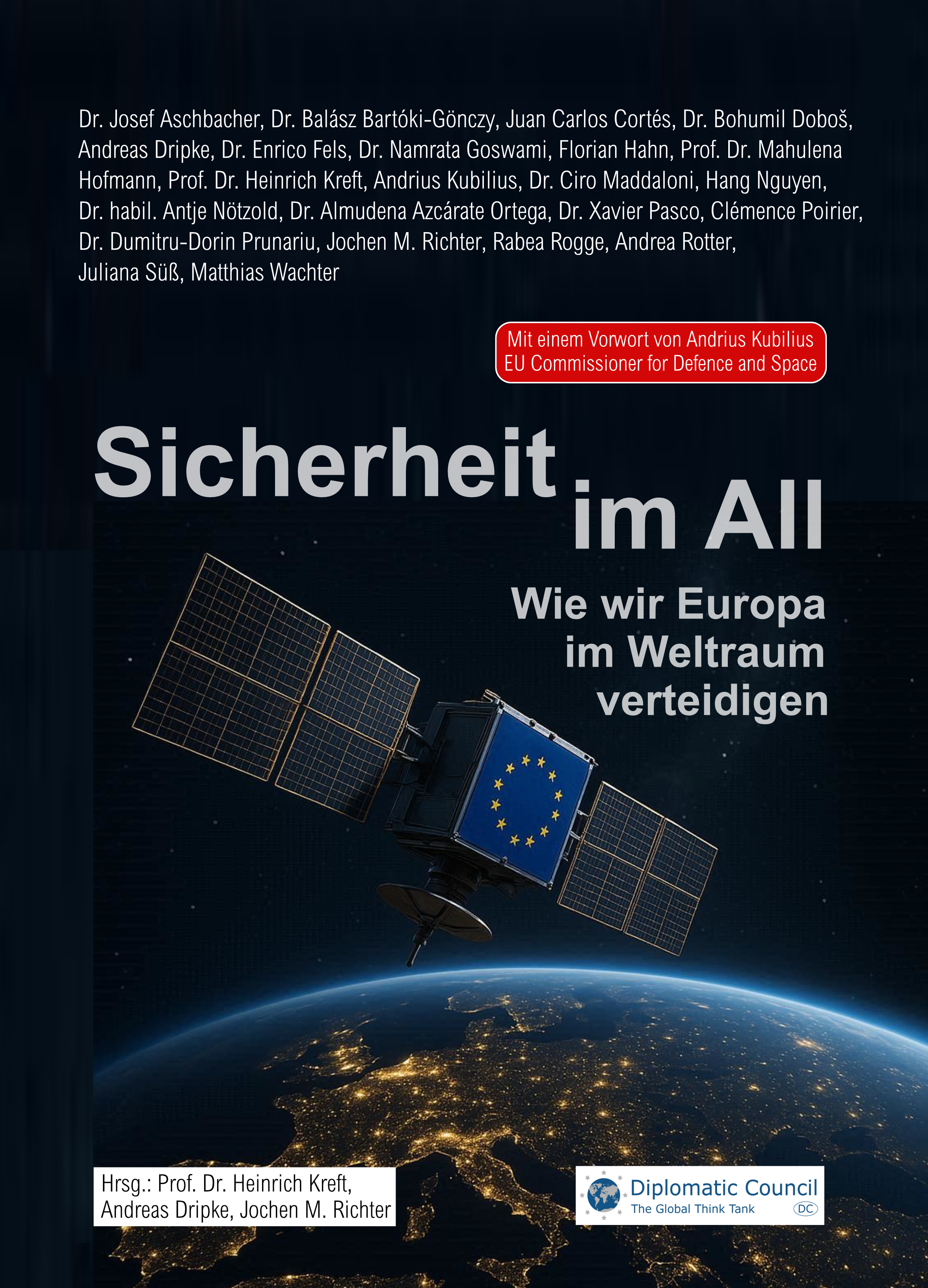
The author Heinrich Kreft was, among other things, ambassador to Luxembourg, president of the Diplomatic Council and program director at the Diplomatic Academy of the Foreign Office. He wrote the book “Kampf ums all” together with journalist Andreas Ripke. In February 2026, a new book on the subject, an anthology with international authors on "Sicherheit im All" (Space Security), will be published by DC Publishing. The book is also published in English.
.webp)