“I would never be able to or want to negotiate with the Höckes of this world for a single second.”
By Gudrun Dometeit
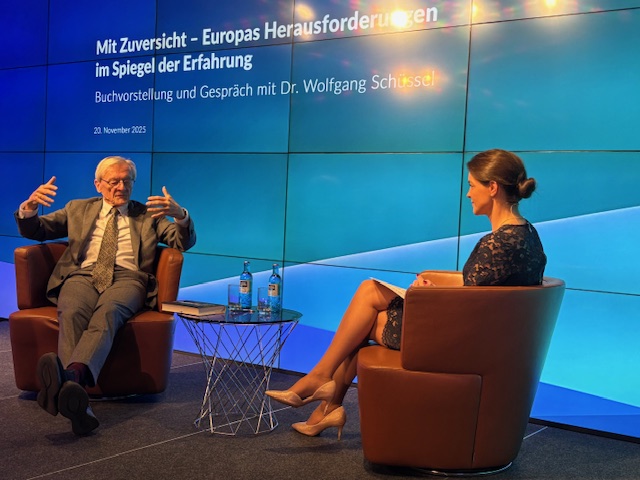
In times of geopolitical turmoil, the words of former top politicians are particularly sought after. Because elder statesmen are generally considered to be free of party considerations and career ambitions, they can assess world events with amusing ease, with serene insight and greater foresight. Wolfgang Schüssel, former Austrian chancellor and just turned 80 years old, probably belongs in this category. He is still a political star in circles of the conservative Austrian People's Party (ÖVP), although his chancellorship ended 18 years ago.In Germany, the ardent European is particularly well known for making Jörg Haider's right-wing nationalist Freedom Party of Austria (FPÖ) socially acceptable, but also for putting it in its place.
On Thursday evening, Schüssel answered the questions at an event organized by the Bertelsmann Foundation in Berlin, of which he was a member of the board of trustees for a long time. The official reason for the event was the launch of a new book titled Mit Zuversicht. Was wir von gestern für morgen lernen können (With Confidence: What We Can Learn from Yesterday for Tomorrow). The ÖVP politician wrote one every five years; on his 70th and 75th birthday, he gave himself the gift of self-reflection.He jokes at the outset that no one is really interested in politicians' autobiographies “from the cradle to the grave,” earning his first well-calculated laughs. The work is actually not an autobiography, but rather an essayistic examination of central life topics such as courage, power, peace, the meaning of history.
He is asked where he finds his optimism for the future, given the many crises and conflicts. Schüssel describes his childhood in Vienna, how his pregnant mother waited it out in the coal cellar while the house above them was hit by a British bomb, and how she supported herself and her son by working for a farmer. After the war, Vienna was one-third destroyed, and according to the UN, Austria was the country most threatened by famine in 1948. Today, life expectancy is over 80 years, and the health, housing and education situation is completely different. “There is absolutely no reason to look negatively ahead. I believe that you can give many people in Central Europe confidence in the future again.” This also applies in a larger context. In the course of human history, many “incomprehensible things” have happened, from the upright walk of the first person to writing, book printing, the Internet. With the help of computers, blind people could see again today. “In the longer term, the forces of hope have always been stronger than the forces of destruction,” says Schüssel.
His mother always played a formative role for him, as did Christianity. Schüssel attended the Schottengymnasium in Vienna run by Benedictines and was involved in church youth work. His father, on the other hand, quickly “disappeared,” and when Schüssel later asked him what he had actually done during the Nazi era, he received a resounding slap in the face, according to Schüssel. His father then had a heart attack, and the subject was never brought up again.
Schüssel recalls a priest who made a particular impression on him because he took such touching care of young prisoners, not a task that the Church considered a priority in the 1960s. He wasn't particularly charismatic, more of a quiet type, but people simply listened to him. “People like that are becoming rare.” He later comes back to special personalities when it comes to honesty and clarity in politics. The Austrian praises Tübingen's Lord Mayor Boris Palmer (independent, formerly Green Party) and Sweden's head of government Mette Frederiksen (Social Democrats) for openly addressing problems. In the migration debate and during the coronavirus pandemic, problems were simply wiped away. “The population in Austria regarded the vaccination as an absolutely unbearable intervention; dissenting opinions could not be addressed.” Russia exploits such social conflicts for its own purposes.
The dangerous complacency of Europeans
What does he advise German politicians about the AfD? In the beginning, the party had more liberal or libertarian elements, but that has now completely changed. “I would never be able to or want to negotiate with the Höckes of this world for a second,” says Schüssel, while at the same time expressing mild criticism of the established parties in Germany, which have so far refused to allow the AfD to hold the office of Bundestag vice president. He doesn't think that's particularly wise; in Austria, people behave differently. If a party is democratically elected, represented in the Bundestag and is entitled to a vice president or committee chair, this should be given to it, of course. The centrist parties had forgotten how to campaign and get back in touch with local citizens.
The former chancellor justifies his decision to join forces with the FPÖ after losing the 1999 election. At the time, EU member states reduced their contacts with the Austrian government to a minimum for months, and there were repeated demonstrations against the alliance within Austria. Haider was an “interesting guy,” a chameleon and highly intelligent. When things were going well, it was possible to work with him constructively. He actually wanted to go into opposition with the ÖVP, which had 415 fewer votes than the FPÖ. Following failed coalition talks with the SPÖ, the ÖVP said yes to Europe as a basic condition for negotiations with the FPÖ. The cooperation was then completely in order, and the European Constitutional Treaty was later adopted by the Austrian Parliament with just one vote against.
Schüssel warned Europeans against complacency, saying it was the most dangerous mistake they could make. He believes that the current crises should serve as a wake-up call to correct mistakes and do better. After 1991, German reunification, and the fall of the Iron Curtain, everyone thought they had made it. Europe was actually well equipped at the time, but then it was forgotten that securing external borders and protecting the population were the most fundamental tasks of a state. 2,000 billion euros in peace dividends flowed into the welfare state. Europe relied on the Americans and neglected its own security concerns. “Right under our noses in Austria, someone like (former Wirecard CEO) Jan Marsalek wanted to build a Russian network across Europe. We were simply naive.” Austrian Marsalek not only built a sham empire, he is also said to have been an agent of the Russian secret service and to have fled to Moscow.
Austria's neutrality and combat operations
Schüssel called for a European cloud to finally be set up for the sake of data security and for Europe to launch its own satellites into space instead of leaving this to Elon Musk or the Chinese. Sovereignty could never be 100%, but unilateral dependencies on Russian gas, industrial goods from China or software from the USA are dangerous. After all, decision makers are now aware of it. Innovation is at the core of competitiveness and economic growth in Europe. However, good ideas migrated because there is no capital market here. “There is no lack of brainpower, but we Europeans must present our strengths better. We need to promote ourselves more.” European companies invested $5 trillion in the US, while American companies invested about the same amount in Europe. However, US companies bring around 4,000 billion dollars in profit from Europe to America every year. Schüssel called the suspension of funds for USAid a great opportunity for Europeans to fill the gap left by the US Development Cooperation Agency. However, Schüssel also criticized EU structures. Brussels does not have to decide everything, but should focus on the most important issues such as security or competitiveness.
When asked whether Austria's policy of neutrality was still appropriate in today's world, the former head of government replied that his country was no longer neutral within the framework of the EU. It had amended its constitution to allow it to support political and economic sanctions under a UN or EU mandate, approve military transports and arms deliveries, and even participate in combat missions.
And how did the former full-blooded politician, now president of the Austrian Society for Foreign Policy and the United Nations, deal with the considerable criticism he received during his career? When things were really bad, he says, he would sit down at the piano and play boogie-woogie. In addition, he had double support at home, because both his wife and daughter are psychologists. It becomes unbelievable, he jokes, when it is made clear to you that it is not about being cheered by the masses at the lectern, but simply about cleaning up your own dirty laundry.
.webp)