Rolf Nikel: Diplomacy Is Discredited Without Economic and Military Strength
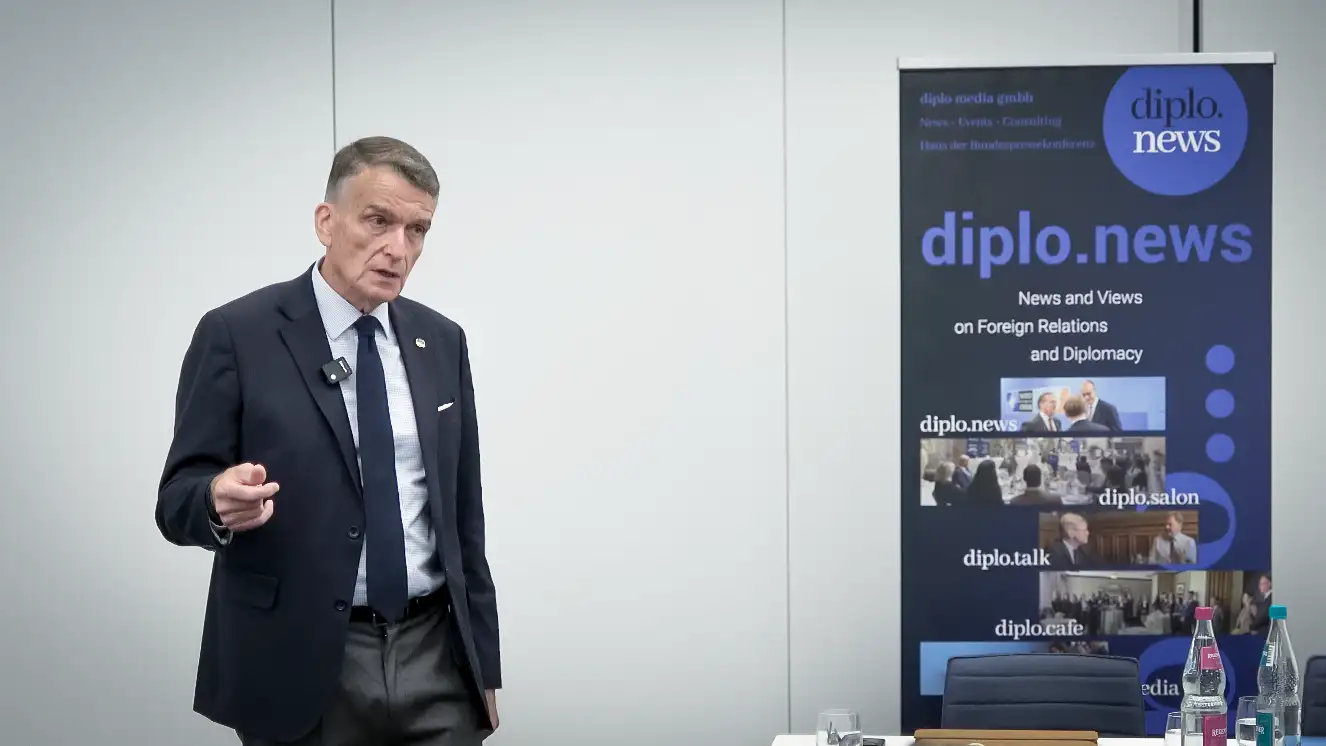
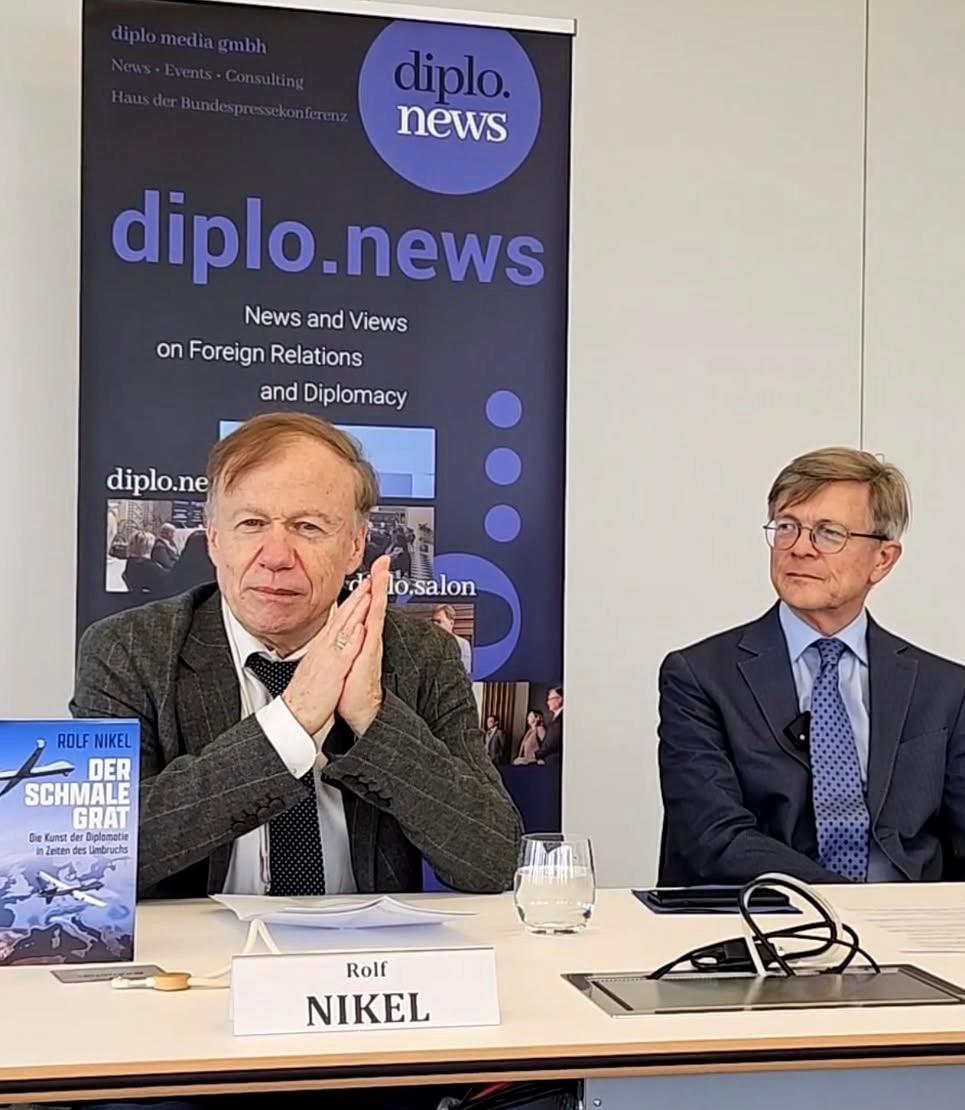
Germany has focused solely on diplomacy and criminally neglected its security, according to Rolf Nikel, author, vice president of the German Council on Foreign Relations (DGAP), and retired ambassador. His main thesis is based on 40 years of professional experience. Nikel spoke on this topic in Berlin at diplo.academy, a platform run by the media outlet diplo.news, before an audience of journalists, diplomats, and think tank experts.
"The discussion in Germany is moving toward rearmament, rearmament, rearmament on one side, and dialogue, dialogue, dialogue on the other. My book's core thesis is that we can only be successful if we have both."
The book is titled "Der schmale Grat" (The Narrow Path), "because—as is so often the case in diplomacy—you have to choose between Scylla and Charybdis, between two unpleasant options, and somehow find a path in the middle."
As an example, Nikel cites the narrow path in Europe: On the one hand, Europe supports Ukraine in its struggle for freedom, which is also Europe’s struggle. On the other hand, however, it is trying to prevent a military confrontation between NATO and Russia. “That is a very, very fine line.”
Conflict Accelerators
Diplomacy is at a fundamental crossroads. The cornerstones of German foreign policy toward America, Russia, and China have begun to falter. "We are dealing with a new reality of disruptive transformations," says Nikel. He includes not only artificial intelligence in this, but also notes: "Climate change acts as an accelerant for conflict."
The core elements of the international order have come under severe pressure. Traditional multilateralism is weakening, and international law is in danger of falling by the wayside. “We are moving toward a new world, a multipolar world in which there is no order—at least no order that is globally recognized,” observes Nikel. “We Europeans are among the few who still adhere to the rules-based order.” International law and traditional multilateralism look very different in other parts of the world—“even among our former ally, the United States of America.” There is a lack of order for this new multipolar world.
"This leads to what we’ve already read in the works of the Greek historian Thucydides. His central message was: The strong do what they can, and the weak endure what they must. “So power takes precedence over right. For three of the five new great powers—namely the U.S., China, and Russia—I would say this is the primary focus.” Nikel still sees India as “somewhere in the middle.” Whether Europe will become a pole of its own and be able to assert itself as a great power in the future remains highly questionable. “Our continent is still very fragmented and lacks the necessary institutions that would make that possible.”
Three scenarios
According to Nikel, this results in three scenarios. The first is a division of the world into spheres of influence, as outlined in the American National Security Strategy. "That is a relatively good scenario. The other two are worse."
He would describe one of them as a doomsday scenario, “where there is actually a military conflict between Russia and NATO—and possibly between the U.S. and China in Asia—and where the use of nuclear weapons must be expected.”
The third is a scenario of anarchy and the collapse of authority. This is not entirely incompatible with the second scenario. To some extent, it can currently be observed in the Middle East or in North Korea, where no one seems to care anymore that this country has acquired nuclear weapons in violation of the Non-Proliferation Treaty and is threatening to use them.
German Diplomacy: Mixed Success
Nikel explores the question in detail: "What can we learn from the experiences of German diplomacy in the past?" He notes that it has had varying degrees of success in recent years. "We won the Cold War together with our partners. We achieved German unity, a high point of German diplomacy. Germany has risen to become the leading political and economic power on the continent. But we 'messed up' our Russia policy."
He has dealt with this issue in various capacities for 30 years. “We tried to integrate Russia into a Euro-Atlantic security architecture. That even worked at first. There was a reduction in nuclear weapons from 70,000 nuclear missiles to 12,000 today. But in the meantime, the system has broken down. Our policy toward Russia has failed spectacularly. You can’t pin the blame on any one person. It was a systemic failure of society, politics, the economy, and other factors.”
Diplomacy is always a tool in the struggle for power, influence, and prestige. Economic and military strength are necessary to be taken seriously. He wants to firmly counter the frequent accusation that diplomacy amounts to appeasement or is soon to become useless. “We will continue to need diplomacy in the future to resolve conflicts, but also to prevent armed conflicts from arising in the first place. “This preventive diplomacy remains a core task of diplomacy.
European Sovereignty
“We are so dependent on the U.S. when it comes to defense. Under normal circumstances, we should never have agreed to the Turnberry (Scotland) agreement on tariffs with the U.S. But we had to because of our dependence. That is why it is our task to establish European sovereignty and to be able to stand on our own, at least in the medium and long term. This applies even to areas where we are not yet capable: in conventional defense and, in the longer term, in the nuclear sphere as well. Because the American security guarantee has become full of leaks.

"Continue to impose sanctions on Russia"
Russia's war goals have failed. The sanctions are having a long-term effect, but they have not yet brought about a change in behavior in the Kremlin. Whether that will happen under President Putin is an open question. Above all, we need a new, stable European security order.
"It is not just about ending the war in Ukraine; we must subsequently create a situation with Russia in which we can live together reasonably in Europe again and potentially tackle important tasks together."
Nikel believes diplomacy has been discredited in the past because it became the primary instrument of German policy. "We focused solely on diplomacy and criminally neglected our security. Defense spending had fallen to 1.2 percent, conscription was suspended, and so on. We based our foreign policy entirely on diplomacy. And that went wrong because we lacked the other components. But now, diplomacy could play an important role again if backed by a strong military and a strong economic component."
This diplo.academy discussion was recorded by Ewald König.