About dark moments, great successes and the influence of parents
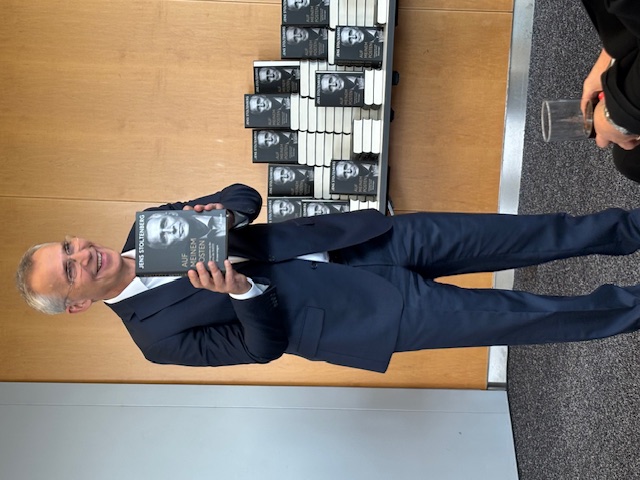
Former NATO Secretary General Jens Stoltenberg has described the withdrawal from Afghanistan in 2021 as the biggest defeat of the Western alliance. “We simply left people who believed in democracy alone,” Stoltenberg said at the Frankfurt Book Fair at the presentation of his book “Auf mein Posten.” The book, which was also published in English at the same time under the title “On my watch,” describes the Norwegian's memories as head of NATO from 2014 to 2024, ten “dramatic years of the Western Alliance,” which also included Russia's invasion of Ukraine in February 2022.
“It was the darkest moment of my term of office,” Stoltenberg said. Although Europe had previously had the same intelligence as the Americans, no one there believed that Russia would actually invade. The Europeans simply hoped that it would not happen or that the plans would change. Even Chancellor Angela Merkel did not draw any conclusions from her observations.
“After the Cold War, we all believed in a better relationship with Russia.” Stoltenberg explained that, following the conflicts in Georgia in 2008 and the occupation of Crimea in 2014, Germany had taken no different stance towards Russia and spent more on defense, with economic interests, but also with historical experience. “Germany believes in peace.” He was also convinced that earlier and stronger military support for Ukraine from NATO could have prevented the outbreak of war. At least, Stoltenberg stressed, the country would control more territory today. “But after 2014, we were too afraid of an escalation.” Nevertheless, he advocated for talking to Russia again, but only on the basis of strength and not without involving Ukraine. After all, even during the Cold War, it had been possible to hold talks, and Russia was a neighbour with long borders, especially with Northern Europe.
In his book, the 66-year-old assured, he tried to be as open and transparent as possible, to show how decisions were made within NATO, to describe their successes and strengths, but also their defeats and weaknesses. The only limitations were where military secrets were involved or the mistakes of others. “I'm describing my own mistakes. ”
Stoltenberg's memories were presented by the CEO of Springer Verlag, Mathias Döpfner. He described them as very personal and inspiring. Stoltenberg recounts his wife Ingrid's reactions to the extension of his term as NATO Secretary General and the political influence of his parents, who were staunch social democrats and both held high government posts. The father, Thorvald Stoltenberg, served, among other things, as Minister of Foreign Affairs and Defense. It was probably also his parents who taught him otherwise after a period of protest against NATO in his youth. Nevertheless, when he took on the job of NATO Secretary General, his father warned him that it would be totally boring because nothing ever happened there. In fact, he then experienced the greatest strengthening of the alliance in decades. ‘If anyone had told me in January 2022 that Sweden would join NATO, I wouldn't have believed them.’
Jens Stoltenberg followed in his family's footsteps and made a political career in Norway at a very early stage; from 2005 to 2013 he was an extremely popular prime minister. His post as designated head of the Munich Security Conference is currently suspended because he was appointed as Minister of Finance in the current Norwegian government. He admitted that his job had always come first – before family life.
gd
%20(1).webp)