A turning point in the South Caucasus?
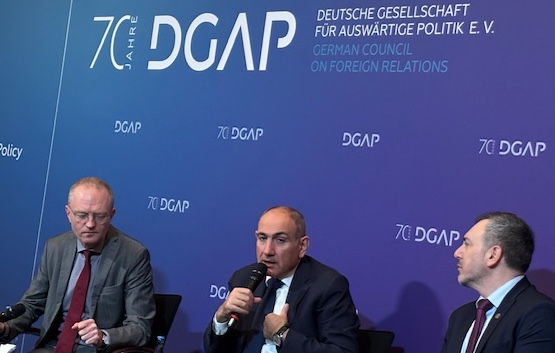
Armenian Prime Minister Nikol Pashinyan sees the Washington agreement with Azerbaijan concluded in the summer as an opportunity for long-term peace in the region. The agreement offers an opportunity to finally close the chapter of long-standing animosities, said Pashinyan at an event organized by the German Council on Foreign Relations (DGAP) in Berlin. In contrast to the situation after 1991, when the former Soviet republics became independent, there is now a recognition and promotion of common interests. “But it takes daily care to keep peace.” The important thing now is not to repeat history and to open a whole new chapter for a more optimistic, prosperous and peaceful future.
The agreement — which was concluded under the auspices of the USA in August — provides for the sovereignty of the states, the acceptance of mutual borders and the rejection of future claims by Azerbaijan. Even the Armenian Constitution does not contain any territorial claims against Azerbaijan, stressed the Prime Minister, who became known as the leader of the so-called Velvet Revolution against the old regime in Armenia. However, if his country's constitutional court declares the treaty unconstitutional, he will advocate for the necessary changes.
The agreement in Washington not only provides for the clarification of the border issue, but also of the conflict over the exclave of Nagorno-Karabakh in Azerbaijan, which has been smoldering for at least 37 years. Until the violent evacuation in 2023, the population there was predominantly Christian Armenians. In addition, the two South Caucasian states agreed on a transit corridor from Azerbaijan through Armenian territory to the Nakhchivan exclave, which borders Iran and is populated mostly by Muslim Azerbaijanis. This would enable trade from Azerbaijan to Turkey and from there on to Central Asia, bypassing Russia and Iran. The corridor with railway line and gas and oil pipelines will bring the region even closer together and create connections between each other, said Pashinyan. Armenia is now hoping for the long-awaited opening of the border with Turkey, which has been closed since 1993.
The accession process for EU membership was an incentive for his country to consistently pursue democratic reforms; it was less about geopolitical reasons. But even if it has achieved the standards but does not become a member, Armenia will have achieved something, namely to become a highly modern country. Opportunities for sectoral integration within the framework of the EU partnership, for example in digitization and energy, are currently being explored. However, in order to make it easier for Armenian businesspeople to enter the EU states, it is necessary to liberalize the visa regime. This will also be the topic of an EU-Armenia summit in May next year.
Daria Isachenko, Turkey expert at the German Institute for International and Security Affairs (SWP), pointed out that the normalization of Armenia's relations with Turkey would take even longer. According to surveys, 66 percent of Armenians would describe their relations with the neighboring country as poor, only 30 percent as good and 66 percent were against opening the border. There is also a long historical conflict between these two countries. Turkey, for example, refuses to recognize the killing of up to 1.5 million Armenians in the First World War in 1915 as genocide. In addition, it has supported Azerbaijan, which is linked to it through culture and language, for years in the Nagorno-Karabakh conflict..
gd


%20(1).webp)