Cyprus and the goddess of discord
By Wassilis Aswestopoulos in Athens
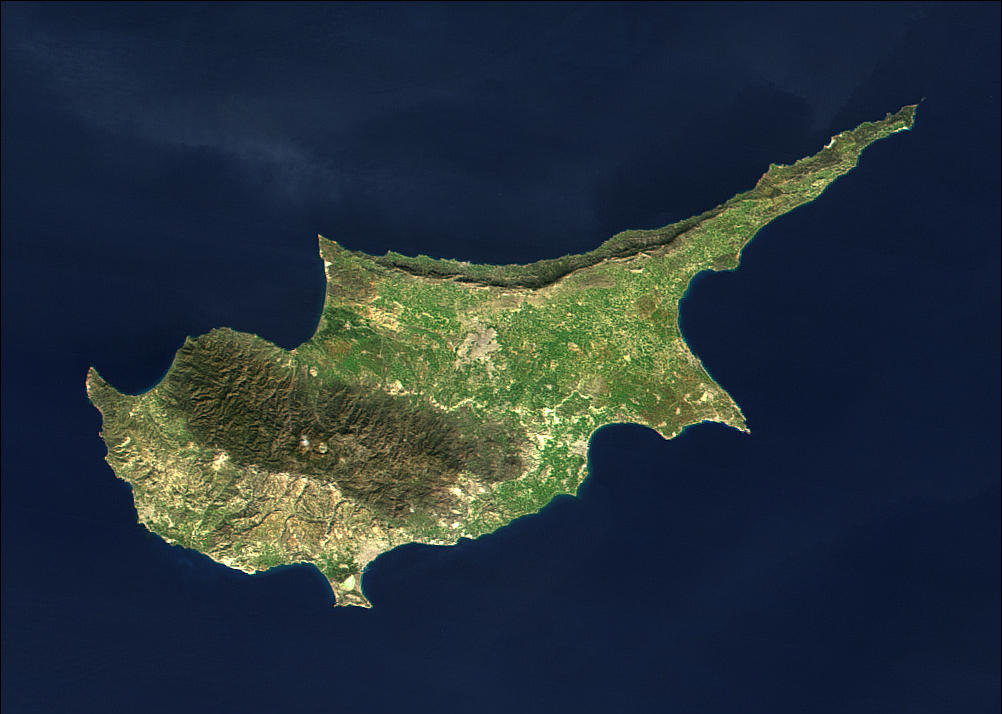
The only divided EU member state, the Republic of Cyprus, took over the rotating presidency of the Council of the European Union for the first half of 2026 in January. Of all times, one might cry out. Against the backdrop of heightened international tensions over territorial integrity and sovereignty – such as those surrounding Greenland – a state that is more than a third occupied is supposed to be the diplomatic primus inter pares and lead the community through turbulent times. Under the motto “An autonomous union. Open to the world,” the Cypriot leadership is nevertheless confidently promoting European autonomy as one of its priorities for its work in the Council of Ministers of the 27 EU states. Only in this way can the EU act independently when necessary without being cut off from international cooperation, according to Nicosia.
Cyprus has coordinated its position with Poland and—once again, one can't help but sigh—Denmark as part of the trio of countries holding the Council Presidency. The Scandinavians are currently at the forefront of fending off US ownership claims against Greenland. All three had agreed on an ambitious 18-month program (1.1.2025 — 30.6.2026), whose most important goals include the Cypriots nothing less than pacifying Ukraine and its admission to the EU. The government of the island republic, with its population of around 1.35 million, has also set itself the goal of strengthening Europe's security and defense capabilities.
Although the Council Presidency's primary task is to coordinate and mediate among EU members, Cyprus also wants to make progress on its own behalf. The once non-aligned state is pushing to join NATO. “If it were possible, Cyprus would join NATO tomorrow,” explained President Nikos Christodoulides. Turkey is the biggest political obstacle to this. Greek media relied on anonymous diplomatic sources according to which the orientation of the island's security and defense policy should be interpreted against the background of the desire to join NATO. According to the same sources, various scenarios are being examined at international level to make a solution to the Cyprus problem more attractive for Turkey. For example, the government in Ankara could be involved in European defense funds if it does not block Cyprus's path to NATO in return. Turkey is hoping to get a share of the 150 billion euro EU SAFE program. However, the Cypriots and Greeks have vetoed this, and a change of opinion would come at a price: without Ankara's concession on the Cyprus issue or the use of mineral resources in the Aegean Sea, the heads of government in Nicosia and Athens would risk their political survival.
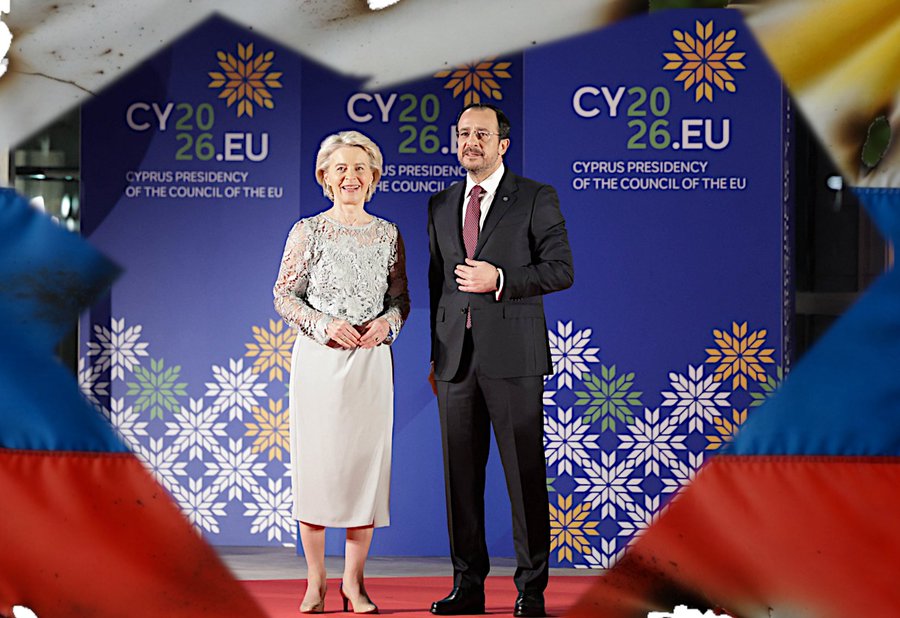
As if the geopolitical turmoil and tensions with Turkey weren't enough of a burden, Cyprus's start to its Presidency is now also being overshadowed by a domestic political scandal involving allegations of nepotism and corruption. The head of the presidential office, Charalambos Charalambous, resigned from his post, as did the president's wife, Philippa Karsera, who stepped down as chair of her charity organization. Charalambous, the president's brother-in-law, a former energy minister, and the director of the largest construction company, the Cyfield Group, are alleged to have made arrangements for the illegal financing of the next presidential election campaign, as shown in an eight-minute video on “X.” It was to be handled through Karsera's organization, the Independent Social Support Body.
Instead of focusing all their energy on diplomatic efforts, Christodoulides' cabinet members now have to defend themselves against a video. “The video attempts to damage the reputation of the government and the country through false and misleading allegations and arbitrary conclusions,” government spokesman Konstantinos Letymbiotis railed. Based on further investigations, a case of hybrid activities against the Republic of Cyprus is being investigated. Individual statements in the video are no longer disputed, but they are said to have been taken out of context by a foreign, malicious power. Russia was named specifically. Ironically, Cyprus is actually considered a refuge for wealthy Russians who, like other rich immigrants, were able to acquire a Cypriot and thus EU passport in exchange for sufficient money.
Even the official opening ceremony of the Council Presidency did not go off without a hitch. Ukrainian President Volodymyr Zelensky, like other guests, spoke about international law and the inviolability of borders and asked Cyprus to support his country's EU accession process. "We respect your territorial integrity and sovereignty. We are Ukraine. Please respect ours too," he said, without directly criticizing Turkey, which has occupied the northern part of Cyprus since 1974 and is the only country to recognize the Turkish Republic of Northern Cyprus, proclaimed in 1983. At a meeting with Georgios, the Archbishop of Cyprus, he also chose diplomatic words without addressing Turkey. Greek and Cypriot media criticized him for this, saying they had expected more solidarity from the Ukrainian president. After all, the Cypriot Church had recognized the Autocephalous Orthodox Church of Ukraine and thus its spiritual separation from the Moscow Patriarchate.
On the other hand, Zelensky's words were apparently not diplomatic enough for Turkish commentators on social media. They called for the end of Turkish support for Ukraine. And official Turkish government representatives immediately reacted to all speakers at the opening ceremony with a sniff. “We oppose the use of terms such as occupation, invasion and division in relation to the island of Cyprus,” said Öncü Keçeli, spokesperson for the Turkish Ministry of Foreign Affairs. “These terms in no way reflect the historical and current reality on the island,” he added. The EU accused Keçeli of double standards “with regard to the basic human values she claims to represent.” For Turkey, the EU is not an impartial and constructive actor in resolving the Cyprus issue.
Many Cypriots and followers of the Zeus cult will probably ask themselves these days whether the island is not the birthplace of the goddess of love Aphrodite at all, but in reality that of Eris, the goddess of discord.

%20(1).webp)