“It's about a gift from the heart”
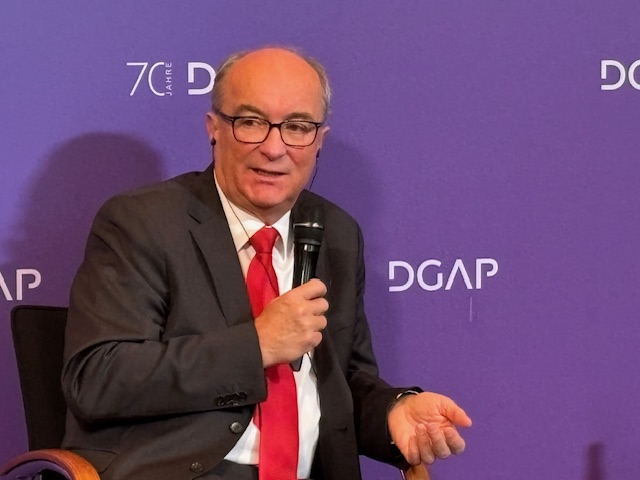
Polish Parliament President Włodzimierz Czarzasty has made an impassioned plea for the strengthening of German-Polish relations and a different perspective on the countries' shared past. Six years of world war should not overshadow the neighborly relationship, as right-wing populist forces in Poland would like, who focused almost exclusively on the graves and suffering of the war's victims, said Czarzasty on the anniversary of the German-Polish Neighbourhood Treaty, which was signed 35 years ago. The politician from Nowa Lewica (New Left) replaced his predecessor in the middle of the legislative period in November in accordance with the coalition agreements of Donald Tusk's government, making him the second-highest-ranking politician in Poland after the head of state. He spoke at an event organized by the German Council on Foreign Relations (DGAP).
New German relations also require a new perspective on history, said Czarzasty. He therefore asked the German government to resolve the issue of reparations quickly. Currently, there are only 55,000 former forced laborers still living in Poland, and in five years there will be even fewer due to their advanced age. However, the issue is being portrayed as enormously significant by the Polish right wing. “If you spend billions on armaments, can't you also afford reparations for these 55,000 people?” In this way, the issue of Germany's reparations to Poland could also be relieved of emotion, the politician explained. A Polish commission of experts once calculated that reparations for war damage would cost around 1.4 trillion (!) euros. The issue keeps coming up, especially in conservative political circles in the country. According to Czarzasty, arguments are needed against the “evil forces” to show that the government is capable of solving the problem.
He also criticized the planned four-year construction period for the German-Polish House and a monument in Berlin commemorating the German invasion of Poland in 1939. “I am full of sympathy for you, but perhaps you should build a smaller monument. It is a gift from the heart.”
Czarzasty recalled the many similarities between the two countries, Willy Brandt's policy of reconciliation, which had done a lot of good for Poland, and the Solidarity movement, which had contributed to the fall of the Berlin Wall. Germany had taken in many migrants, Poland several million Ukrainians – this showed the sensitivity of both countries on this issue. Unlike many politicians and experts in Poland and Germany, he defended Germany's former policy toward Russia. Russia had torn off the mask of the polite seller of minerals. "You are not the only ones who believed that. We also thought that Russia would move closer to Europe. No one should blame you for that. You did it with a clear conscience. But a gentleman's agreement always takes two."
New German-Polish relations could also serve as a model within the European Union – for how a partnership between two countries can grow even in difficult times. Germany and Poland must ask themselves every day how they can reform their relations. It is not too late, but they must wake up. Without a secure Germany, there can be no secure Poland, and without a secure Poland, there can be no secure Germany. Czarzasty also called for the revival of the Weimar Triangle between Germany, Poland, and France at the parliamentary level. The last meeting took place in 2016. Poland has agreed to be the next host. “But no matter where it takes place, we must show that the heart of the EU is still beating.”
The Union has now left its development on autopilot, and it is in danger of becoming an open-air museum with yesterday's technologies, the head of parliament criticized in drastic terms. Poland can only produce twenty of 4,000 medicines itself; for the rest, it is dependent on the US and China, as is the rest of Europe. “It is also unacceptable that we only buy weapons from one country. And if that country then refuses to provide repairs and spare parts, what then?” Czarzasty was obviously referring to the US, which, for example, sells its fighter jets throughout Europe and has contributed significantly to the modernization of the Polish army with its arms exports.
He doesn't like much about US President Donald Trump, but at least he has shaken the EU awake. However, if he stops criticizing the EU, the Union will fall back asleep, Czarzasty explained, calling for more realism in Europe. It must imagine a world in which the US no longer helps Europe, but pursues its interests elsewhere. Europeans must take greater care of their own affairs.
There has been repeated tension between Germany and Poland recently, not only over the issue of reparations, but also over tighter border controls and the treatment of refugees. Poland's right-wing conservative president, Karol Nawrocki, has repeatedly demanded new compensation from Germany for war losses. One of the right-wing populist forces is the “Konfederacja” (Confederation for Freedom and Independence) – a gathering place for right-wing forces in Poland that is particularly popular with young people. According to Czarzasty, the political right is trying to win more votes by “spitting” more at Germany. But he wants respect for Germany. It has been a long time since such positive signals have been heard from Polish politics.
gd

.webp)