A Strategic Alliance Rather Than a Convenient Partnership

Germany is working to deepen its foreign policy and economic ties with Africa, and Kenya, as the most politically stable country in the east of the continent, plays a special role in this regard. Foreign Minister Johann Wadephul (CDU) traveled to Nairobi—which also serves as the headquarters and venue for international organizations—among other destinations, on his first trip to Africa earlier this year with a business delegation. Incidentally, Germany was the first country to recognize Kenya diplomatically in 1963. A delegation of members of the Kenyan Parliament and the Ministry of Foreign Affairs is currently in Berlin for talks with various ministries. Tomorrow, Wednesday, the delegation will travel on to Prague for the Globsec Forum, one of the world’s largest conferences on international security and politics.
“Germany and Kenya do not have a friendship of convenience, but rather a strategic alliance based on shared values and convictions,” emphasized Kenya’s Ambassador to Germany, Stella Orina, on Monday evening at an event organized by the German Africa Foundation and the Konrad Adenauer Foundation. Africa is changing, and relations with Germany are no longer shaped solely by development issues, but also by shared responsibility and an interest in strengthening multilateral institutions.
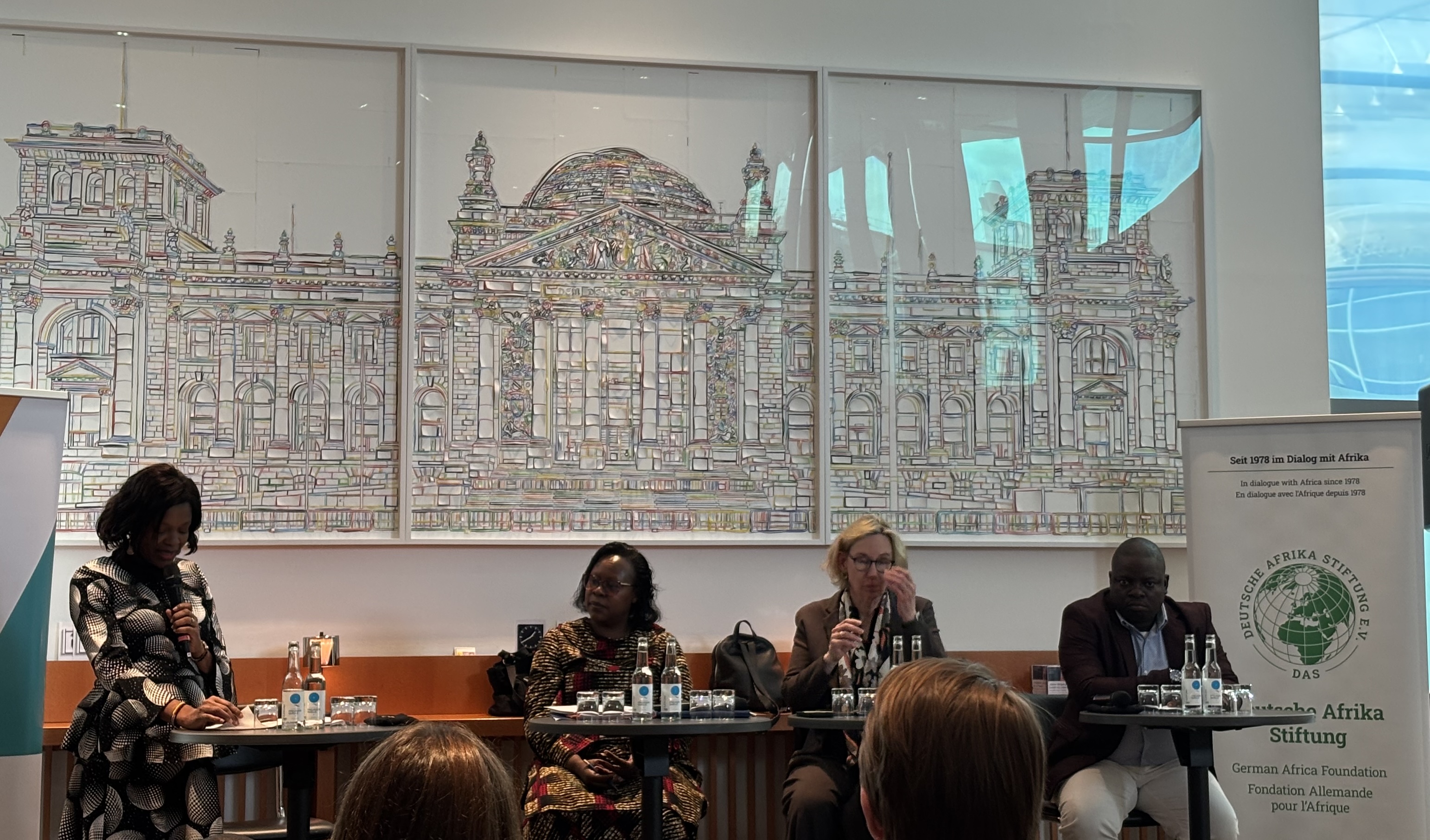
Kenya is guided by four principles in its international relations, explained Judy Njau, Director of the Department for Europe and the Commonwealth at the Ministry of Foreign Affairs in Nairobi: a fair financial system not only for its own country but for the entire Global South, climate justice, rules-based cooperation, and partnerships that benefit both sides. Other members of the delegation highlighted the importance of the African Continental Free Trade Area and a fair share of global trade for African nations, and sought to attract German investment in Kenya, for example to boost food production. Kenya and its approximately 59 million inhabitants are increasingly suffering from droughts and associated crop failures. In addition, supply chains are considered inefficient.
On June 24, companies and politicians from both countries will meet at the German-Kenyan Business Day in Berlin to explore concrete opportunities for cooperation and investment in the areas of agriculture, digitalization, renewable energy, and labor mobility. Trade volume between the two countries amounts to just 450 million euros (out of a total of 63 billion euros across all of Africa); 120 German companies are represented in Kenya.
The results of the Business Day are to be directly incorporated into the subsequent German-Kenyan government negotiations. The Business Day is being organized jointly by the Federal Ministry for Economic Affairs and Energy and the Federal Ministry for Economic Cooperation and Development—in line with the German government’s new policy of focusing more on private investment than on traditional aid in development policy.
Germany is not the only country interested in expanding relations with Africa and Kenya: French President Emmanuel Macron convened an “Africa Forward” summit in Nairobi a few days ago—the first of its kind—and arrived with a large economic delegation. The two countries signed eleven agreements, including ones on modernizing the rail network and expanding the port in Mombasa. With this trip, Macron sought to demonstrate his country’s growing political and economic interest in the English-speaking part of Africa. This region is considered more economically dynamic than the former French-speaking colonies.
gd
.webp)