Study for BMZ: Combining development policy with geopolitical interests

One of the most frequently voiced criticisms of German foreign policy is its lack of strategic capacity, which often enough led to hasty reactions and mere crisis management. The Cologne-based consulting firm Z_punkt GmbH The Foresight Company has now developed future scenarios for the year 2035 on behalf of the Federal Ministry for Economic Cooperation and Development (BMZ), which are intended to serve as a kind of early warning system and enable proactive action. The Indo-Pacific states of China, India, Vietnam and Indonesia as well as the five Central Asian countries Kazakhstan, Uzbekistan, Tajikistan, Kyrgyzstan and Turkmenistan were selected for this purpose. Strategic foresight is also explicitly mentioned in the coalition agreement of the black-and-red federal government as a means of interdepartmental policy making. In view of an increasingly fragmented and power-political world, Germany should also redefine its development policy, the authors of the study recommend.
Value-based foreign policy must be combined with pragmatic interest policies. Asian political and economic development, such as resource conflicts or biodiversity losses, had a direct impact on the security of German supply chains or climate goals. Development policy must also address how Germany's interests can be safeguarded in disruptive scenarios, such as a new “Great Game” between the major and regional powers in Central Asia.
According to the authors, the withdrawal of the USA from global development cooperation and climate and biodiversity protection has created a power vacuum that others could fill. “Anyone who builds ports, finances energy networks, enables climate protection and adaptation, or controls data networks not only shapes economic development but also political alliances. Infrastructures, climate resilience, and digital sovereignty have long since become geopolitical resources of power. ”
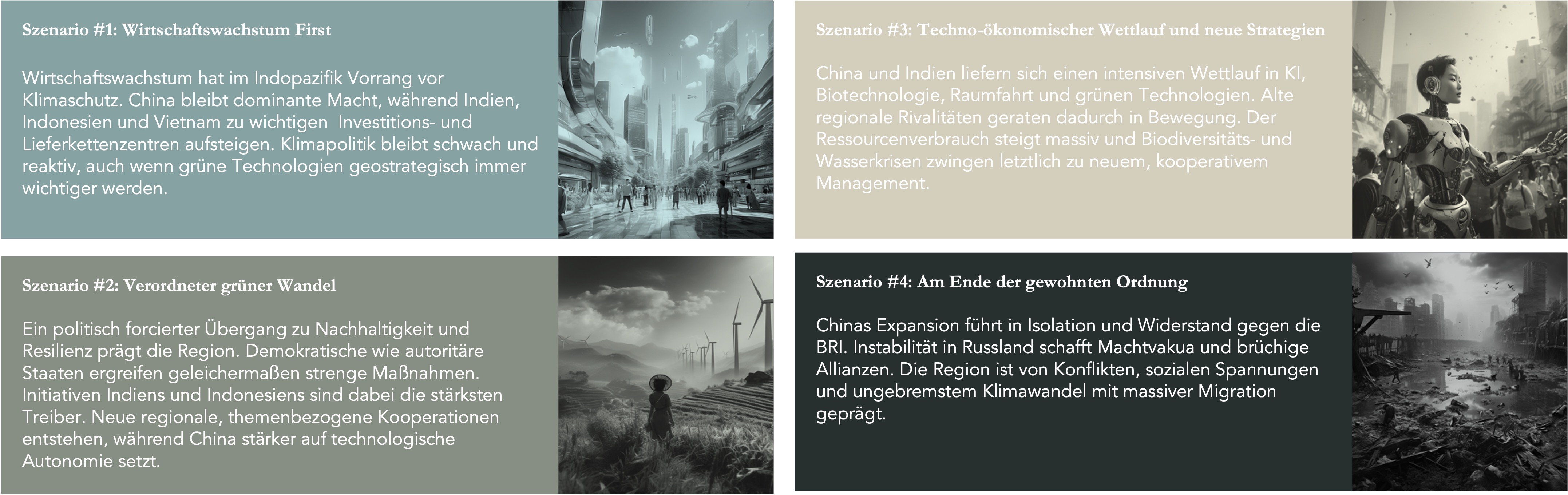
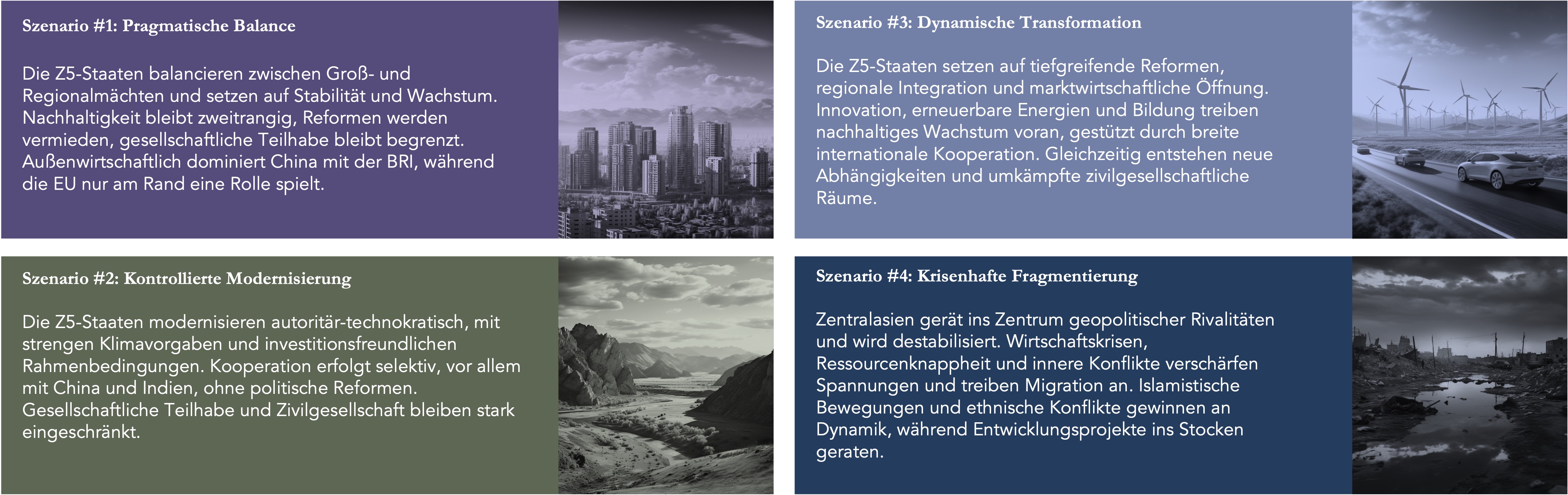
The scenarios, which the consulting firm created on the basis of expert surveys, show a wide range of possible developments both in Central Asia and in the Indo-Pacific. In the Z5 countries, everything is therefore possible, from controlled modernization by authoritarian-technocratic governments with a regulated economy, strict climate requirements and massive infrastructure investments with little social participation to “dynamic transformation.” The latter is characterized by far-reaching reforms, innovation, investments in education and renewable energy. In the Indo-Pacific, one of the possible scenarios shows a fast-paced race between China and India in artificial intelligence, biotechnology and other technologies as well as the acquisition of new alliance partners. Both giants are exerting considerable resource and innovation pressure on the region.
Many scenarios describe an erosion of global governance structures, in which the United Nations is losing influence but authoritarian alliances are gaining in importance. Large multilateral organizations are increasingly being replaced by small, more flexible associations focused on specific issues.
According to the study, the rise of so-called “emerging anchors,” i.e. the drivers of economic development and innovation such as India, Indonesia, Kazakhstan or Uzbekistan, offers a double opportunity: Germany and other EU states have a strategic interest in promoting the broadest possible economic dynamism in the region and concluding an EU free trade agreement to reduce dependencies on China and the USA while investing in resilient supply chains, local value creation and regional integration. When combined, trade and climate policy could serve as a geopolitical instrument. “Energy and raw material partnerships, for example in the area of hydrogen or lithium, with regions such as Central Asia and Southeast Asia are therefore not only a means of meeting demand, but also a lever for representing one's own geopolitical interests and securing international spheres of influence, for example to establish trade routes more independent of Russia via the mid-corridor. ”
The authors stress that the scenarios are expressly not to be understood as forecasts but as plausible, fundamentally conceivable but future-oriented descriptions of future developments. gd
The entire study can be found at this link: Think for the future, prepare for action — Strategic foresight as an instrument of effective policy making using the example of German development policy with Asia