Where Europe's economy seeks and finds greater security

Europe's economy is experiencing more and more shocking moments from China and the US. The European Union is attempting to offset economic pressure from the US and China and defend trade with economic security measures. That is why the EU wants to cooperate more closely and coordinate better with South Korea. There are two reasons for this: On the one hand, the EU needs trustworthy strategic partners, and on the other hand, South Korea fears that it could be affected by measures against China.
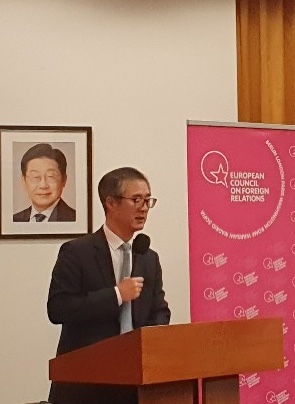
These were the topics of a recent conference at the South Korean Embassy in Berlin, which focused on strategies for how Brussels, Berlin and Seoul should respond to current challenges and make economic security more effective.
South Korea's Ambassador Sang-beom Lim introduced the topic, followed by decision makers and experts such as Andreas Nicolin from the Federal Ministry of Economics; Nils Redeker from the Jacques Delors Centre at the Hertie School; Andrew Small from the European Council on Foreign Relations (ECFR); Sanho Lim from the Center for Economic Security & Foreign Affairs at the Ministry of Foreign Affairs of the Republic of Korea; Kerstin Meyer from the think tank Agora Verkehrswende and Alexander Lipke, program coordinator of the Asia program at ECFR, and others.
Be less vulnerable
They analyzed how the combination of Chinese export restrictions, industrial overcapacity, and renewed US protectionism is fundamentally changing the global economy. In doing so, they examined areas in which Korea, Germany, and the EU can better coordinate their efforts in order to be less vulnerable. The focus was on measures that reduce risks but do not lead to protectionism or the exclusion of partners.
The conference was prompted by the EU's economic security agenda, driven not only by China-related shocks, but also by declining export prospects and increasing dependencies in critical technologies. Key findings were that the change in economic policy in the EU, and particularly in Germany, is accelerating. Measures against China could also affect partners such as Korea if there is no coordination.
Europe and Korea: similar structures, similar risks
The EU is specifically seeking “trustworthy partners” to jointly develop new technologies and diversify supply chains. The main thing: away from China. The EU, Germany and Korea have similar structures and interests and therefore the same structural risks, namely export-oriented economies, high import dependencies for raw materials and intermediate products, and leading positions in key technologies such as batteries, electric mobility, semiconductors and precision machinery. But cooperation is rather selective and has not been institutionalized enough.
Batteries as a test case of cooperation
Batteries and battery supply chains play an important role. The sector is an example of the opportunities for cooperation. Korea's battery industry in Europe is suffering from fluctuating demand and high dependence on China and its dominance. As a result, As a result, Korean investment has increasingly flowed into the US, which offers clear financial incentives through the Inflation Reduction Act and effectively excludes Chinese competitors.
Europe, on the other hand, does not yet offer comparably attractive conditions. Without improved economic incentives, however, Europe risks falling behind as an investment location. Although Korean companies have long played a central role in the European ecosystem for electric vehicles and batteries, investment volumes lag behind those in the US. Common standards and other policy instruments are intended to make the European-Korean partnership beneficial for both sides.
In any case, Europe's decarbonization goals and the rapid transition to electric mobility offer good opportunities for deeper cooperation between the EU and Korea. On the other hand, increasing Chinese greenfield investments in the European battery sector carry the risk of further cementing existing dependencies in the supply chain.
WTO processes too slow
China's export controls have turned long-term dependency risks into acute political pressures for action. Existing instruments – the Critical Raw Materials Act and investment reviews – are no longer sufficient. Many decision-makers consider the traditional processes based on World Trade Organization guidelines to be too slow. Conference participants therefore agreed that instruments must be found that go beyond the classic WTO framework.
ekö
.webp)